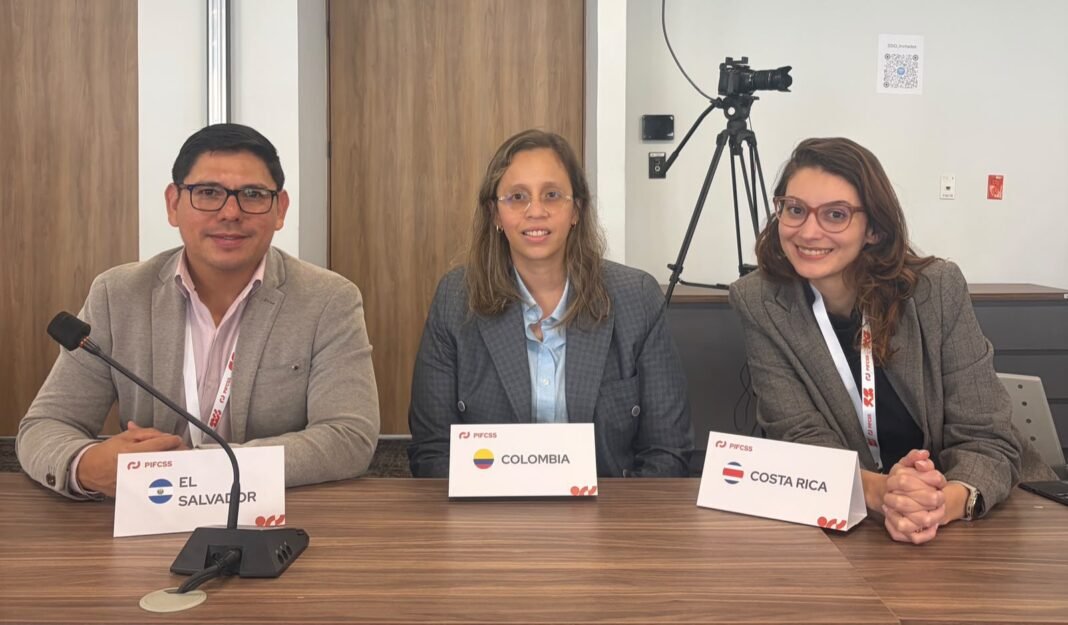
Colombia participated in the “Ibero-American Dialogue 2026 on Decentralized South-South and Triangular Cooperation” held in Puebla, Mexico, from September 29th to October 1st, 2026. The event, organized by the Ministry of Foreign Affairs, focused on exchanging knowledge and experiences among Ibero-American institutions and governments. This participation was spearheaded by the Director of International Cooperation, Katherine Diartt Pombo, representing Colombia. The statement does not mention the specific number of attendees or the formal agenda of the dialogue.; see the full statement.

Background
The Ibero-American Dialogue 2026 centered on the strategic objectives of the Ibero-American Programme for the Strengthening of South-South Cooperation (PIFCSS). Specifically, the focus was on the third strategic objective – strengthening decentralized South-South and Triangular cooperation schemes. This dialogue is facilitated by institutions governing cooperation, subnational governments, and other actors within the ecosystem of cooperation. The meeting occurred in Puebla, Mexico, on September 30th, 2026. The Cancillería de Colombia (@CancilleriaCol) hosted the event.
Analysis
Colombia’s participation, as outlined by Director Diartt Pombo, reflects a strategic alignment between the nation’s foreign policy and its domestic development priorities. The statement does not address the specific challenges Colombia faces in achieving these priorities through international cooperation. The dialogue’s emphasis on integrating territorial capacities and strengthening local capabilities suggests a recognition of the importance of bottom-up approaches to development. The involvement of the Department of National Planning (DNP) and the Presidential Agency for International Cooperation of Colombia (APC-Colombia) indicates a coordinated effort to shape Colombia’s international cooperation agenda. The dialogue’s focus on a 2027-2028 roadmap for the PIFCSS highlights a commitment to long-term strategic planning within the framework of Ibero-American cooperation.
Implications
Colombia’s engagement in this dialogue has implications for regional stability and trade relations within the Ibero-American community. The emphasis on decentralized cooperation suggests a desire to foster greater regional integration and address development challenges through collaborative efforts. The inclusion of the SNCIC, led by the Ministry of Foreign Affairs, demonstrates a commitment to aligning international cooperation with national development goals. The dialogue could potentially lead to increased trade and investment flows between Colombia and other Ibero-American nations, particularly if the collaborative agenda is successfully implemented. The statement does not address the potential impact on Colombia’s security interests within the region.
Outlook
Should the visit yield a formalized agreement on the 2027-2028 roadmap, Colombia’s cooperation strategy will likely continue to prioritize the PIFCSS’s strategic objective 3. If the integration of territorial capacities proves successful, the Colombian government may seek to expand its engagement in Triangular Cooperation initiatives, partnering with other nations to address shared development challenges. The success of this dialogue hinges on the willingness of Ibero-American governments to adopt a collaborative approach to development, a factor that remains uncertain.
Conclusion
The Colombian delegation’s participation in this dialogue raises a key question: can a truly decentralized cooperative framework be established within the Ibero-American context, effectively translating regional priorities into tangible outcomes for Colombia’s development agenda?