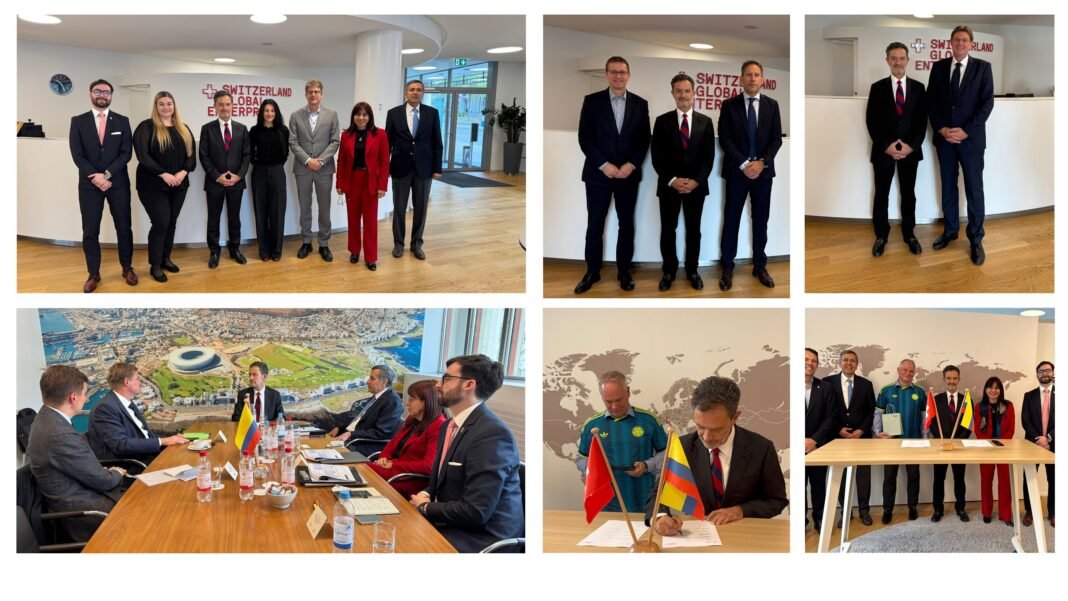
Details in a press release show that Colombia’s Minister for Foreign Affairs, Omar Bula Escobar, concluded a visit to Switzerland on October 20th, 2026, focused on bolstering economic relations, stimulating investment opportunities, and positioning the country as a key destination for strategic projects. The significance of this visit lies in the concrete outcome: the signing of a Memorandum of Understanding between ProColombia and Switzerland Global Enterprise (S-GE), an organization tasked with promoting international exports and investment. This agreement, facilitated by Minister Bula’s presence in Berna, represents a tangible step in Colombia’s efforts to diversify its economic partnerships and attract foreign capital (cancilleria.gov.co).

Background
Prior to this visit, the ministry’s broader policy, as outlined on October 19th, 2026, had focused on strengthening ties with both Israel and Switzerland, aiming to “promote the investment and expand the cooperation in benefit of the Colombians” (cancilleria.gov.co). The inauguration of Colombia’s Embassy in Jerusalem on October 14th, 2026, – a symbolic move – underscored the government’s commitment to rebuilding diplomatic relations with key partners. The visit to Switzerland, however, represents a more targeted effort, specifically aimed at attracting investment in sectors identified as strategic by the Colombian government: infrastructure, healthcare, energy, and construction. The ministry’s previous statement on October 19th focused on a broader engagement, while this visit zeroes in on specific investment targets.
Analysis
The agreements reached reflect a calculated approach to Colombia’s foreign policy. The memorandum of understanding between ProColombia and S-GE is not simply about boosting exports; it’s a deliberate effort to leverage Switzerland’s expertise and network to attract larger-scale foreign direct investment. The $240 million investment commitment from Roche, detailed in the press release, demonstrates a strategic interest in Colombia’s burgeoning healthcare sector, which the ministry has previously highlighted as a priority (cancilleria.gov.co). However, the statement does not address the underlying economic conditions within Colombia that might influence investor decisions. The potential for Hitachi Energy to invest $80 million in its Dosquebradas transformer plant – a project already underway – suggests a willingness to support infrastructure development, particularly in the Risaralda region. The ministry’s stated goal of “strengthening the productive capacity national” (cancilleria.gov.co) is directly addressed by this investment. The fact that Hitachi Energy is considering Colombia as a primary investment destination in Latin America indicates a broader strategic shift in the company’s global investment portfolio. The absence of any discussion regarding trade agreements or specific commodity exports, beyond the potential for increased exports to Switzerland, suggests a focus on attracting capital rather than purely trade-dependent growth.
Implications
The deepening economic ties with Switzerland hold several implications. For Colombia, the influx of foreign investment could stimulate economic growth, create jobs, and modernize key sectors. The potential for increased trade with Switzerland could diversify Colombia’s export markets, reducing reliance on traditional trading partners. However, the success of these initiatives hinges on Colombia’s ability to maintain a stable and attractive investment climate, a challenge highlighted in the ministry’s earlier statement on October 19th, 2026, which focused on “strengthening the relationship bilateral” (cancilleria.gov.co). The shifts in investment from companies like Hitachi Energy also suggest a potential reorientation of Colombia’s energy policy, prioritizing modernization and technological advancement. The agreements could also influence regional stability, potentially fostering closer ties with other European nations and strengthening Colombia’s position within the Latin American trade landscape.
Outlook
Should the visit yield the anticipated investment commitments, Colombia’s economic growth trajectory could accelerate. However, this depends on the successful execution of projects, particularly the Hitachi Energy investment, and on the government’s ability to create a favorable investment climate. If the Swiss firms continue to view Colombia as a strategic investment destination, the country could attract further foreign capital, solidifying its position as a key player in Latin America’s economic landscape. Furthermore, should the government successfully negotiate trade agreements with Switzerland, Colombia could gain access to new markets and diversify its export base. The ministry’s focus on attracting investment in strategic sectors suggests a long-term commitment to economic diversification, though the absence of discussion about specific trade deals or commodity exports highlights the cautious approach being taken.
Sources & Further Reading
- Official press release
- Foreign ministry source
- Colombia y Suiza suscriben acuerdo para impulsar las exportaciones, el turismo y la inversión (2026-10-20)
- Visita del canciller Omar Bula a Suiza, impulsa la seguridad social y promueve oportunidades de inversión, innovación y cooperación para Colombia (2026-10-19)
- Colombia inaugura su Embajada en Jerusalén y consolida una nueva etapa en la relación bilateral con Israel (2026-10-14)