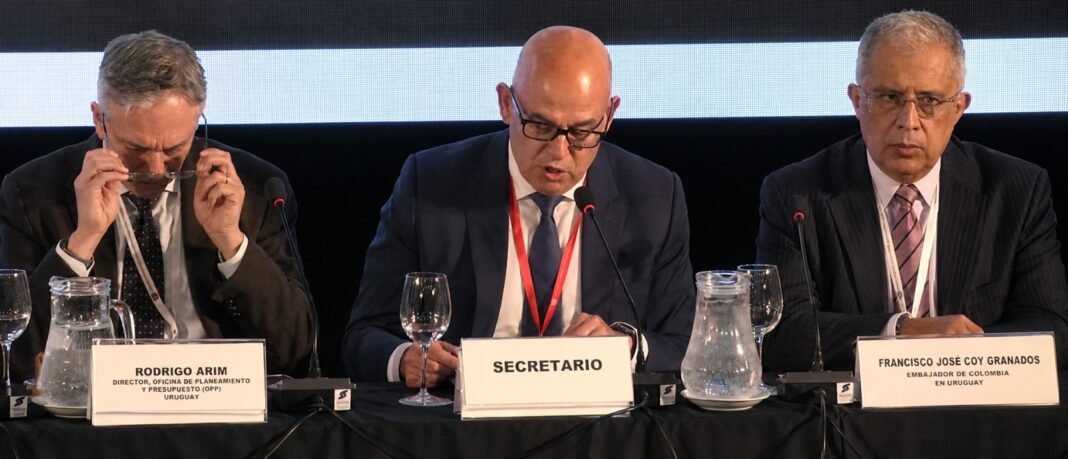
Reporting in a government statement, Montevideo, Uruguay hosted the conclusion of Colombia’s tenure as President of the Mesa Directiva of the Conference Regional on Population and Development for Latin America and the Caribbean (CRPD) from 2024 to 2026, concluding on August 20th, 2026. The statement, released by the Ministry of Foreign Affairs, details the presentation of achievements during this period and the transfer of leadership to Uruguay. This marks a formal transition within a regional body focused on demographic challenges facing the Americas – a focus described as crucial for contributing to the implementation of the Montevideo Consensus on Population and Development.

Background
Colombia’s role as President of the Mesa Directiva (MD) spanned from 2024 to 2026, a period coinciding with the VI Conference Regional on Population and Development for Latin America and the Caribbean. The MD serves as a forum for regional cooperation and policy coordination among states within the Americas, facilitated by the CEPAL (Centro Latinoamericano y Caribeño de Demografía) and the UNFPA (Fondo de Población de las Naciones Unidas). This framework was established to facilitate dialogue regarding demographic trends and challenges within the region. The statement identifies key partners – CELADE (the Centro Latinoamericano y Caribeño de Demografía), a CEPAL institution, and UNFPA – as central to Colombia’s efforts.
Analysis
The core of Colombia’s presidency centered on strengthening regional dialogue and exchanging experiences, aiming to generate evidence-based insights for the implementation of the Montevideo Consensus. The creation of a joint and participatory Plan de Trabajo (Work Plan) with member states of the MD is presented as central to this effort. This suggests an emphasis on collaborative policy formulation rather than prescriptive directives. The statement highlights the development of two key documents: the “Grupo de Amigos de la Presidencia” document on the rights of persons with disabilities (the Cartagena Group), and a Comparative Regional Population Situation Analysis (ASP) produced by UNFPA’s regional office for Latin America and the Caribbean. The strategic value of these tools, intended to provide technical support for regional dialogue and policy design, is explicitly stated.
Implications
The transition of leadership to Uruguay carries implications for regional coordination on population-related issues. If the statement accurately reflects the MD’s priorities, Colombia’s contribution has been largely focused on facilitating knowledge sharing and collaborative policy design. This suggests a conservative approach to regional engagement – prioritizing consensus building over potentially contentious debates about demographic policies. The adoption of these documents by the Conference Resolution indicates acceptance of Colombia’s contributions within the framework, though the statement does not address potential disagreements or alternative approaches.
Outlook
Should Uruguay successfully build upon this foundation, and if the regional dialogue continues to prioritize evidence-based policymaking as indicated by the document outputs, then Colombia’s legacy will be one of sustained regional cooperation. However, should the new leadership adopt a more assertive or divergent approach to demographic policy – particularly concerning issues not explicitly addressed in the Cartagena Group—the impact on the MD’s effectiveness could be significant. The statement does not address potential shifts in priorities or emerging challenges within the region.
Conclusion
Colombia’s handover of the presidency to Uruguay concludes a period defined by collaborative policy development and regional knowledge sharing, as outlined in the official statement. The absence of any discussion regarding future strategic goals or long-term demographic projections leaves open the question of whether this was simply a strategically timed pause, or a reflection of deeper uncertainties surrounding the region’s developmental trajectory.