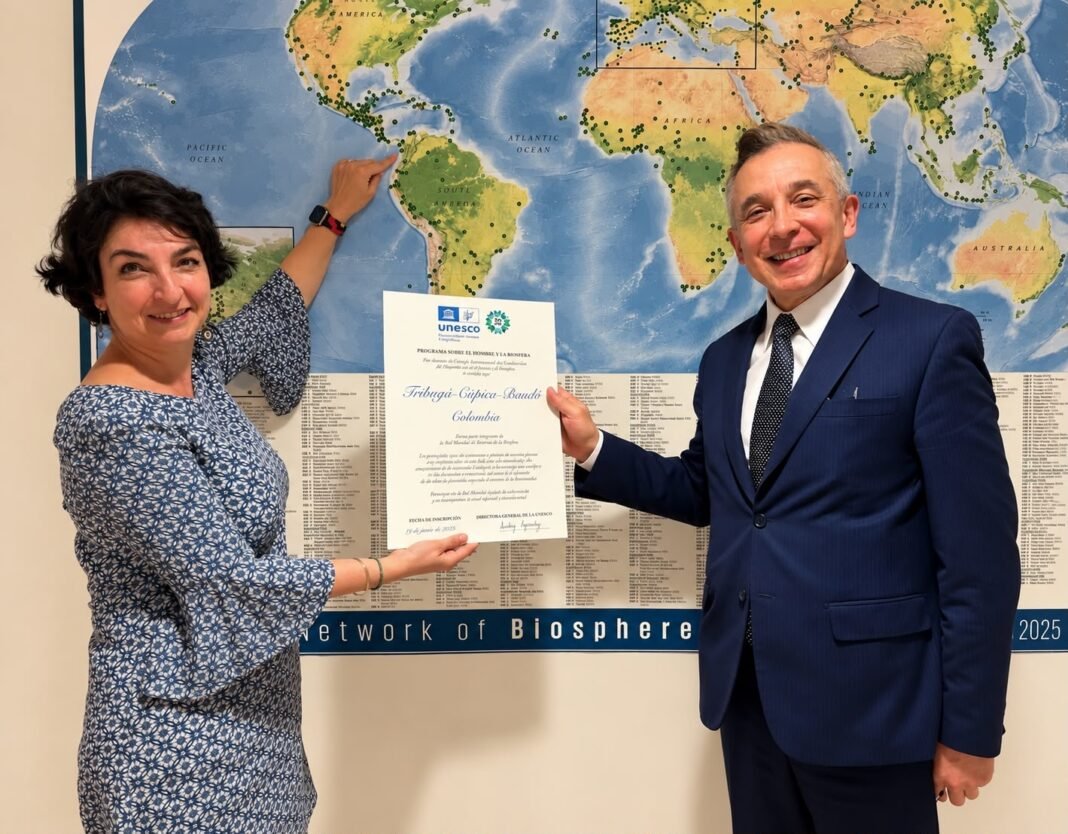

As set out in a formal announcement, Colombia has received official certification designating the “Tribugá-Cupica-Baudó” area as a member of the UNESCO World Network of Biosphere Reserves. This marks a significant step in protecting Colombia’s Pacific coast, an area recognized for its exceptional ecological and cultural value. The announcement, made by Ambassador Álvaro Sandoval Bernal, Delegado Permanente Adjunto, to Sima Taheri of the Division of Ecological and Earth Sciences at UNESCO, underscores a strategic priority for the nation – safeguarding biodiversity and promoting sustainable development amidst growing pressures on coastal ecosystems.
Background
The certification process aligns with the 35th International Coordination Council (ICC) session of the Man and the Biosphere (MAB) Programme, held in Paris from June 12 to 15, 2023. The “Tribugá-Cupica-Baudó” region is now formally recognized within the UNESCO network, a structure established in 1974 to foster international collaboration on environmental issues and sustainable development. This designation follows years of preparatory work involving Colombian authorities and local communities, reflecting a longer-term commitment to conservation efforts. The process also connects to the broader goals of the MAB Programme—a collaborative initiative that uses ecological research to promote human well-being and sustainable development.
Analysis
The recognition of “Tribugá-Cupica-Baudó” as Colombia’s first Pacific Biosphere Reserve represents a key element of national environmental policy. The statement does not address potential challenges related to resource extraction or tourism pressures within the region, issues that could undermine conservation efforts. The designator’s emphasis on community involvement and traditional knowledge suggests an attempt to balance economic development with ecological preservation—a delicate balancing act particularly relevant for the Chocó department where this reserve is located. This signifies a shift toward integrating indigenous and Afro-Colombian perspectives into environmental management, a process that has historically been fraught with difficulties. The recognition’s impact hinges on whether Colombia can translate this international validation into sustained investment and effective governance at the local level.
Implications
The certification holds implications for regional stability by potentially strengthening governance structures within the Chocó region—a territory often characterized by organized crime and limited state capacity. This designation could also positively influence trade relations, particularly if Colombia leverages its status as a biosphere reserve to attract environmentally conscious tourism or access sustainable development funding from international organizations. The move does not address potential conflicts related to resource rights between local communities and external actors – notably multinational mining companies operating in the area. Should the visit yield further support for conservation initiatives, it could bolster Colombia’s position within Latin America as a leader on environmental protection.
Outlook
If the Colombian government successfully secures additional funding to implement the reserve’s management plan, it would strengthen its commitment to biodiversity conservation and sustainable development. Should the recognition be accompanied by robust enforcement mechanisms against illegal logging or mining activities, this could help mitigate potential threats to the region’s ecosystem. The certification does not address the ongoing security challenges within the Chocó department—a factor that will ultimately determine the long-term viability of the reserve.
Conclusion
The designation of “Tribugá-Cupica-Baudó” as a UNESCO Biosphere Reserve represents an important step, but the future of this area remains contingent on Colombia’s ability to translate international recognition into tangible action – particularly regarding sustained funding and robust community engagement within the region.