
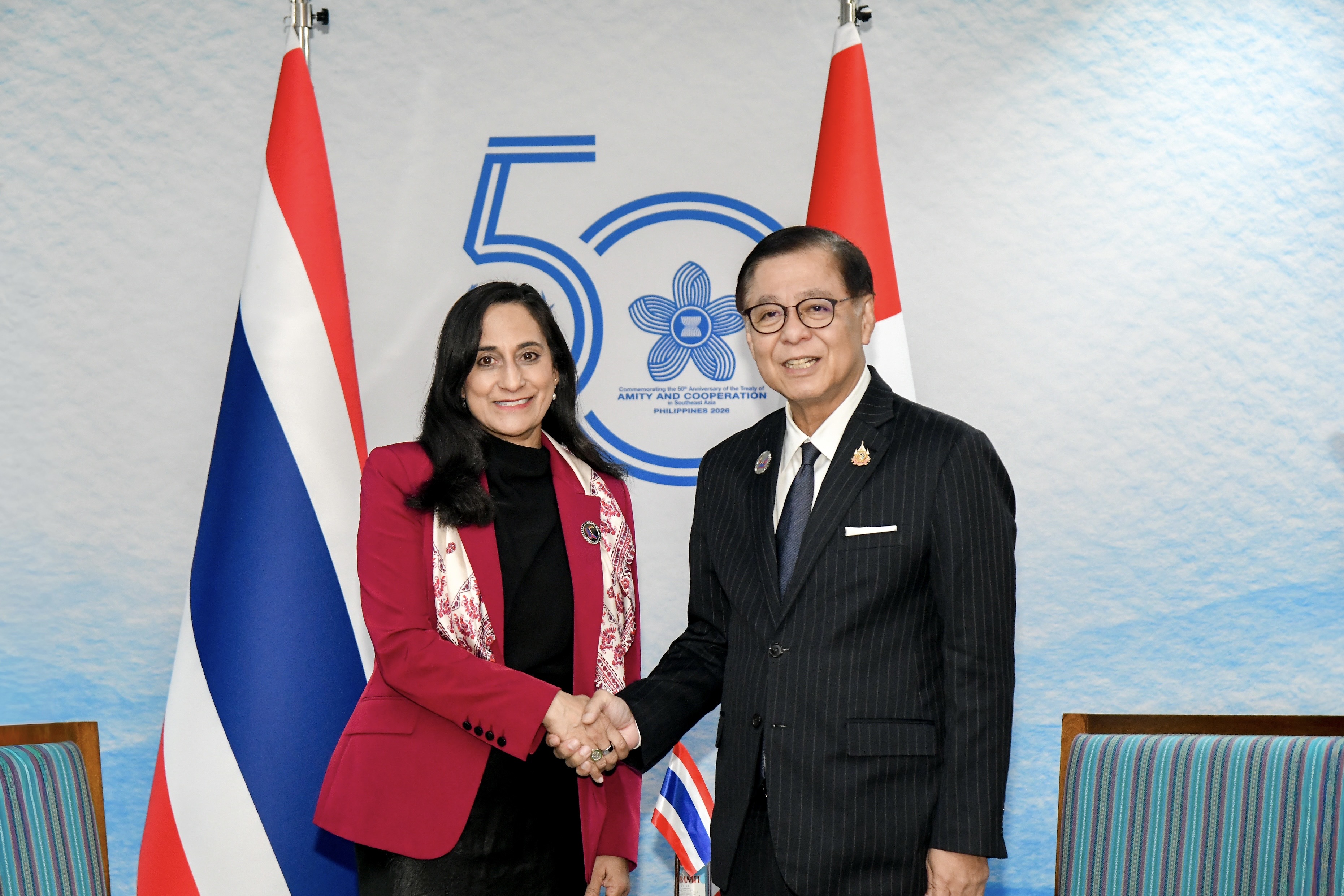
The foreign ministry readout describes The Deputy Prime Minister and Minister of Foreign Affairs of Thailand, H.E. Mr. Sihasak Phuangketkeow, held a bilateral meeting with the Honourable Anita Anand, Minister of Foreign Affairs of Canada, during the 59th ASEAN Foreign Ministers’ Meeting in Manila on 23 July 2026 (Press Release: Ministry of Foreign Affairs). This engagement, occurring on the sidelines of the ASEAN gathering, underscores a deliberate effort to bolster existing relations between the two nations. The significance lies in the timing – coinciding with the approaching 65th anniversary of diplomatic ties – and the stated objectives: trade, investment, climate change mitigation, and combating online fraud. These are explicitly identified as areas for enhanced cooperation, reflecting a pragmatic approach to bilateral engagement within the broader ASEAN context.
Background: The statement does not mention specific prior meetings or agreements between the two countries. However, it notes that this milestone – the 65th anniversary of diplomatic relations – is viewed as an opportunity to further enhance cooperation. This anniversary itself is framed within the existing “5S Foreign Affairs Masterplan,” a long-term strategy outlined by the Thai Ministry of Foreign Affairs (Press Release: Ministry of Foreign Affairs), though the statement does not detail how this anniversary specifically aligns with or reinforces that plan. The meeting took place during the 59th ASEAN Foreign Ministers’ Meeting and Related Meetings, signaling Thailand’s continued commitment to regional multilateralism.
Analysis: The bilateral meeting represents a calculated effort by both governments to solidify strategic partnerships amidst evolving geopolitical dynamics. For Thailand, reaffirming support for the conclusion of the ASEAN – Canada Free Trade Agreement highlights a long-standing priority within its foreign policy framework. Simultaneously, initiating negotiations on a Thailand – Canada Free Trade Agreement suggests an ambition to deepen economic ties beyond the regional ASEAN context. The inclusion of combating online scams reflects a growing concern shared by both nations regarding transnational criminal activity. However, the statement does not address the underlying motivations driving these initiatives or any potential shifts in Thailand’s broader foreign policy orientation. Crucially, it does not mention any specific commitments regarding investment or trade volume, nor does it delve into the potential implications of this renewed focus on economic cooperation.
Implications: This engagement carries significant implications for regional stability and Thailand’s role within ASEAN. The explicit support for concluding free trade agreements suggests a desire to drive greater economic integration across Southeast Asia – potentially shifting Thailand’s diplomatic priorities towards more proactive engagement with key trading partners. Should the negotiations on the Free Trade Agreements proceed as indicated, it could create both opportunities and tensions within the ASEAN bloc, particularly if other member states are not aligned on similar initiatives. Furthermore, the shared concern regarding online scams highlights a growing area of cooperation that could influence Thailand’s approach to cybersecurity and international law enforcement collaboration. The statement does not address the potential impact this engagement might have on Thailand’s relations with other regional powers, notably China or Vietnam.
Outlook: If the visit yields positive outcomes in terms of initiating trade negotiations, it would represent a significant step towards strengthening economic ties between Thailand and Canada. Should the ASEAN – Canada Free Trade Agreement reach completion, it could bolster Thailand’s position as a key trading partner within the region. However, if the negotiations on the Thailand – Canada Free Trade Agreement stall or fail to progress beyond initial discussions, it could signal a recalibration of Thailand’s economic ambitions. The continued exchange of views on regional developments, including the situation in Myanmar, suggests a commitment to addressing ongoing instability – though the statement does not outline specific strategies for engagement or diplomatic pressure within Myanmar.
Conclusion: The bilateral meeting demonstrates a renewed focus on key areas of cooperation between Thailand and Canada. However, the absence of concrete commitments regarding investment levels or broader strategic objectives leaves open questions about the sustained impact of this engagement. The Ministry’s continued emphasis on ASEAN integration offers a framework for future collaboration, but whether Thailand can effectively navigate competing interests within the bloc remains to be seen.