
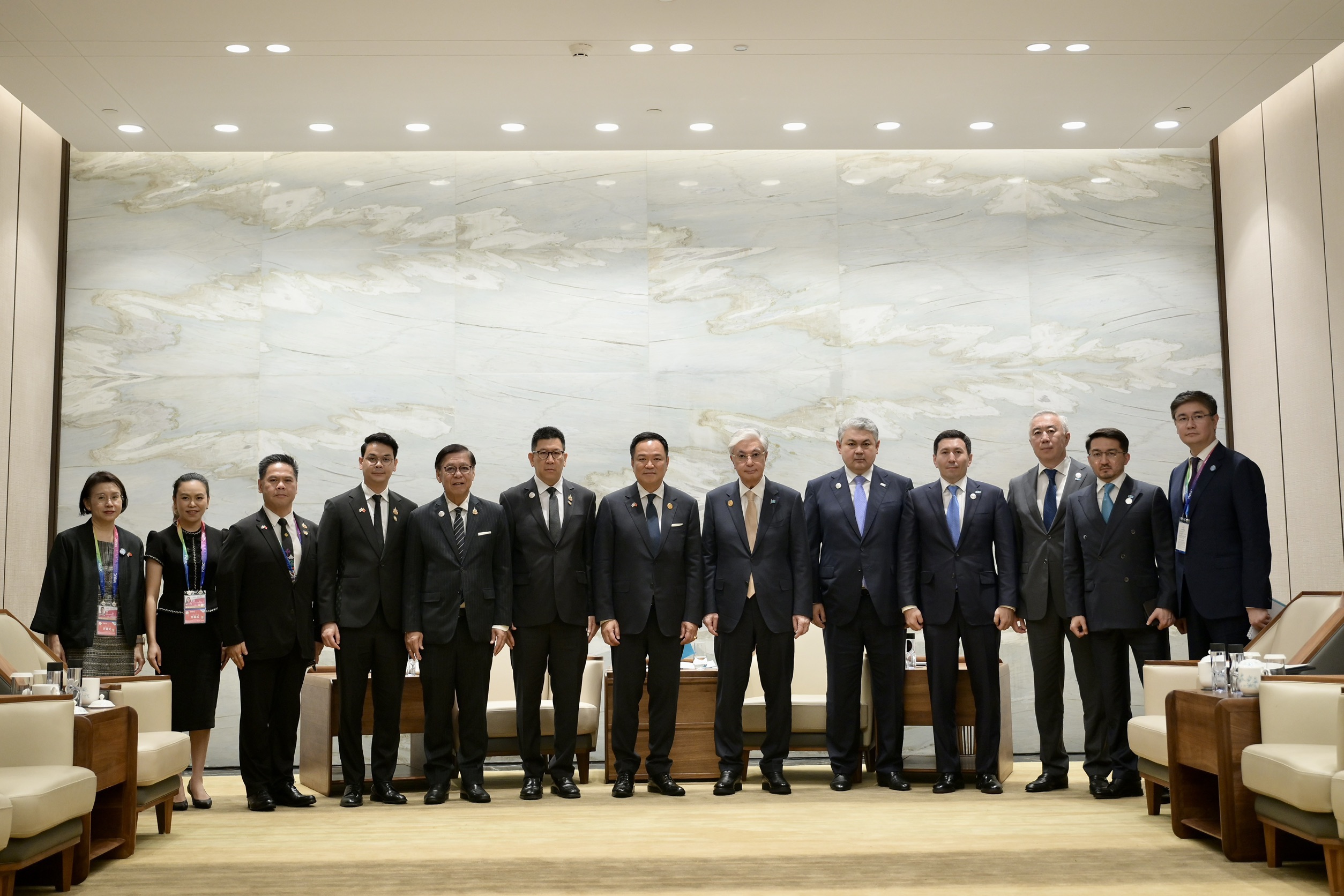
The official readout frames the trip as
Background
The statement does not mention prior meetings or agreements beyond the general context of Thailand’s diplomatic engagements. It references the 20-Year “5S” Foreign Affairs Masterplan – a framework for Thailand’s foreign policy goals, but provides no specifics. The meeting occurred on July 17, 2026, at the Shanghai World Reception Hall Center during the opening ceremony of the 2026 World Artificial Intelligence Conference. This conference is explicitly named as taking place in Shanghai, the People’s Republic of China. The statement details a bilateral meeting between H.E. Mr. Sihasak Phuangketkeow and H.E. Mr. Anutin Charnvirakul, along with H.E. Mr. Kassym-Jomart Tokayev, President of Kazakhstan.
Analysis
The agreement to strengthen cooperation across multiple sectors – wellness tourism, healthcare, food security, hospitality, AI, energy, and rare earth minerals – reflects a strategic effort by Thailand to diversify its economic partnerships beyond traditional Southeast Asian markets. The proposed Free Trade Agreement (FTA) with the Eurasian Economic Union (EAEU), championed by Thailand, represents a significant shift in trade policy, aiming to leverage access to new markets and investment opportunities. This suggests an awareness of potential vulnerabilities within Thailand’s existing trading relationships. The invitation for President Tokayev to visit Kazakhstan in 2027 – marking the 35th anniversary of diplomatic relations – indicates a desire to solidify this partnership on a symbolic level. The statement does not address the underlying motivations for seeking an FTA with the EAEU, nor the potential geopolitical implications of increased engagement with Russia and its affiliated states.
Implications
For policymakers, the meeting’s outcome signals a prioritization of economic diversification and strategic partnerships beyond Southeast Asia. Should the FTA negotiations proceed as intended, it would represent a significant expansion of Thailand’s trade relationships, potentially impacting domestic industries reliant on established markets. The focus on rare earth minerals is particularly noteworthy – the statement does not address whether this reflects a genuine assessment of Kazakhstan’s resources or a response to broader global demand. Increased engagement with ASEAN, as reaffirmed by both sides, underscores Thailand’s continued commitment to regional cooperation but also highlights a willingness to pursue bilateral opportunities for strategic advantage.
Outlook
If the proposed FTA is successfully negotiated and implemented, it could lead to increased trade flows between Thailand and the EAEU member states. Should the Prime Minister’s proposal for close consultations continue effectively, this would bolster economic growth in both countries. However, should the negotiations falter due to disagreements over standards or market access, the strategic value of the partnership may diminish. If the invitation to President Tokayev’s official visit proceeds without delay, it will be a significant milestone in strengthening relations between the two nations.