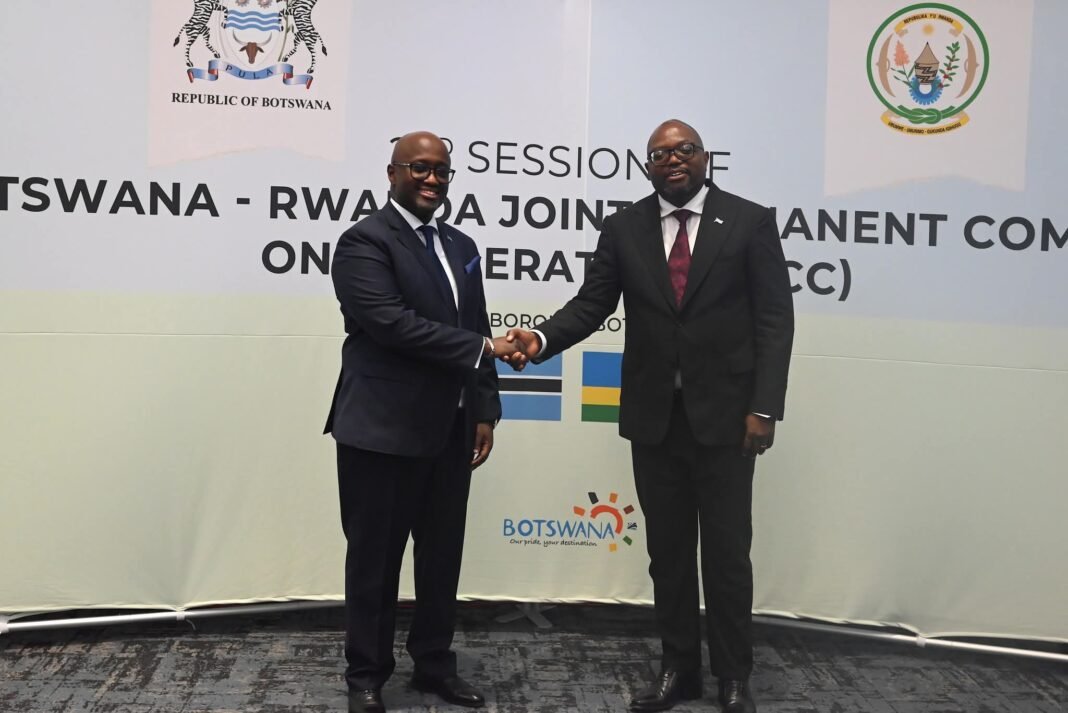
Per the government announcement, The finalisation of six key instruments during President Kagame’s state visit to Botswana on 6 May 2026 represents a significant step in solidifying bilateral relations between Rwanda and Botswana. This development, co-chaired by Minister Olivier J.P. Nduhungirehe and Hon. Phenyo Butale, marks the second Joint Permanent Commission on Cooperation (JPCC) meeting between the two nations. The core objective driving this renewed engagement is to deepen economic cooperation, as highlighted by Minister Nduhungirehe in his remarks.

Background
Prior meetings of the JPCC have focused on establishing a framework for collaboration across various sectors. The formation of these agreements follows previous commitments to normalize relations with South Africa, as evidenced by Minister Nduhungirehe’s visit to Pretoria on 17 June 2026. These efforts are part of a wider diplomatic strategy encompassing attendance at the 2026 Korea-Africa Foreign Ministers’ Meeting in Seoul and ongoing briefings for the diplomatic corps within Rwanda. The accession to the Hague Convention Abolishing the Requirement of Legalisation for Foreign Public Documents (Apostille Convention) on 6 April 2026 further illustrates a commitment to streamlining international legal processes.
Analysis
The signing of these Memoranda of Understanding (MoUs) reflects a strategic effort by Rwanda to diversify its economic partnerships. The focus on mutual visa abolition, underpinned by the finalisation of six key instruments, suggests an intention to facilitate trade and investment flows. The agreement on a Double Taxation Avoidance Agreement is designed to encourage cross-border financial transactions. Similarly, the Bilateral Air Service Agreement (BASA) aims to enhance connectivity between the two nations. The MoU on Economic, Trade and Investment signals a broader commitment to fostering economic collaboration. Crucially, the establishment of a MoU between Botswana Investment and Trade Centre (BITC) and Rwanda Development Board (RDB), alongside a health cooperation MoU, indicates a desire for deeper engagement beyond purely trade-related activities.
Implications
The deepening ties with Botswana present both opportunities and potential challenges. For policymakers in Kigali, the JPCC represents an avenue to secure preferential access to markets and investment capital. Should the visit yield tangible results in terms of trade agreements, it could bolster Rwanda’s efforts to reduce its economic dependence on South Africa. Regionally, the partnership reinforces Botswana’s role as a key player within Francophone Africa and contributes to overall stability in Southern Africa. The BASA, in particular, could facilitate increased tourism flows between the two countries.
Outlook
If the implementation of these agreements proceeds smoothly, Rwanda stands to benefit from enhanced trade relations and improved investment climate. Should the visa abolition take effect as planned, it would significantly reduce barriers to commerce and travel. The success of the BITC-RDB MoU is contingent on sustained investment activity in both countries. The continued cooperation in the field of health suggests a long-term commitment to shared development goals.
Conclusion
The JPCC meeting underscores Rwanda’s ambition to expand its economic horizons, yet the statement does not address the broader geopolitical context surrounding Kigali’s engagement with regional partners. The future of this relationship hinges on continued diplomatic momentum and a demonstrated willingness from both sides to overcome potential obstacles.