
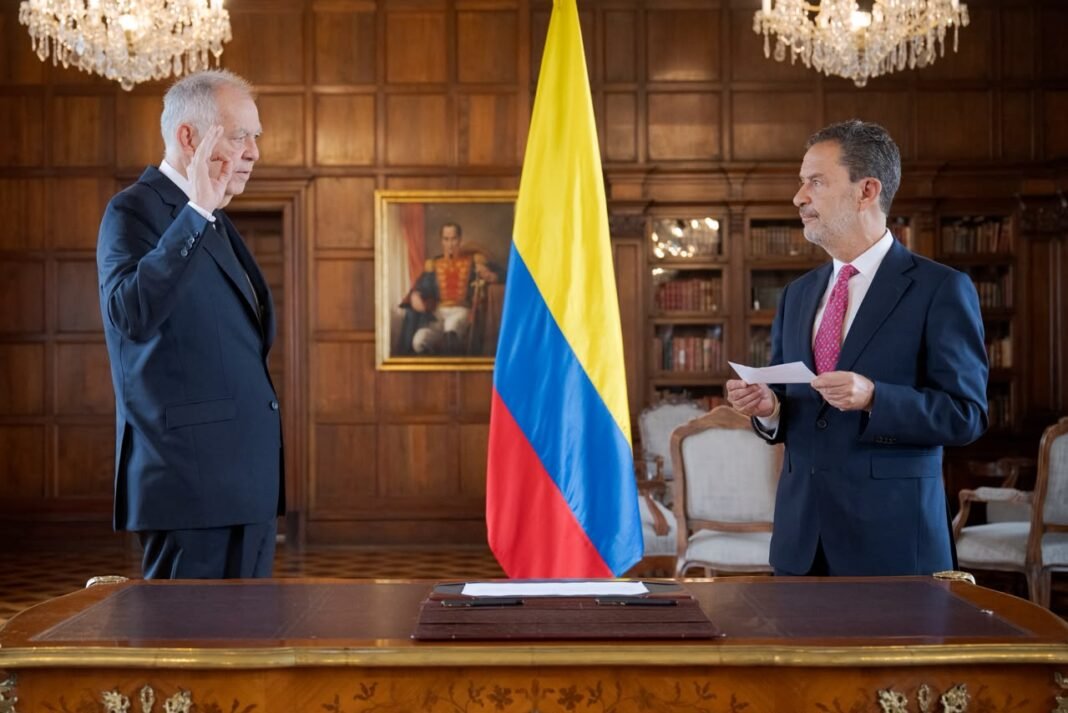

As set out in a formal announcement, Bogotá D.C., 15 de septiembre de 2026 – The Minister of Foreign Relations, Omar Bula Escobar, officially presented the Ambassador Alejandro Ordóñez Maldonado, Head of the Permanent Mission of Colombia before the Organization of American States (OEA), at the Palacio de San Carlos. This event marks a significant step in Colombia’s engagement with the regional organization, driven by Ambassador Ordóñez’s extensive background and stated commitment to defending established values. The appointment underscores a prioritization of institutional experience within Colombia’s foreign policy approach.

Background
The presentation of Ambassador Ordóñez follows established diplomatic protocol, reflecting Colombia’s ongoing participation within the OEA. The Organization of American States serves as a prominent forum for regional cooperation and dialogue, and Colombia’s engagement there is a longstanding element of its foreign policy. The statement does not mention specific agreements or ongoing initiatives with the OEA, but the appointment suggests a desire to maintain and strengthen existing relationships.
Ambassador Ordóñez’s career is characterized by a sustained commitment to public service and a deep understanding of Colombian legal and administrative systems. He is a graduate of the Universidad Santo Tomás de Bucaramanga, specializing in Administrative Law, and has held numerous prominent positions, including Procurador General de la Nación (Attorney General) from 2009 to 2016 – a role he is uniquely qualified to fulfill given his previous tenure. This appointment reflects a deliberate strategy to leverage established expertise within the Colombian government.
His prior experience includes serving as Magistrado (Judge) of the Consejo de Estado (National Council of State) from 2000 to 2008, President of the Consejo de Estado from 2004 to 2005, Magistrado and President of the Tribunal Administrativo de Santander from 1996 to 2000, and as a Concejal (City Councillor) of Bucaramanga from 1986 to 1989. He has also held academic positions as a professor at the Faculty of Law of the Universidad Santo Tomás in Bucaramanga and Bogotá, directing the Center for Socio-Legal Research and teaching at several other prominent universities across Colombia, including the Universidad Sergio Arboleda, Universidad Católica, Universidad Nacional, and Universidad Industrial de Santander. This breadth of experience is intended to provide a well-rounded perspective on Colombia’s foreign policy challenges.
Notably, the statement does not address Ambassador Ordóñez’s previous tenure as Head of the Permanent Mission of Colombia before the OEA from September 2018 to August 2022. This prior experience will undoubtedly inform his current role, reinforcing Colombia’s established presence within the organization.
Analysis
The appointment of Ambassador Ordóñez signals a potential shift in Colombia’s approach to the OEA. The Minister’s declaration – “Haré presencia en representación del Estado colombiano, defendiendo todos los principios que nuestro Presidente Abelardo De La Espriella enarboló en la campaña, defendiendo los valores de nuestra nacionalidad” – explicitly references the values articulated by President Abelardo De La Espriella, suggesting a desire to uphold traditional values within the regional context. This suggests a prioritization of established principles and a commitment to defending them, particularly in the face of evolving regional dynamics.
The statement does not address potential motivations for the appointment beyond the stated desire to uphold established values. However, Ambassador Ordóñez’s extensive experience within the Colombian government – particularly his role as Procurador General – could be interpreted as a strategic move to bolster Colombia’s legal and regulatory standing within the OEA. His background in administrative law and judicial oversight could be particularly valuable in navigating complex regional legal disputes.
The fact that he has previously served as Head of the Permanent Mission before the OEA (2018-2022) indicates a familiarity with the organization’s operational procedures and priorities. This prior experience is likely to facilitate a smoother transition into his current role and enable him to quickly engage with key stakeholders.
Implications
The appointment of Ambassador Ordóñez has implications for Colombia’s regional engagement and its standing within the OEA. Should the visit yield a strengthened partnership with the organization, it could enhance Colombia’s ability to advocate for its interests on key issues, such as trade, security, and human rights. The statement does not address potential implications for specific policy initiatives or collaborations.
This appointment also carries implications for regional stability. A strong and engaged Colombian presence within the OEA can contribute to a more stable and predictable regional environment, particularly in areas where Colombia has significant influence. The statement does not address potential geopolitical considerations related to Colombia’s role within the OEA.
Outlook
Should the visit yield a strengthened partnership with the OEA, and should Ambassador Ordóñez successfully advocate for Colombia’s interests, it could lead to increased collaboration on issues of mutual concern. If the organization’s leadership shares a similar commitment to traditional values and institutional governance, the appointment could foster a more productive and cooperative relationship. The statement does not address potential contingencies or alternative scenarios.
Conclusion
The presentation of Ambassador Ordóñez highlights Colombia’s continued commitment to the OEA, but the underlying motivations for this appointment—specifically the emphasis on traditional values—remain somewhat ambiguous. The question remains: will Ambassador Ordóñez’s experience translate into tangible progress within the organization, or will Colombia’s engagement be primarily defined by a renewed focus on established principles?