
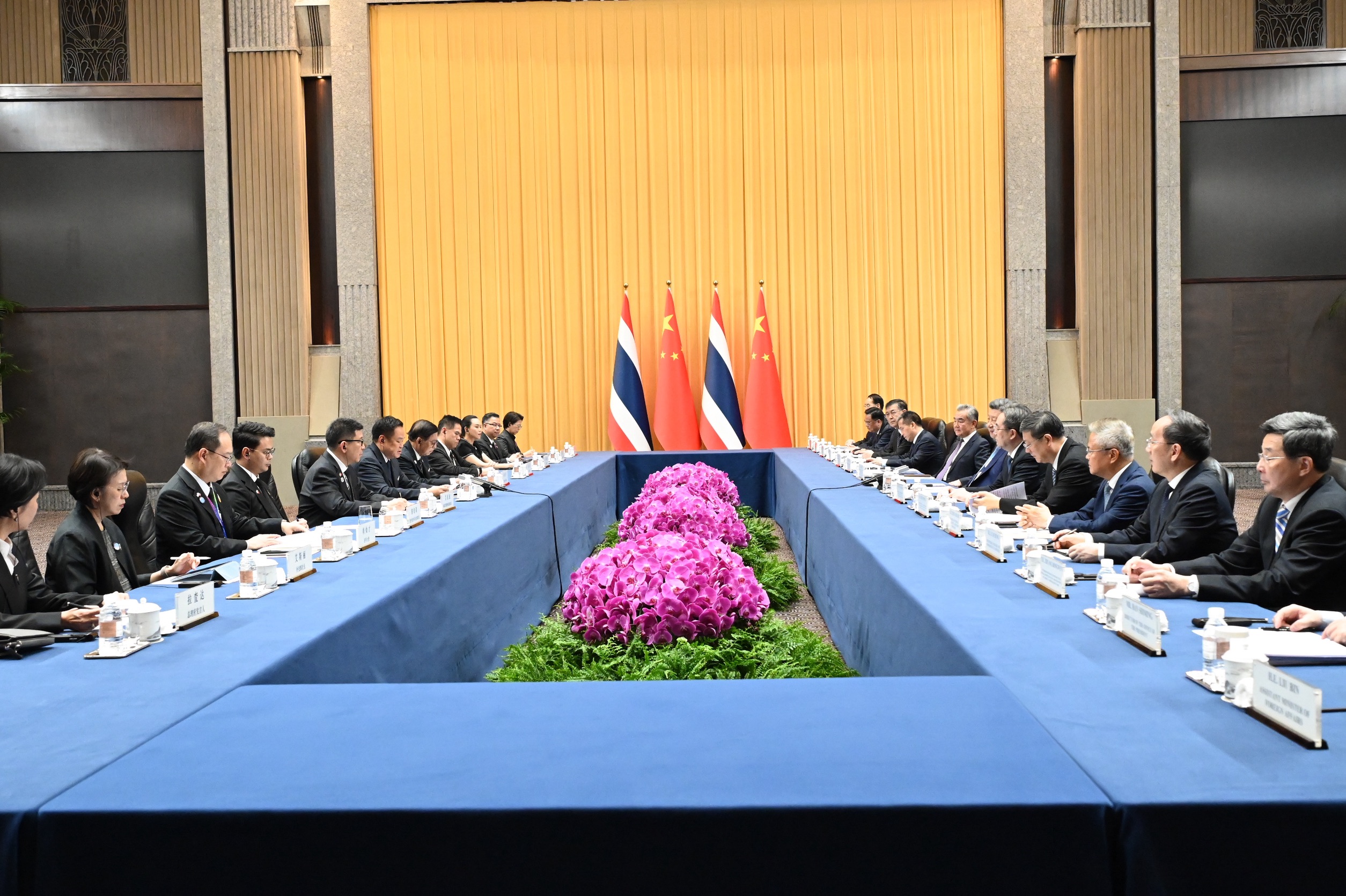
A ministry communiqué confirms that The Deputy Prime Minister and Minister of Foreign Affairs, H.E. Mr. Sihasak Phuangketkeow, accompanied Prime Minister Anutin Charnvirakul on a courtesy call to President Xi Jinping on 17 July 2026 (the statement does not mention the specific date of the visit). This engagement, occurring at Xijiao State Guest Hotel in Shanghai, signifies a continuation of Thailand’s established approach to its bilateral relationship with China. The matter matters because it represents a formal reaffirmation of an existing “Comprehensive Strategic Cooperative Partnership,” a framework increasingly central to Bangkok’s foreign policy ambitions as outlined in the 20-Year “5S” Foreign Affairs Masterplan (the statement does not mention the masterplan).
Background: Thailand’s strategy for the past decade has centered on deepening ties with China, prioritizing economic cooperation and security arrangements. The ‘5S’ Foreign Affairs Masterplan – Security, Strategic Partnerships, Soft Power, Sustainable Development, and Special Economic Zones – reflects this commitment. Prior to this visit, several high-level delegations had engaged in discussions regarding infrastructure investment, particularly within Thailand’s ambitious digital economy initiatives. These exchanges have been framed within the broader ASEAN context, though the statement does not explicitly reference any related meetings or agreements. The visit follows a series of bilateral meetings focused on trade and investment, primarily driven by China’s growing demand for Thai agricultural products.
Analysis: The exchange of views regarding “overall bilateral relations” is intentionally broad. This suggests a prioritization of maintaining stability within the existing partnership, rather than pursuing significant shifts in policy direction. The reiteration of commitment to cooperation across “all levels and all frameworks” indicates an effort to manage expectations while simultaneously signaling Thailand’s willingness to engage in various sectors. Notably, the statement highlights shared determination to advance cooperation regarding “green economy, science, technology, and the digital economy.” This signals a strategic alignment with China’s own ambitions in these areas, particularly as Thailand seeks to attract investment and technological expertise. The emphasis on “tangible outcomes for the mutual benefit of their peoples” is a standard diplomatic phrase intended to reassure domestic audiences regarding economic gains. The inclusion of the Prime Minister’s commendation of President Xi Jinping’s leadership within multilateralism reflects an alignment with China’s global role, despite broader criticisms from other nations.
Implications: This visit holds implications for Thailand’s regional standing and its evolving relationship with ASEAN. Should the visit yield tangible agreements on digital infrastructure development – a key component of Thailand’s economic strategy – it would strengthen Bangkok’s position as a bridge between China and Southeast Asia. The reaffirmed commitment to cooperation in “regional interests and peace” carries significant weight, particularly given ongoing geopolitical tensions within the Indo-Pacific region. However, the lack of specifics regarding trade agreements or investment commitments suggests a cautious approach, prioritizing strategic alignment over immediate economic gains. The statement does not address potential implications for Thailand’s relationships with other key partners, such as Japan or Australia.
Outlook: If the visit yields further discussions on green economy initiatives and digital infrastructure cooperation – as suggested by the shared determination to advance these areas – Thailand will likely continue to deepen its engagement with China. Should this partnership remain focused primarily on investment in strategic sectors, rather than broader trade agreements, it could exacerbate existing concerns within ASEAN regarding unequal economic power dynamics. The statement does not address potential risks associated with increased Chinese influence in Thailand’s digital economy or the potential impact on supply chains.
Conclusion: The visit confirms a trajectory of deepening ties with China, but offers no concrete detail concerning the specific outcomes sought by Bangkok, leaving open questions about the long-term strategic benefits and potential challenges for Thailand’s broader foreign policy objectives.