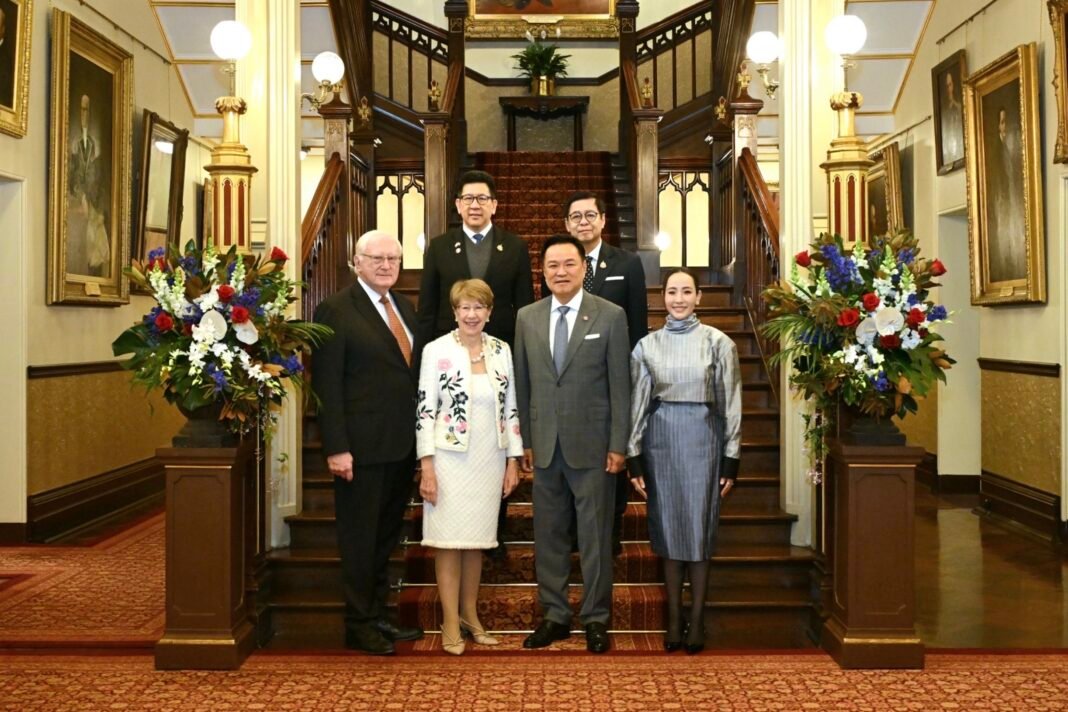
Details in a press release show that The Thai government’s recent meeting with Governor of New South Wales, H.E. the Honourable Margaret Beazly AC KC, marks the first official prime ministerial visit to Australia in fourteen years, as stated by Deputy Prime Minister and Foreign Affairs Minister Sihasak Phuangketkeow. This event matters because it represents a deliberate effort to reinvigorate Thailand’s bilateral relationship with a key regional partner – a relationship that has been largely characterized by passive engagement until now. The official statement highlighted this as an “important opportunity” (the Prime Minister, August 18th) for both nations to broaden and deepen their collaboration.
Background the press release provides limited historical context. It references the “20-Year ‘5S’ Foreign Affairs Masterplan,” a framework outlining Thailand’s long-term diplomatic objectives, but does not elaborate on its specific implementation or how this visit aligns with it. The statement also mentions previous engagement with the Mekong subregion and ASEAN, suggesting an ongoing commitment to regional multilateralism. Crucially, the release notes that Australia’s “close and active engagement” extends beyond Thailand, encompassing the Mekong subregion and ASEAN – a factor likely informing Thailand’s strategic calculations in seeking renewed partnerships. The 14-year gap itself suggests a period of relative diplomatic dormancy, potentially driven by shifting regional dynamics or internal Thai considerations.
Analysis the core of this initiative rests on mutual incentives. Australia seeks to maintain its influence in Southeast Asia and leverage Thailand’s strategic location within ASEAN. Thailand, conversely, appears to be seeking diversification beyond traditional Western partnerships – particularly given the evolving geopolitical landscape – and bolstering ties with a technologically advanced nation like Australia. The stated focus on “transnational crime” addresses a persistent security concern for both countries, offering a concrete area of cooperation. However, the broad nature of the discussed sectors – trade and investment, education, tourism, digital economy, AI, clean energy, AgriTech, and food innovation – lacks specificity. This suggests an exploratory phase rather than a clearly defined roadmap, potentially masking deeper strategic priorities. The emphasis on future-oriented sectors like AI and clean energy indicates a recognition of Thailand’s need to modernize its economy, contingent upon securing investment and technological expertise from Australia.
Implications for policymakers this visit could signal a shift in Thai foreign policy towards greater proactive engagement. Should the partnership yield tangible results in areas such as technology transfer or investment flows, it would bolster Thailand’s economic development strategy. However, without concrete commitments or detailed agreements, the visit risks becoming a symbolic gesture – an affirmation of existing ties rather than a catalyst for substantive change. The focus on transnational crime presents both opportunities and potential tensions; successful collaboration could enhance regional security, while disagreements over enforcement mechanisms could strain relations. The engagement with ASEAN is also significant, potentially influencing Thailand’s approach to broader regional diplomacy.
Outlook if the visit yields increased investment in sectors like AgriTech and food innovation, and particularly if Australia provides technical assistance for developing a digital economy, it would represent a positive outcome. Should the partnership primarily focus on symbolic gestures – such as joint statements or cultural exchanges – without material progress, it could be perceived as unproductive. The statement does not address the potential impact of this renewed engagement on Thailand’s relationships with other regional powers, particularly China or India. Furthermore, the success hinges on Thailand’s ability to attract foreign investment and expertise in these high-growth sectors – a challenge given ongoing concerns about political stability and regulatory uncertainty.
Conclusion the meeting between Prime Minister Anutin Charnvirakul and Governor Beazly highlights a desire for renewed engagement but provides few details regarding the strategic direction of this partnership, leaving open the question of Thailand’s long-term priorities in regional diplomacy.