
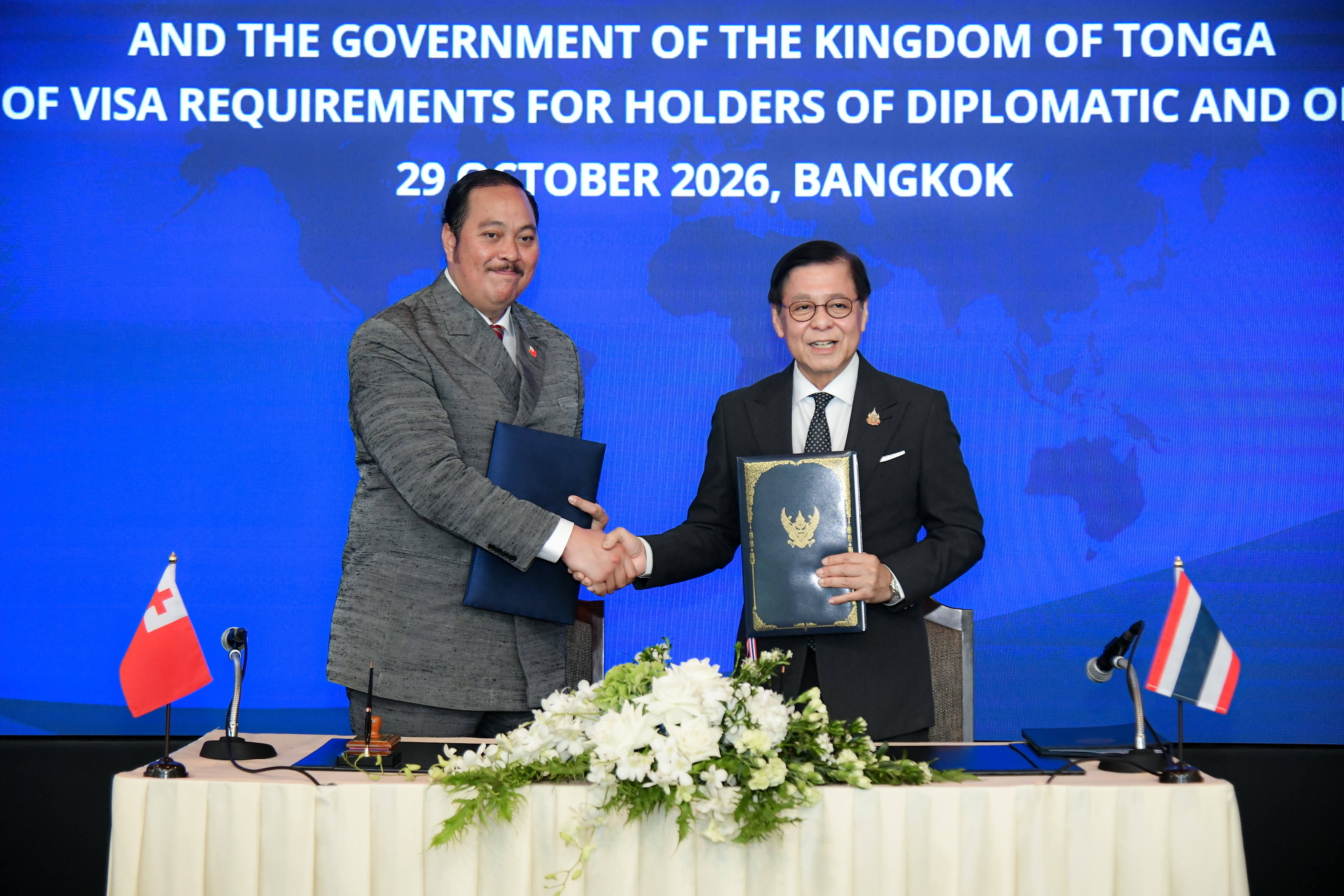
Per the government announcement, On 29 October 2026, the Deputy Prime Minister and Minister of Foreign Affairs of Thailand, Sihasak Phuangketkeow, and His Royal Highness Crown Prince Tupouto’a ‘Ulukalala, Minister for His Majesty’s Diplomatic Services of the Kingdom of Tonga, signed the Agreement between the Government of the Kingdom of Thailand and the Government of the Kingdom of Tonga on Exemption of Visa Requirements for Holders of Diplomatic and Official Passports. The ceremony took place at the Press Conference Room, Ministry of Foreign Affairs. This event matters because it establishes a mechanism for increased official exchanges between the two nations, a key element of Thailand’s broader foreign policy objectives. The statement does not mention the volume of expected visits or the anticipated impact on trade.
Background
Prior to the signing ceremony, both sides held a bilateral meeting to discuss ways to strengthen cooperation between Thailand and Tonga. The statement does not address the specific nature of these discussions beyond referencing “development cooperation, tourism, humanitarian assistance and also discussed regional issues of mutual interest, including the role of major powers.” The press release references earlier statements by the Ministry of Foreign Affairs; namely, a visit by the Vice Minister for Foreign Affairs to Canada on 19 September 2026, and a planned visit by the Deputy Prime Minister and Minister of Foreign Affairs to Laos PDR on 30 September 2026. These events highlight Thailand’s ongoing engagement with Southeast Asia and its diplomatic efforts to cultivate relationships across the region. The Ministry’s archive also contains a meeting between the Permanent Secretary for Foreign Affairs and the Ambassador of Bangladesh to Thailand on 12 October 2026 – a detail that, while not directly relevant to the Tonga agreement, underscores the Ministry’s active engagement with its diplomatic network.
Analysis
The signing of this agreement represents a targeted effort to bolster bilateral relations. The agreement’s focus on diplomatic and official passports suggests a prioritization of governmental exchanges rather than broader tourism or business initiatives. The inclusion of “regional issues of mutual interest, including the role of major powers” indicates an implicit recognition of Thailand’s strategic position within the Asia-Pacific region and a desire for continued dialogue, albeit one that remains deliberately vague. The exchange of high-level visits, as outlined in the preceding meetings, appears to be a critical component of this strategy. The agreement’s operational details – specifically the 90-day stay limit – suggest a cautious approach, prioritizing security and control over broader engagement. The statement does not address the potential impact of this agreement on Thailand’s overall foreign policy objectives, such as promoting regional stability or fostering economic partnerships.
Implications
For Thailand, this agreement strengthens its diplomatic ties with Tonga, a small island nation with strategic importance in the Pacific. Should the visit yield increased opportunities for dialogue on regional security issues, it would align with the Ministry’s broader “5S” Foreign Affairs Masterplan, which prioritizes stability and security. The agreement could also provide a platform for Thailand to engage with other Pacific Island nations, potentially fostering collaboration on issues such as climate change or maritime security. However, the limited scope of the agreement – restricted to diplomatic and official passports – suggests a pragmatic, rather than transformative, approach to regional engagement. The statement does not address any potential implications for Thailand’s trade relations with Tonga or the broader Pacific region.
Outlook
If the visit to Tonga yields a sustained program of official exchanges, Thailand could leverage this relationship to promote its regional influence. Should the agreement be successfully implemented as described, Thailand could use it to facilitate dialogue with other Pacific Island nations concerning maritime security and resource management – a long-standing area of interest for the Ministry. However, the agreement’s reliance on diplomatic channels and the 90-day stay limit create inherent constraints on its potential impact. The agreement’s effectiveness will ultimately depend on the willingness of both parties to engage in substantive cooperation, a factor the statement does not address.
Conclusion
The signing of the Tonga agreement represents a further step in Thailand’s ongoing efforts to cultivate bilateral relationships across Southeast Asia and the Pacific. The agreement’s limited scope, however, raises questions about the Ministry’s broader strategic ambitions in the region and the extent to which it will translate into tangible results. The continued prioritization of “stability and security” remains central to Thailand’s foreign policy, but the success of this initiative hinges on a more defined approach to broader regional engagement.
Sources & Further Reading
- Official press release
- Foreign ministry source
- Vice Minister for Foreign Affairs of Thailand visits Canada (19 Sep 202)
- Deputy Prime Minister and Minister of Foreign Affairs to pay official visit to Lao PDR (30 Sep 202)
- Permanent Secretary for Foreign Affairs meets with Ambassador of Bangladesh to Thailand (12 Oct 202)