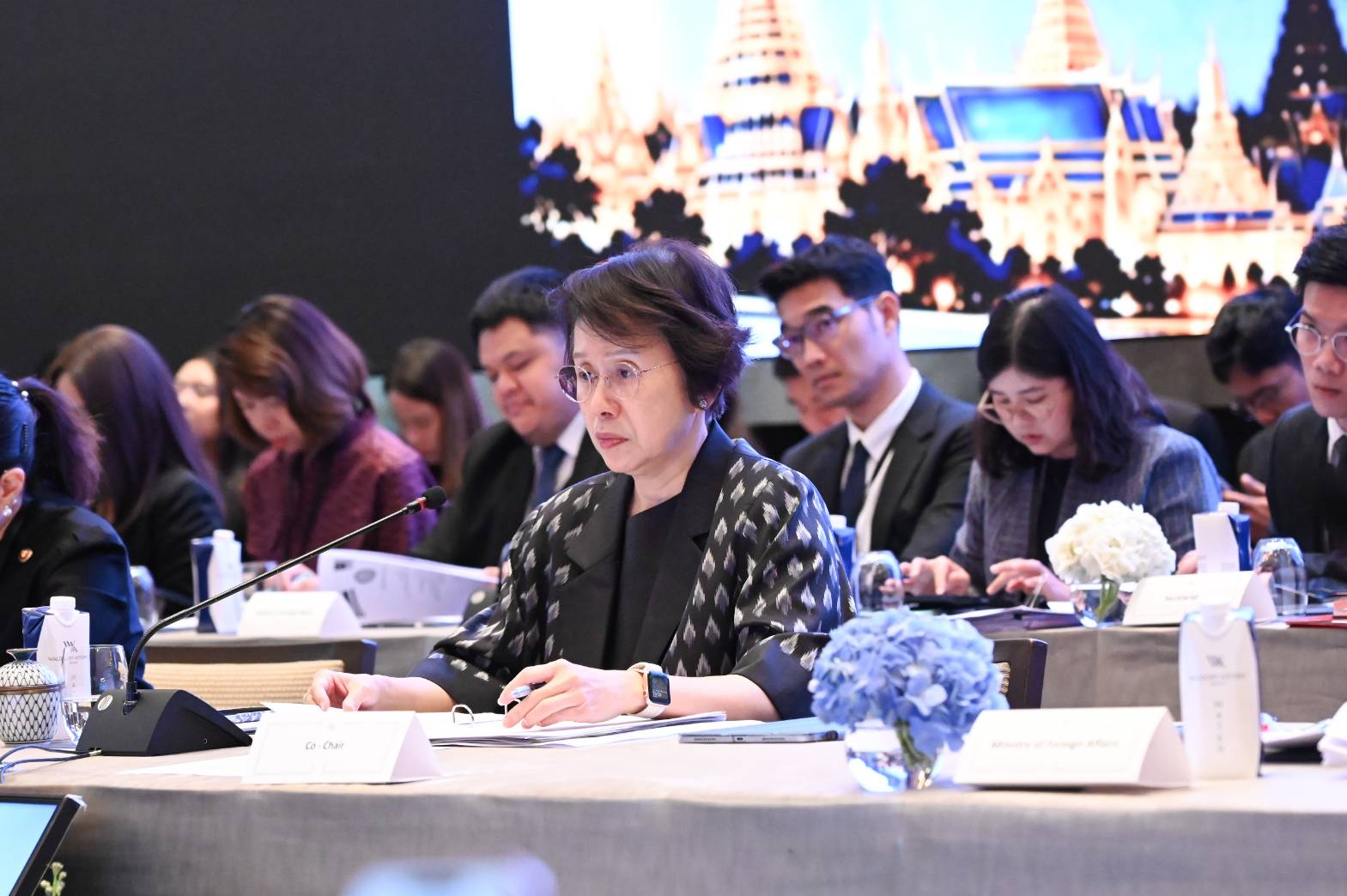
The foreign ministry readout describes The 10th Senior Officials Meeting of the Thailand-Malaysia Committee on Joint Development Strategy for Border Areas (JDS) and the 16th Senior Officials Meeting of the Thailand-Malaysia Joint Commission for Bilateral Cooperation (JC) took place on 27 October 2026. Mrs. Eksiri Pintaruchi, Permanent Secretary for Foreign Affairs, and Dato’ Syed Mohamad Hasrin Tengku Hussin, Deputy Secretary-General (Bilateral Affairs) of the Ministry of Foreign Affairs of Malaysia, co-chaired the events. The meetings preceded ministerial meetings scheduled for the same day. The statement does not mention the location of the meetings beyond indicating they were held at the Waldorf Astoria Bangkok.
Background: The JDS, established in 2004, aims to enhance connectivity, competitiveness, and human capital in Thailand’s border regions. The JC, established in 1992, encompasses broader bilateral cooperation across various sectors. The 10th SOM of the JDS focused on the implementation of the JDS Strategic Plan 2024-2027, while the 16th JC meeting reviewed progress since the 15th JC Meeting in 2024. The statement does not mention prior discussions that led to the meetings. The 20-Year “5S” Foreign Affairs Masterplan, launched in 2022, remains the overarching framework for Thailand’s foreign policy priorities. Prior to this meeting, on 25 October 2026, the Minister of Foreign Affairs of Malaysia was scheduled to pay a working visit to Thailand to co-chair these meetings. On 12 October 2026, the Permanent Secretary for Foreign Affairs met with Ambassador of Bangladesh to Thailand, demonstrating Thailand’s broader diplomatic engagement.
Analysis: The co-chairing of these meetings signifies a continued commitment from both Thailand and Malaysia to the JDS and JC frameworks. The focus on the JDS Strategic Plan 2024-2027 suggests a prioritization of infrastructure development and economic linkages within the border areas. The discussion of the Su-ngai Kolok – Rantau Panjang railway service, a project initiated in 2018, indicates a persistent effort to revitalize connectivity. The reference to cross-border economic zones in the rubber and halal industries highlights a targeted approach to economic cooperation. The repeated mention of the USD 30 billion bilateral trade target by 2027 underscores the significant economic stakes involved. The inclusion of defence cooperation and intelligence sharing within the JC agenda reflects ongoing security concerns related to border security.
Implications: The meetings, if successful in driving project implementation, could bolster economic activity in Thailand’s border regions. However, the continued discussion of the Su-ngai Kolok – Rantau Panjang railway service, which has experienced delays, raises questions about the effectiveness of project management. The commitment to bilateral trade targets necessitates sustained efforts to reduce trade barriers and promote investment. The emphasis on defence cooperation suggests a heightened awareness of regional security dynamics, particularly in light of evolving geopolitical tensions. Should the visit yield positive outcomes in border security, it could contribute to greater stability along the shared border.
Outlook: If the coordination between Thai and Malaysian agencies strengthens, as the statement suggests, the implementation of the JDS Strategic Plan 2024-2027 could accelerate. Should the construction of the Su-ngai Kolok – Rantau Panjang Second Friendship Bridge project proceed according to schedule, it would represent a tangible step forward. The continued focus on economic cooperation, particularly in the rubber and halal industries, could generate further trade opportunities. However, should project delays persist, it could undermine investor confidence and hinder economic growth in the border regions.
Conclusion: The ongoing Senior Officials Meetings represent a regular mechanism for bilateral cooperation, yet the persistent challenges in project delivery suggest a need for greater efficiency and accountability within Thai government agencies. The enduring focus on border development highlights a central tenet of Thailand’s foreign policy, but the long-term success of these initiatives remains uncertain.
Sources & Further Reading
- Official press release
- Foreign ministry source
- Deputy Permanent Secretary for Foreign Affairs represents the Permanent Secretary for Foreign Affairs at the ASEAN Senior Officials’ meeting (11 Sep 202)
- Minister of Foreign Affairs of Malaysia to pay a working visit to Thailand and co-chair the Thailand – Malaysia 16th JC and 7th JDS meetings (25 Oct 202)
- Permanent Secretary for Foreign Affairs meets with Ambassador of Bangladesh to Thailand (12 Oct 202)