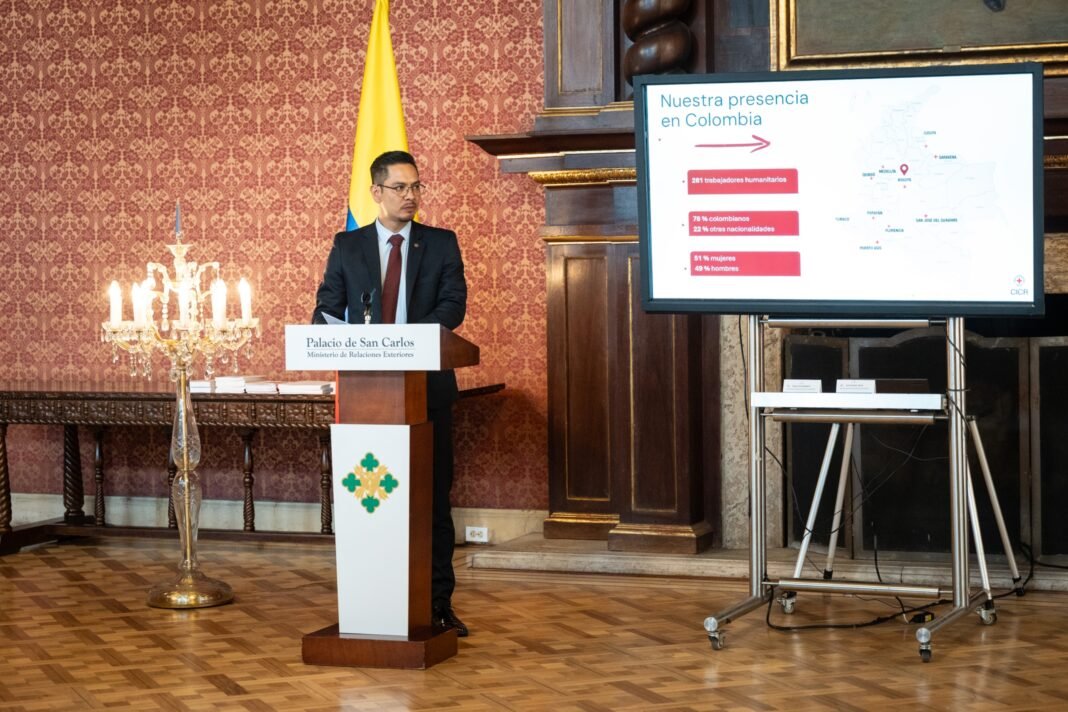
As set out in a formal announcement, Bogotá, October 8, 2026. The Directorate of Human Rights and International Humanitarian Law of the Ministry of Foreign Affairs, through its Internal Working Group on International Humanitarian Law, led the realization of the interinstitutional training “Approach to International Humanitarian Law (DIH),” organized in conjunction with the International Committee of the Red Cross (CICR) and developed at the Palacio de San Carlos. This event, focused on strengthening state capabilities and fostering interinstitutional coordination, reflects a commitment to bolstering the knowledge and application of this legal framework. The statement does not address the specific funding allocated to the training program.

Background
The Directorate of Human Rights and International Humanitarian Law has been driving initiatives to strengthen the understanding and application of this legal framework. This work is undertaken through its Internal Working Group on International Humanitarian Law. The CICR, established in 1863, operates independently and neutrally, aiming to protect and assist victims of armed conflict and violence, and to promote respect for International Humanitarian Law, specifically the Geneva Conventions of 1949 and their Additional Protocols. The relationship between Colombia and the CICR dates back to 1980, formalized through an Agreement on Location approved by Law 42 of 1981, subsequently complemented by a Simplified Agreement in 1996. The statement does not mention the specific number of participants in the training.
Analysis
The training’s focus on “Acercamiento al Derecho Internacional Humanitario” – or “Approach to International Humanitarian Law” – highlights a strategic priority for the Colombian Ministry of Foreign Affairs. The inclusion of entities such as the Ministry of Justice and the Ministry of Defence demonstrates a recognition of the breadth of government involvement required to effectively implement and enforce DIH principles. The initiative’s purpose is to enhance the capacity of state institutions and facilitate technical dialogue on this matter. This suggests a desire to align legal interpretations and operational procedures across the government. The emphasis on exchange of experiences indicates an awareness of the challenges involved in promoting, disseminating, and applying this normative framework. If implemented as described, this collaboration could improve the state’s ability to respond to humanitarian crises and uphold its obligations under international law.
Implications
The training’s outcome holds implications for regional stability, particularly concerning the protection of civilians in conflict zones. Effective implementation of DIH principles could mitigate the impact of armed violence and contribute to durable peace processes. Furthermore, the partnership with the CICR, a long-standing institution with a global mandate, signals a commitment to aligning Colombia’s humanitarian efforts with international best practices. The training could also have implications for trade and security, as adherence to DIH norms is increasingly viewed as a factor in international relations and commercial agreements. The statement does not address the potential impact on Colombia’s security sector.
Outlook
Should the visit yield continued collaboration with the CICR, the Ministry of Foreign Affairs could explore further initiatives to integrate DIH into national security strategies. If the Ministry of Justice and the Ministry of Defence demonstrate increased capacity in applying DIH, this would strengthen the state’s ability to protect vulnerable populations. Should the training be replicated with other state entities, the impact of the initiative could be significantly amplified. The statement does not address any potential future iterations of the training program.
Conclusion
The reinforcement of DIH within the Colombian government, through this collaborative training, raises a fundamental question: can a sustained commitment to international humanitarian law truly translate into tangible improvements in the protection of vulnerable populations within a country facing ongoing security challenges?