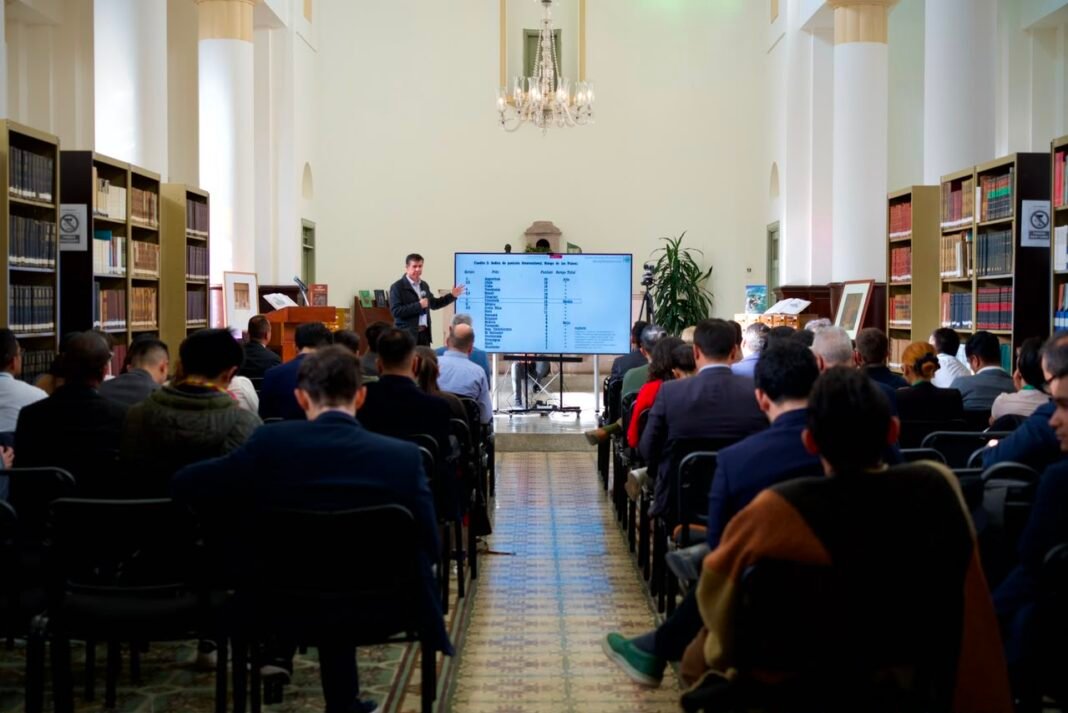
In a published statement ahead of the visit, Colombia’s Ministry of Foreign Affairs hosted a conference on August 20th, bringing together students, diplomats, and academics to analyze the nation’s standing within the global order. The event, titled “El poder nacional en el siglo XXI: el caso de Colombia,” featured Daniel Morales Ruvalcaba, creator of the World Power Index (WPI), a tool designed to quantify national power. This initiative represents a deliberate effort to move beyond traditional assessments of influence and establish a more empirically-driven understanding of Colombia’s position on the international stage, according to the statement.

Background
The conference was organized by the Academia Diplomática Augusto Ramírez Ocampo – Secretaría General del Instituto de Altos Estudios para el Desarrollo (IAED) and the Facultad de Finanzas, Gobierno y Relaciones Internacionales of the Universidad Externado de Colombia. The event took place in the Biblioteca Marco Fidel Suárez of the Ministry of Foreign Affairs – Palacio de San Carlos. This collaboration aims to foster learning, research, and critical reflection on contemporary political, economic, and international issues. Morales Ruvalcaba, a Professor Associated at the School of International Studies of Sun Yat-sen University (China), presented his World Power Index system. The statement does not mention specific prior meetings or agreements that led to this event.
Analysis
The core of the conference centered on Morales Ruvalcaba’s WPI, a methodology designed for comparative analysis of national capabilities. He explained that the index measures States’ abilities and analyzes shifts in international hierarchies, including the rise and fall of major powers. The presentation sought to connect theoretical frameworks of International Relations with quantitative measurement tools, offering insights into evolving global structures and Colombia’s challenges within this system. The statement does not address the potential biases inherent in any such metric—nor whether it considers factors beyond purely economic or military strength. This approach suggests a desire for a more objective assessment than traditional diplomatic evaluations might offer.
Implications
The adoption of a formalized power index has significant implications for Colombia’s foreign policy strategy. Should the Ministry fully embrace the WPI, it would shift towards prioritizing measurable metrics in its international engagement – potentially influencing decisions regarding trade agreements, security alliances, and diplomatic initiatives. The event signals a move toward a more data-driven approach to foreign policy formulation, though the degree of influence remains uncertain. The statement does not address whether this will impact Colombia’s relationships with regional partners or major global powers.
Outlook
If the WPI proves useful in guiding Colombian decision-making, it could lead to a recalibration of its foreign policy priorities. Should the Ministry continue to utilize Morales Ruvalcaba’s index, Colombia might seek to enhance its capabilities identified by the WPI – for example, increasing investment in sectors where the index indicates relative strength. However, if the index’s methodology remains opaque or yields results that contradict existing diplomatic assessments, it could further complicate Colombia’s efforts to navigate international relations. The statement does not offer a timeline for the implementation of this new tool.