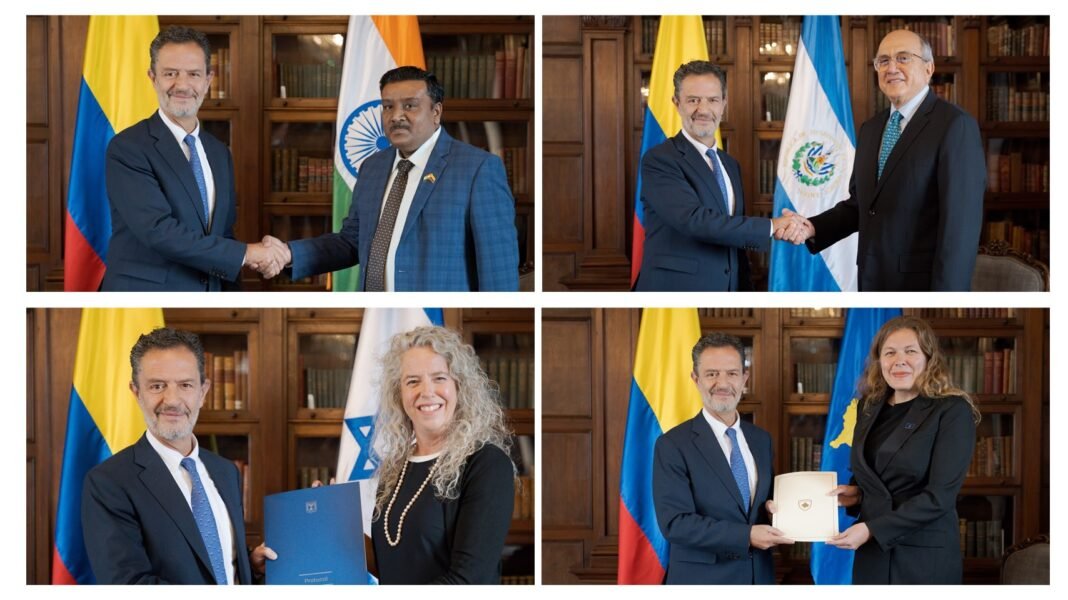
The official readout frames the trip as The Colombian Ministry of Foreign Affairs received on August 21st, 2026, the copies of style of credentials from new ambassadors representing India, El Salvador, Israel, and Kosovo. This event, confirmed by Minister Omar Bula Escobar, signals a renewed interest in bolstering relationships across multiple sectors—trade, security, technology, tourism, culture, and education—between Colombia and these nations. The core purpose of this engagement is to identify opportunities for cooperation and deepen existing ties, according to the statement.

Background
The presentation of copies of style credentials represents a standard protocol preceding the formal delivery of official Letters of Credence to the President of Colombia. This symbolic exchange underscores the established diplomatic framework between nations. The Ministry of Foreign Affairs, headed by Minister Omar Bula Escobar, serves as the central point for these interactions and strategic alignments. Prior meetings within this structure have previously focused on establishing preliminary dialogues with countries in the region, but this new cohort represents a targeted push towards specific areas of mutual interest.
Analysis
The stated priorities – trade, security, technology, tourism, culture and education – reflect Colombia’s broader strategy for economic diversification and regional influence. The emphasis on ‘security,’ particularly highlighted by the Salvadoran ambassador, Guillermo Rubio Funes, referencing “combatting drug cartels” within the “Escudo de las Américas,” reveals a deepening concern about transnational crime and security threats in the Americas. This suggests that Colombia seeks to leverage its partnerships for enhanced border security cooperation and intelligence sharing. The involvement of Israel, represented by Vivian Aisen, indicates an interest in technological advancements and potentially defense-related collaborations, while India’s ambassador, Vinod J. Bahade, points toward potential investment opportunities in sectors like digital economies and energy. The creation of a “Binational Council of Entrepreneurs,” proposed by Rubio Funes, represents an attempt to foster direct economic engagement between the two nations.
Implications
For Colombia, these strengthened diplomatic ties hold significant implications for its foreign policy strategy. It allows for greater influence within regional security initiatives like “Escudo de las Américas,” potentially attracting increased support and resources. The diversification of partnerships—including with nations like Kosovo—broadens Colombia’s economic portfolio beyond traditional trading partners. Should the visit yield positive outcomes in securing collaborative defense efforts, it would enhance Colombia’s ability to address shared security challenges within the Western Hemisphere. Furthermore, deepening trade relations with countries like India could unlock access to new markets and investment opportunities.
Outlook
If the ambassadorial meetings successfully identify concrete projects in areas such as cybersecurity cooperation or joint law enforcement operations, it would represent a tangible step forward. Should the visit yield agreements regarding increased trade flows between Colombia and El Salvador, particularly concerning agro-industrial products and tourism, then this could contribute to economic growth within both nations. The success of these efforts hinges on the willingness of all parties to address underlying security concerns effectively; specifically, if the shared commitment to combating transnational crime can be solidified through collaborative mechanisms.
Conclusion
The arrival of these new ambassadors marks a pivotal moment in Colombia’s foreign relations strategy. The question remains whether this renewed diplomatic focus on security and economic diversification will translate into tangible results, or if it ultimately proves to be another iteration of Colombia’s long-standing efforts to secure its borders and foster regional stability.