
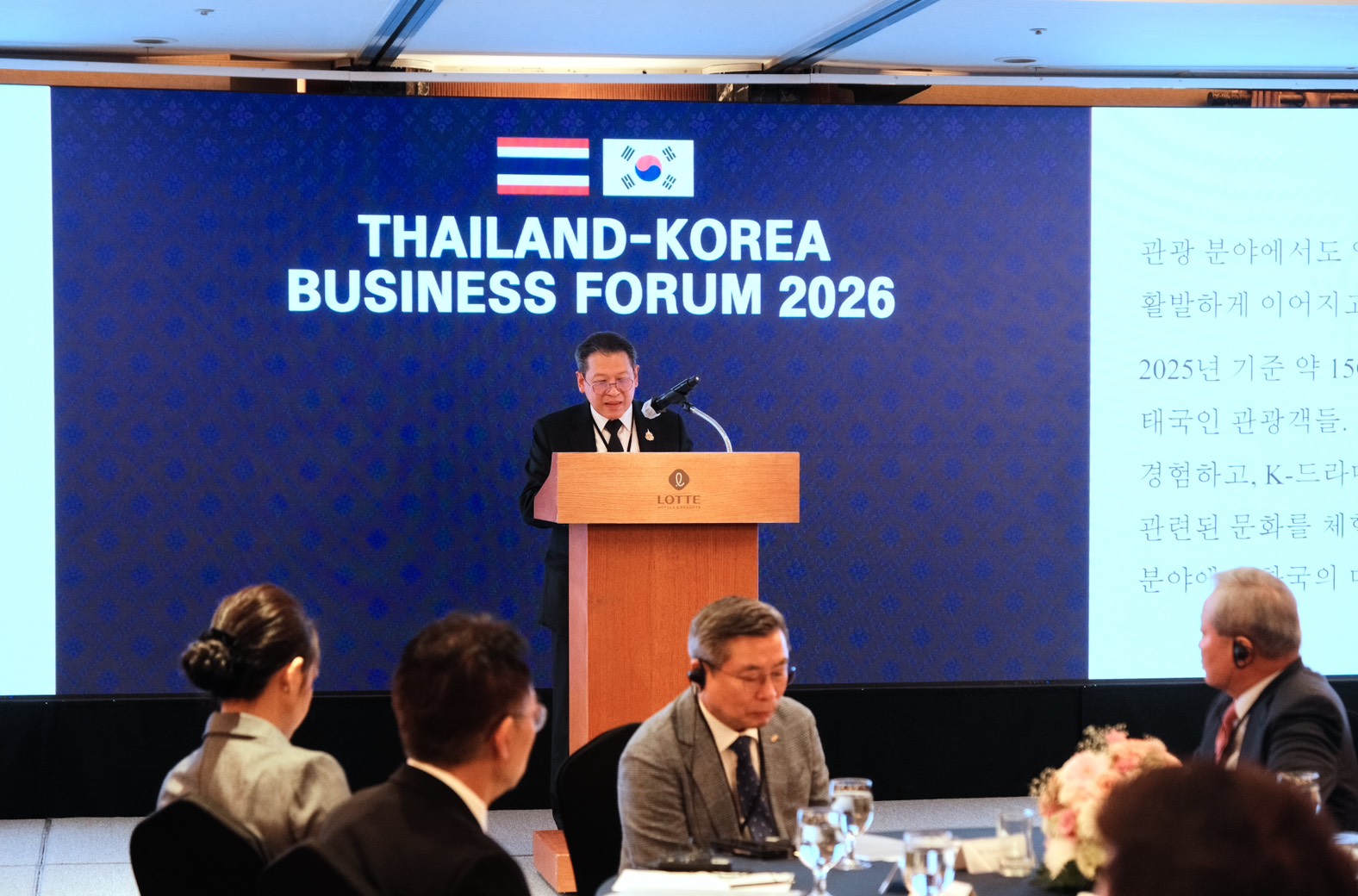
A ministry communiqué confirms that The stability of the Thai Government, according to Vice Minister for Foreign Affairs Sarun Charoensuwan, was presented as a key factor in attracting Korean investment during the Thailand – Korea Business Forum: Biohealth, Medtech, Wellness, and Future Food held on 22 July 2026. This declaration, delivered at the Lotte Hotel in Seoul, immediately frames Thailand’s current political situation – a point consistently absent from official messaging – as a critical element of its broader economic strategy. The statement matters because Korea’s investment decisions are inherently linked to perceived governance risk, and Charoensuwan’s focus on governmental stability represents a calculated effort to reassure potential partners navigating an increasingly complex global landscape.
Background
The event itself – a seminar promoting trade and investment in the biotechnology sector – was designed to foster collaboration between Thailand and the Republic of Korea. Senior representatives from both public and private sectors attended, signaling a targeted effort within the Thai government’s 20-Year “5S” Foreign Affairs Masterplan, which prioritizes strategic partnerships with nations like South Korea. The presence of Deputy Prime Minister and Minister of Higher Education, Science, Research and Innovation, Yodchanan Wongsawat, as a keynote speaker further underscored this commitment to bilateral engagement. Crucially, the forum’s focus on “Biohealth, Medtech, Wellness, and Future Food” reflects Thailand’s stated ambitions within its national development strategies – particularly in leveraging innovation for economic growth.
Analysis
Charoensuwan’s commendation of Korea’s rapid economic development implicitly acknowledges a comparative disadvantage faced by Thailand. The emphasis on “good governance” and Thailand’s accession to the Organisation for Economic Co-operation and Development (OECD) suggests a deliberate alignment with Western standards, a move that could significantly alter Thailand’s regulatory environment. This ambition – if implemented as described – represents a long-term strategic shift, one not fully articulated by the Ministry of Foreign Affairs in its broader communications. The statement does not address potential friction between these aspirations and existing Thai regulations concerning investment or trade. Furthermore, it is unclear whether this acceleration towards OECD membership will be met with resistance from domestic industries accustomed to different operating models.
Implications
The event’s implications extend beyond bilateral trade; they carry considerable weight for regional stability and Thailand’s position within the global economic order. The stated commitment to OECD accession – a process notoriously complex and demanding – signals a willingness to subject Thai economic policies to rigorous scrutiny. Should the visit yield further commitments, it would necessitate significant reforms across sectors, including healthcare, pharmaceuticals, and potentially agriculture. This pursuit of OECD membership also carries implications for trade agreements with other nations, particularly those within ASEAN, where differing standards could create barriers to integration. The statement does not address potential tensions arising from this realignment.
Outlook
If the visit successfully catalyzes investment flows into Thailand’s biotech sector – a conditional outcome – it would represent a significant early win for the Thai government’s foreign policy objectives. Should the OECD accession process proceed smoothly, and the reforms required to meet OECD standards be implemented effectively, Thailand could unlock substantial foreign capital and enhance its global competitiveness. However, should delays or complications arise within the OECD framework, or if domestic resistance to regulatory changes proves significant, Thailand’s attractiveness as an investment destination would diminish, potentially jeopardizing the economic benefits anticipated from this forum.
Conclusion
Charoensuwan’s emphasis on governmental stability and OECD accession leaves open a critical question: can Thailand genuinely reconcile its traditional development model with the stringent requirements of Western governance standards? The trajectory of this ambition remains uncertain, dependent entirely on the outcome of ongoing negotiations within the OECD framework.