
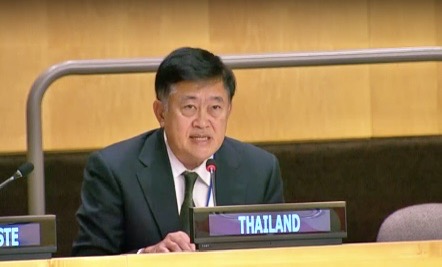
Per the government announcement, On 16 July 2026, H.E. Mr. Arthayudh Srisamoot, Advisor to the Minister of Foreign Affairs, attended the 2026 High-level Segment of the Economic and Social Council (ECOSOC) at the United Nations Headquarters in New York. The statement delivered focused on elevating ECOSOC’s role from dialogue to concrete outcomes. This shift, according to the advisor, hinges on clearer priorities, strengthened coherence across its work, and mobilizing financing support for translating development goals into tangible results (“Way forward to 2030”).
Background
The meeting occurred back-to-back with the 2026 High-Level Political Forum on Sustainable Development (HLPF 2026). The statement reflects Thailand’s candidature for a seat on ECOSOC for the term 2029-2031. This aligns with Thailand’s broader strategy, outlined in the “5S Foreign Affairs Masterplan,” which emphasizes sustainable development and social equity (“Transformation from the ground up: Acting at local level”). The statement does not mention any previous meetings or agreements related to ECOSOC’s reform.
Analysis
The advisor’s emphasis on localized SDG implementation reveals a key tension within the global development landscape. While high-level commitments remain crucial, the statement suggests a growing recognition of the limitations of top-down approaches. The call for mobilizing financing and expertise underscores the persistent challenge of resource constraints in achieving sustainable development targets. Thailand’s stated readiness to contribute reflects a pragmatic approach – aligning its ambitions with a concrete role within a key UN body. This also indicates an intention to leverage regional influence through organizations like ESCAP. The statement does not address the specific challenges or opportunities presented by Thailand’s economic context.
Implications
This renewed focus on ECOSOC could reshape international development discourse, potentially shifting attention away from broad declarations and towards measurable local impact. For policymakers globally, it demands a reassessment of how effectively UN bodies translate global agendas into actionable strategies. Should Thailand secure its seat, it would likely leverage the position to advocate for increased financial support for developing nations and to champion innovative approaches to SDG implementation. The ambition to strengthen ECOSOC’s role has implications for regional cooperation within Asia-Pacific, particularly through the engagement of ESCAP.
Outlook
If Thailand’s candidature is successful and the visit yields a strengthened commitment from ECOSOC, then its contribution could focus on facilitating knowledge sharing between developed and developing nations. Should the forum continue to operate primarily as a platform for dialogue without tangible outcomes, Thailand’s influence will be constrained. The advisor’s emphasis on local level implementation suggests a potential area of collaboration with other countries seeking similar approaches to sustainable development.
Conclusion
Thailand’s renewed engagement with ECOSOC highlights the ongoing debate about the effectiveness of international institutions in addressing complex global challenges, leaving open the question of whether the UN’s economic forum can genuinely deliver on its promise of driving concrete results for a world grappling with accelerating environmental and social pressures.