
News
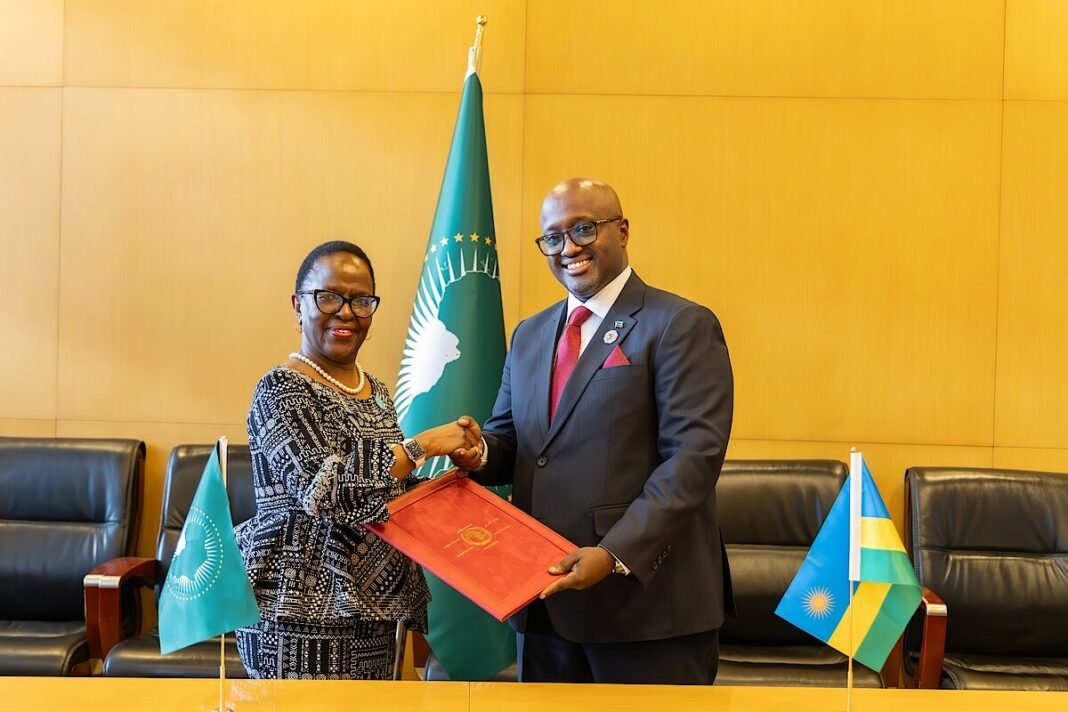
Addis Ababa, 29 July 2026 – Minister Olivier J.P. Nduhungirehe signed the African Union convention on ending violence against women and girls (AU-CEVAWG) making Rwanda the 9th signatory country. The convention provides a comprehensive continental legal framework to prevent and respond to all forms of violence against women and girls. Rwanda supports the convention as it aligns with Rwanda’s vision and National Gender Policy.
Background
The 49th Ordinary Session of the Executive Council of African Union convened in Addis Ababa, featuring Minister Nduhungirehe’s participation alongside discussions on various continental initiatives. Prior to this event, Rwanda had already engaged in diplomatic activity—a visit to Tanzania followed by interactions with Itorero Indangamirwa participants and engagement with South Africa regarding normalizing relations. The government also addressed condolences to Qatar via a signed Book of Condolence. Furthermore, Minister Nduhungirehe attended the 2026 Korea-Africa Foreign Ministers’ Meeting and briefed members of the diplomatic corps in Rwanda on diplomatic developments.
Analysis
The signing of this convention represents an affirmation of Rwanda’s stated commitment to gender equality. This aligns with the government’s National Gender Policy, suggesting a prioritization of addressing violence against women and girls within the country’s development agenda. The statement does not address the potential impact of this convention on existing Rwandan legislation or the specific mechanisms for its enforcement. If implemented as described, the convention could create pressure to align domestic laws with international standards, but the absence of detail raises questions about the extent of this commitment. The government’s support signals a willingness to engage in continental efforts, although the lack of information regarding resources allocated and concrete action plans remains a concern.
Implications
This development has implications for regional stability, particularly within the African Union’s framework for combating gender-based violence. Rwanda’s participation could influence other nations to adopt similar measures. The convention’s adoption also raises questions about trade relations—if implemented as described—it could trigger scrutiny from international partners regarding Rwanda’s human rights record and compliance with international norms. There is no mention of any impact on the country’s security sector or its engagement with regional peacekeeping operations, a gap that warrants attention.
Outlook
Should the visit to Tanzania yield further diplomatic engagements, increased pressure may arise for Rwanda to demonstrate tangible progress in addressing violence against women and girls. If the convention’s provisions are fully implemented, the government will need to invest in capacity building and resource allocation to support its enforcement. If implementation remains vague, the potential for criticism from international bodies regarding Rwanda’s commitment to human rights standards increases; however, the statement does not address this possibility explicitly.
Conclusion
Rwanda’s alignment with the AU convention on ending violence against women and girls highlights a stated policy priority. The question remains: will this translate into demonstrable action or remain simply a symbolic gesture?