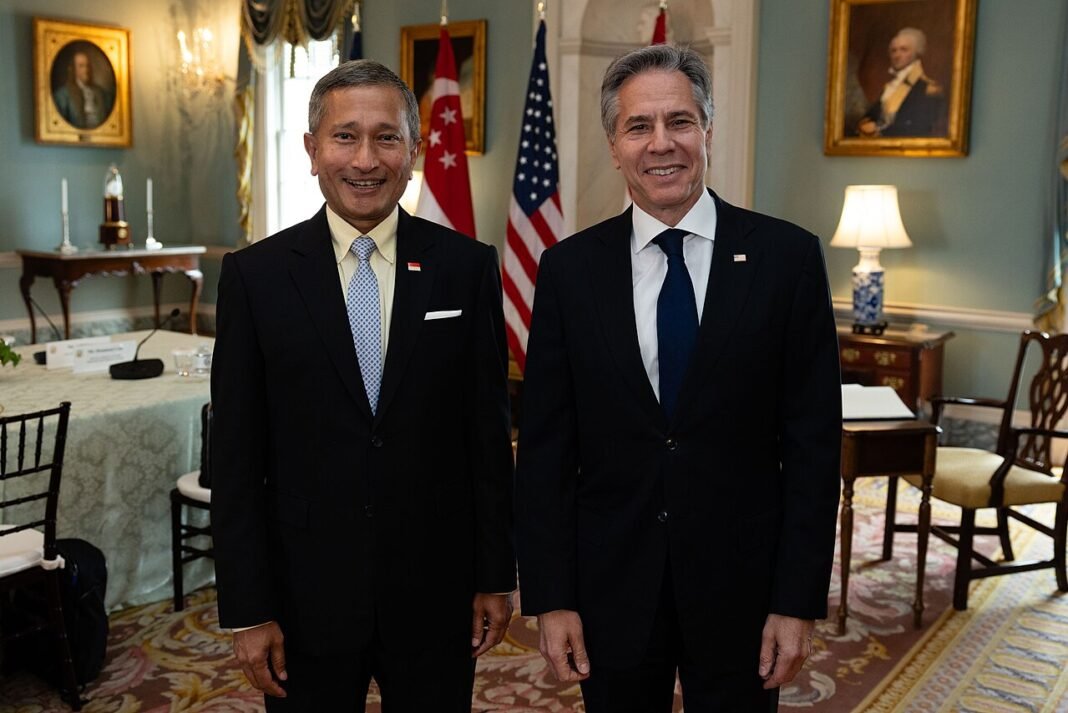
Reporting in a government statement, The most consequential concrete detail from the press release is the third visit by Minister for Foreign Affairs Dr Vivian Balakrishnan to Indonesia this year—a fact that underscores the depth and sustained priority of Singapore’s engagement with Jakarta. This repeated engagement, coupled with the signing of 26 agreements in July, suggests a deliberate effort to solidify a relationship increasingly framed as vital to both nations’ long-term stability and prosperity. The statement’s emphasis on intertwined futures—Singapore’s success dependent on Indonesia’s stability, and vice versa—highlights a pragmatic, if somewhat understated, recognition of mutual vulnerability.

Background
The press release situates this meeting within a broader context of intensified diplomatic activity. Prior to this joint press conference, Dr Balakrishnan had already undertaken a series of meetings with Indonesian President Prabowo Subianto, beginning with the Singapore-Indonesia Leaders’ Retreat in July. This retreat culminated in the signing of 26 agreements, spanning diverse sectors including economy, energy, defence, digital cooperation, the environment, and human capital development. The statement references the ASEAN Secretariat’s location in Jakarta, a historical point of alignment, and acknowledges Indonesia’s role as a founding member of ASEAN. The reference to El Niño as a ‘natural climatic phenomenon’ is notable for its careful framing, immediately followed by an assertion that the ‘haze’ is not a natural phenomenon, a deliberate attempt to shift responsibility.
Analysis
The core incentive driving Singapore’s engagement with Indonesia is clearly a calculation of mutual benefit. Singapore’s significant foreign investment in Indonesia – topping the list since 2014 – represents a strategic bet on Indonesia’s economic potential. The statement’s assertion that Singapore’s success depends on a prosperous, stable Indonesia reveals a fundamental understanding of geopolitical interdependence. The focus on ASEAN, particularly Singapore’s upcoming chairmanship in 2027, suggests a desire to leverage this relationship to enhance Singapore’s regional influence. The repeated emphasis on a ‘fruitful, sincere conversation’ is a carefully calibrated diplomatic signal, attempting to manage expectations while conveying a commitment to collaboration. The contradictory framing of the El Niño crisis – a natural phenomenon versus human-caused fires – reveals a strategic attempt to avoid directly confronting Indonesia over the haze issue, instead framing it as a shared responsibility.
Implications
This meeting has significant implications for regional stability. Indonesia’s role as a major player in Southeast Asia, coupled with Singapore’s economic influence, means any divergence in their relationships could have ripple effects throughout the ASEAN bloc. The commitment to building on the momentum of the Leaders’ Retreat suggests a desire to avoid a potential rift stemming from disagreements over the haze crisis. The planned establishment of a ‘Joint Task Force’ is a key step towards formalizing cooperation and ensuring consistent action. The potential for increased defence cooperation, hinted at through the agreement portfolio, could further strengthen the security dimension of the relationship. The deepening trade ties, underpinned by Singapore’s foreign investment, could boost Indonesia’s economic growth and contribute to regional integration.
Outlook
Should the visit yield a concrete agreement on enhanced haze monitoring and prevention strategies, the immediate risk of further environmental damage could be mitigated. If the Joint Task Force proves effective in coordinating responses to future crises, it could serve as a model for regional cooperation on transboundary issues. However, if the two countries remain unable to reach a consensus on the root causes of the haze and hold responsible parties accountable, the relationship could suffer a setback, undermining the strategic rationale for the increased engagement. The success of Singapore’s ASEAN chairmanship in 2027 hinges, in part, on its ability to leverage its relationship with Indonesia to foster greater regional unity and resilience.
Conclusion
The Jakarta summit underscored a commitment to an enduring partnership, but the underlying tensions – most notably the El Niño crisis and the accountability of polluting companies – remain unresolved. The long-term success of this relationship will depend on the ability of both nations to translate rhetorical commitments into tangible action, particularly in addressing the pressing environmental challenges that threaten their shared future.
Sources & Further Reading
- Official press release
- Foreign ministry source
- 13 October 202613 October 2026Joint Statement Between the Republic of Singapore and the Republic of Finland on Foreign Policy and Cooperation in the Age of AI, 13 October 2026CountryFinlandJoint Statement Between the Republic of Singapore and the Republic of Finland on Foreign Policy and Cooperation in the Age of AI, 13 October 2026Press Statements (13 October)
- 19 September 2026Official Visit by Minister for Foreign Affairs Dr Vivian Balakrishnan to Ottawa, Canada, 17 to 18 September 2026CountryCanadaOfficial Visit by Minister for Foreign Affairs Dr Vivian Balakrishnan to Ottawa, Canada, 17 to 18 September 2026Press Statements (19 Septemb)
- 23 October 202623 October 2026Transcript of Remarks by Minister for Foreign Affairs Dr Vivian Balakrishnan at the NUH International Ophthalmology Scientific Congress 2026, 23 October 2026Transcript of Remarks by Minister for Foreign Affairs Dr Vivian Balakrishnan at the NUH International Ophthalmology Scientific Congress 2026, 23 October 2026Transcripts (23 October)