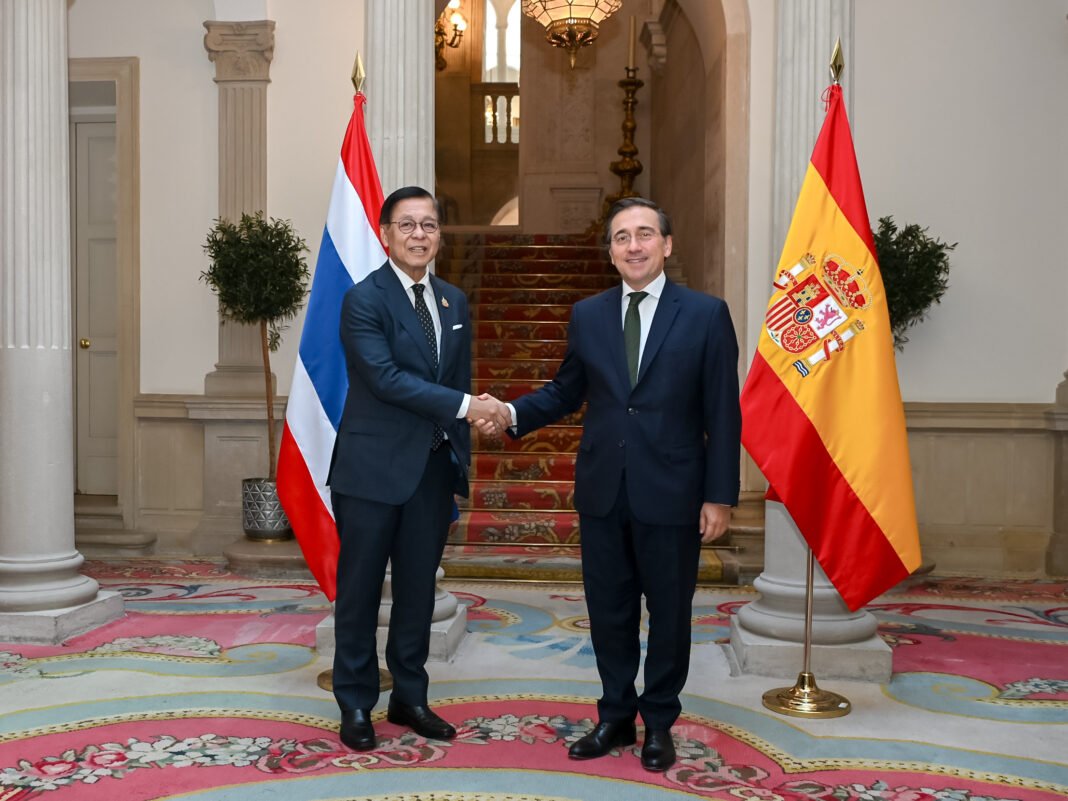
On 21 October 2026, Deputy Prime Minister and Minister of Foreign Affairs, Sihasak Phuangketkeow, alongside Minister for Foreign Affairs, European Union and Cooperation of Spain, José Manuel Albares Bueno, co-chaired the 8th Thailand – Spain Political Consultations in Madrid. This marked the first time the meeting was elevated to the ministerial level, reflecting both countries’ increasing interest in strengthening their bilateral relationship. The significance lies in the direct engagement of top diplomats, a shift from previous, lower-level discussions, according to the statement. (Read the full statement.)
Background
The Thailand – Spain Political Consultations have been a regular feature of Thailand’s foreign policy since 2018, established to foster deeper ties. Previous iterations of these consultations, as documented in the Ministry of Foreign Affairs archive, primarily focused on consular matters and broader regional cooperation. The 20-Year “5S” Foreign Affairs Masterplan, launched in 2018, prioritizes Security, Stability, Sustainability, Service, and Synergy – elements the statement indicates are now being directly addressed through this elevated dialogue. Prior statements, such as the visit to Malaysia in September 2026, demonstrate a continued effort to broaden Thailand’s diplomatic engagement.
Analysis
The elevation of this meeting to the ministerial level suggests a strategic recalibration within Thailand’s foreign policy. The stated focus on “political and security cooperation” – including promoting high-level exchanges – indicates a desire to move beyond traditional diplomatic courtesies and engage in more substantive discussions. The inclusion of cybersecurity and combating online scams highlights emerging security concerns, while the emphasis on renewable energy, medical technology, nanotechnology, and infrastructure development signals Thailand’s ambitions for economic diversification. The support for ASEAN – EU cooperation and Thailand’s accession to the OECD reflects a broader commitment to regional integration and economic advancement. This move appears to be driven by a recognition of Spain’s growing influence within the European Union and a desire to secure Spain’s support for Thailand’s key policy objectives.
Implications
For Thailand, the elevated consultations represent an opportunity to advance its strategic interests within the EU. Securing Spain’s support for the Thailand – EU Free Trade Agreement is a key priority, given the potential for increased trade and investment. The discussions on visa exemption for Thai nationals travelling to the Schengen Area could significantly boost tourism, a vital sector for Thailand’s economy. Furthermore, the focus on infrastructure development could unlock access to European investment and technological expertise. Regionally, the engagement with Spain strengthens Thailand’s ties within ASEAN and signals a commitment to multilateral cooperation. Should the visit yield support for Thailand’s OECD accession, it would represent a significant step towards economic modernization.
Outlook
If the discussions surrounding infrastructure and transport cooperation are successful, and a memorandum of understanding can be finalized, it would represent a tangible commitment to joint development projects. Should Spain continue to advocate for Thailand’s visa exemption requests, it could significantly alleviate travel barriers for Thai citizens, boosting tourism and facilitating business connections. However, the situation regarding Thailand and Cambodia remains a persistent concern, and the statement does not address the ongoing tensions. The continued engagement with the Russia – Ukraine conflict and the situation in the Middle East suggests that Thailand will remain a participant in international diplomacy, seeking to mediate and promote stability.
Conclusion
The Madrid meeting underscores a shift in Thailand’s foreign policy towards a more proactive and targeted engagement with key partners. The success of these consultations will hinge on translating diplomatic momentum into concrete agreements, leaving open the question of whether Thailand can translate this elevated dialogue into tangible benefits for its economy and strategic objectives.
Sources & Further Reading
- Official press release
- Foreign ministry source
- Deputy Prime Minister and Minister of Foreign Affairs to pay official visit to Lao PDR (30 Sep 202)
- Deputy Permanent Secretary for Foreign Affairs co-chairs the Second Round of Thailand – Kuwait Political Consultations (30 Sep 202)
- Deputy Prime Minister and Minister of Foreign Affairs to pay a working visit to Malaysia (4 Sep 2026)