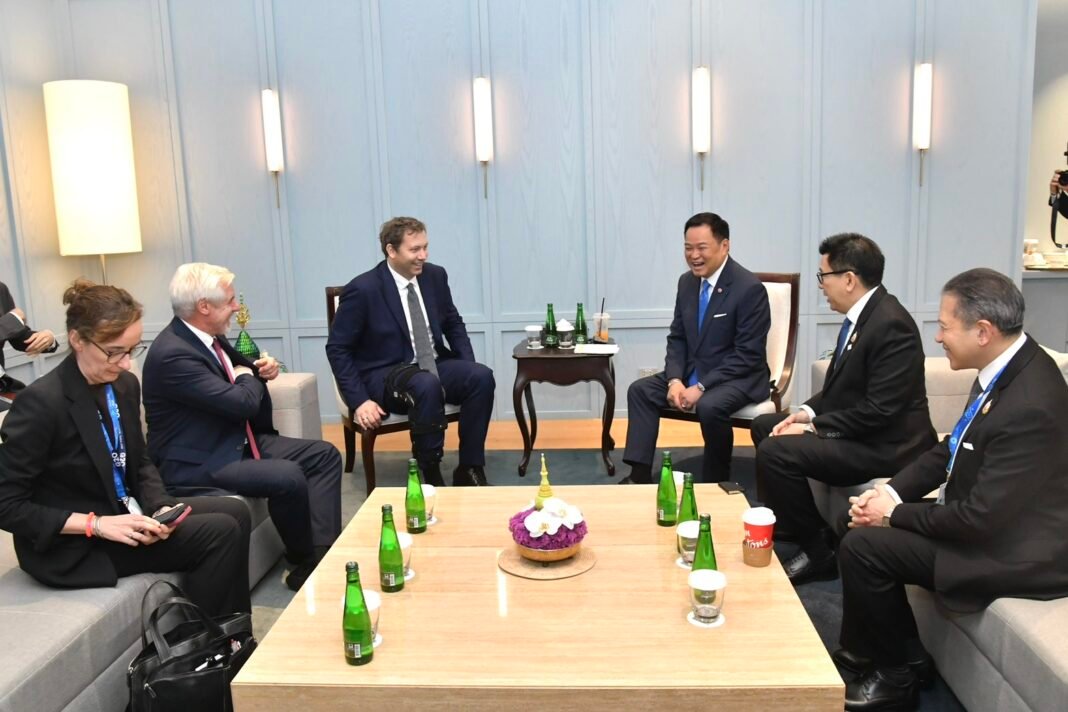
As set out in a formal announcement, On 16 October 2026, H.E. Mr. Sarun Charoensuwan, Vice Minister for Foreign Affairs, participated in a meeting between H.E. Mr. Anutin Charnvirakul, Prime Minister, and H.E. Mr. Lars Klingbeil, Vice Chancellor of Germany and Federal Minister of Finance. The statement does not mention the specific location of the meeting, but it occurred on the sidelines of the IMF-World Bank Group Annual Meetings 2026. This event matters because it represents a formal engagement between Thailand and Germany, a key trading partner, to further strengthen their bilateral relationship. The statement does not elaborate on the scope of the discussions, but it highlights a shared commitment to cooperation across a range of sectors.
Background
The Ministry of Foreign Affairs’ press release indicates a continued focus on high-level exchanges as a cornerstone of Thailand’s foreign policy. The statement references previous engagements, including a visit by the Deputy Prime Minister and Minister of Foreign Affairs to Laos in September 2026, and a working visit to Malaysia planned for the same month. Furthermore, the release cites a statement from September 2026 regarding a visit to Malaysia, and a prior statement from September 2026 concerning a visit to Laos. These recurring engagements demonstrate a sustained diplomatic effort to cultivate and maintain relationships with key international partners. The 20-Year “5S” Foreign Affairs Masterplan, outlined in the Ministry’s documentation, prioritizes strategic partnerships, suggesting this meeting aligns with broader strategic objectives. The statement does not address the specific goals of these ongoing diplomatic efforts beyond a general commitment to strengthening ties.
Analysis
The meeting’s focus on investment and workforce development suggests a strategic effort by Thailand to attract foreign capital and enhance the skills of its workforce. The emphasis on “advanced technologies and future industries” indicates a recognition of Thailand’s need to adapt to evolving global economic trends. The reference to vocational education directly addresses a recognized skills gap within the Thai labour market. The statement does not address the potential economic implications of attracting foreign investment. The inclusion of “people-to-people exchanges” points to a broader effort to foster cultural understanding and strengthen bilateral relations beyond purely economic considerations. The discussion on ASEAN cooperation suggests Thailand’s intention to leverage its position within ASEAN to promote regional trade and investment. The statement does not address the potential challenges associated with Thailand’s accession to the OECD, nor does it detail the specific areas of cooperation with Germany on this matter. The event’s timing, coinciding with the IMF-World Bank Group Annual Meetings, provides a valuable platform for bilateral discussions and networking.
Implications
For policymakers, the meeting signals a willingness to engage with Germany on key economic priorities, particularly in the technology sector. Should the visit yield concrete commitments regarding investment, it would represent a positive step for Thailand’s efforts to diversify its economy. The discussions on the Thailand-EU Free Trade Agreement (FTA) and OECD accession underscore Thailand’s ongoing commitment to regional integration and economic reforms. The meeting could potentially strengthen Thailand’s position within ASEAN, particularly concerning trade and investment opportunities. The statement does not address the potential impact of these discussions on Thailand’s trade balance or its overall economic growth. The focus on workforce development has implications for educational policies and training programs within Thailand.
Outlook
If the visit yields agreements regarding investment in advanced technologies, Thailand could potentially attract significant foreign capital and create new high-skilled jobs. Should the discussions on the FTA and OECD accession progress effectively, it would bolster Thailand’s economic competitiveness and attract further foreign investment. The statement does not address the potential challenges or obstacles that Thailand might face in securing these agreements. The continued focus on ASEAN cooperation suggests a long-term commitment to regional integration and trade. The meeting’s success will depend on Thailand’s ability to demonstrate its commitment to reforms and its openness to foreign investment.
Conclusion
The meeting between the Thai and German officials represents a continuation of Thailand’s efforts to secure bilateral partnerships. The statement does not offer a definitive assessment of the meeting’s success or its long-term implications. However, it does highlight the ongoing importance of strategic engagement with key international partners to support Thailand’s economic development and regional integration.
Sources & Further Reading
- Official press release
- Foreign ministry source
- Deputy Prime Minister and Minister of Foreign Affairs to pay official visit to Lao PDR (30 Sep 202)
- Ministry of Foreign Affairs participates in the UK in Thailand Football Tournament 2026 (9 Sep 2026)
- Deputy Prime Minister and Minister of Foreign Affairs to pay a working visit to Malaysia (4 Sep 2026)