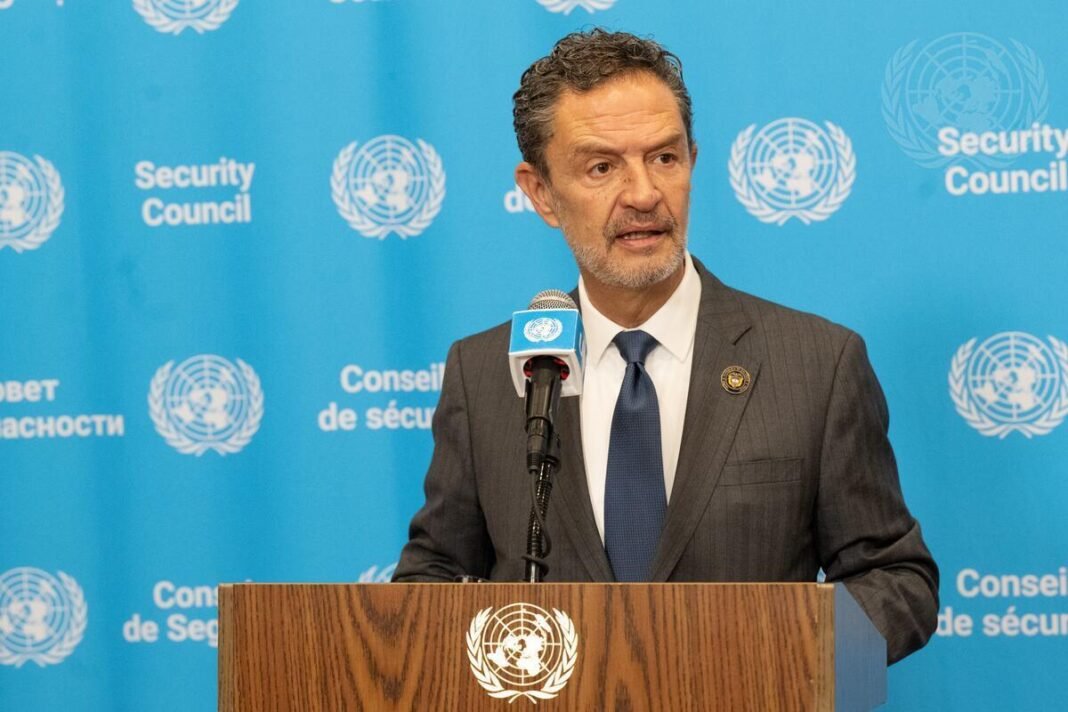
As set out in a formal announcement, Nueva York, 12 de octubre de 2026. In his first intervention before the United Nations Security Council, Foreign Minister Omar Bula Escobar stated that Colombia is convinced that security is not contrary to peace; rather, it is a necessary condition to achieve it. This assertion, made during a meeting with council members, reflects a fundamental disagreement with the trajectory of the 2016 Peace Accord and the government’s assessment of its implementation. The statement matters because it signals a renewed, and arguably more forceful, commitment to prioritizing security as a prerequisite for any further progress towards lasting peace, a position directly challenged by those advocating for a purely political approach to the conflict.

Background
The statement follows a meeting with Abelardo De La Espriella, the President of Colombia, and comes amid ongoing debate regarding the implementation of the Final Agreement signed between the Colombian State and the FARC-EP in 2016. The agreement, intended to bring an end to five decades of armed conflict, has faced persistent challenges related to disarmament, demobilization, and rural development. The current administration, elected with a significant mandate reflecting widespread dissatisfaction with the peace process, is now openly questioning the effectiveness of the accord’s execution. The meeting occurred within the context of the United Nations Security Council’s ongoing scrutiny of Colombia’s progress and its concerns regarding security and human rights.
Analysis
Bula’s intervention reveals a significant shift in incentives. The government, under President De La Espriella, is prioritizing a security-first approach, likely driven by a perception of failure within the current peace process. The cited figures – 132,930 homicides since 2016, over 2,750 kidnappings, and a five-fold increase in armed groups – paint a stark picture of ongoing instability and demonstrate the government’s argument that the current peace process has not delivered tangible benefits to the Colombian people. The fact that the government was elected on a platform of dissatisfaction with the existing peace is crucial. The data presented – 300% increase in child recruitment, 253,000 hectares of coca cultivation, and 2,664 tons of cocaine production – further underscore the government’s justification for prioritizing security operations. This suggests a strategy to regain territorial control and combat organized crime, believing that a secure environment is a prerequisite for any meaningful political reconciliation.
Implications
The implications of Bula’s address extend beyond Colombia’s borders. The renewed emphasis on security could strain relations with international actors who advocate for a purely political solution and have long criticized the Colombian government’s reliance on military force. The shift also carries significant implications for regional stability, particularly given the involvement of transnational criminal organizations and the potential for spillover effects into neighboring countries. Furthermore, the proposed refocusing of the UN Mission’s mandate – specifically, concentrating on reincorporation and security guarantees – demonstrates a desire to reassert Colombian sovereignty and control over the peace process, potentially reducing the role of international observers. The increased focus on coca cultivation and cocaine production presents a challenge for trade relations, particularly with countries that have strict anti-narcotics policies.
Outlook
Should the visit yield no immediate changes in the UN Security Council’s approach, the Colombian government will likely continue to pursue a security-focused strategy. If the government’s operational results improve, as they have indicated, this will strengthen their argument for a more assertive approach. If the security situation deteriorates further – as the presented data suggests is possible – the government may face increasing domestic pressure to re-evaluate its strategy. The proposed refocusing of the UN Mission, should it be adopted, will be a key test of international support for Colombia’s peace efforts.
Conclusion
Bula’s uncompromising stance underscores a fundamental question: can Colombia achieve lasting peace without simultaneously addressing the underlying security challenges that fuel the conflict? The statement’s focus on tangible results – security, control, and a reduction in illicit activities – suggests a pragmatic, if somewhat pessimistic, view of the prospects for a political settlement.