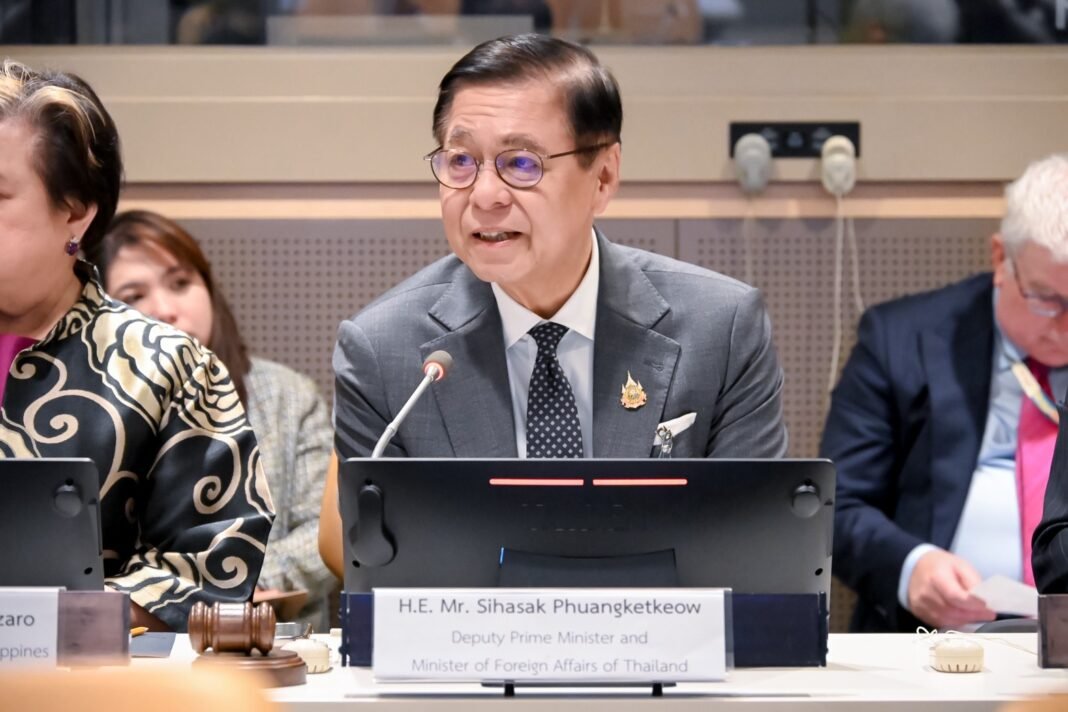
The official readout frames the trip as The announcement of a joint ministerial communiqué, issued on September 24th, 2026, by the French Ministers of Foreign Affairs and Health alongside representatives from Brazil, Indonesia, Norway, Senegal, South Africa, and Thailand, signals a continued commitment to the Global Health Initiative. This event, held on the margins of the eighty-first session of the United Nations General Assembly (UNGA81) in New York, reflects a recognition of the evolving landscape of global health threats and the need for a strengthened multilateral response. The statement’s core purpose is to reaffirm the foundational principles of the Initiative, particularly its role in facilitating consensus and driving action on pressing health issues – a fact underscored by the convening of the UNGA High-level Meeting on Pandemic Prevention, Preparedness and Response.

Background
The Joint Ministerial Communiqué builds upon two previous ministerial communiqués, issued in 2007 and 2017. The 2007 declaration, entitled “Global health: a pressing foreign policy issue of our time,” established the Foreign Policy and Global Health Initiative (FPGH). The 2017 communiqué reiterated the Initiative’s strategic leadership, highlighting its function as a cross-regional forum for addressing global health concerns. This framework, the statement notes, has consistently driven the agenda at the United Nations General Assembly (UNGA) through the annual resolution on important topics of global health and foreign policy. The Ministry of Europe and Foreign Affairs, through Jean-Noel Barrot, Minister, has been involved in this initiative since September 21st, 2026, as evidenced by a meeting with his Indian counterpart. Similarly, the G7 Development Ministers, chaired by Eléonore Caroit, met in New York on September 23rd, 2026, also on the margins of UNGA81.
Analysis
The communiqué’s emphasis on pandemic preparedness reflects a direct response to recent outbreaks, including Hantavirus, Mpox, and Ebola. This suggests a heightened awareness of the potential for emerging infectious diseases and the need for proactive measures. The inclusion of the Pandemic Fund, established in 2022, and the amendments to the International Health Regulations adopted in 2024, demonstrate a tangible effort to translate political commitments into concrete resources and legal frameworks. The statement does not address the level of funding contributed to the Pandemic Fund, nor does it detail the specific changes made to the International Health Regulations. The focus on equitable access to vaccines, therapeutics, and diagnostics underlines a concern about global health inequalities, a persistent challenge highlighted by the FPGH since its inception. The reference to the One Health approach – recognizing interlinkages between human, animal, plant, and ecosystem health – indicates a shift towards a more holistic understanding of disease prevention. The statement does not mention potential challenges or disagreements regarding the implementation of this approach.
Implications
The renewed commitment to multilateralism has implications for France’s foreign policy, particularly in the context of its broader engagement with the United Nations. The strengthening of the WHO’s role is likely to be a key priority for the French government, given the organization’s central position in the global health architecture. This reinforces France’s support for the WHO’s normative and standard-setting functions. The push for the timely conclusion of the WHO Pathogen Access and Benefit-Sharing System (PABS) Annex is crucial for unlocking the full potential of the Pandemic Agreement. Should the Annex be finalized and opened for signature and ratification, it would accelerate the response to future pandemics. The communiqué’s call for strengthened efforts to counter disinformation and misinformation reflects growing concerns about the impact of misinformation on public health. The statement does not outline specific strategies for addressing this challenge.
Outlook
If the visit to New York yields further momentum on the PABS Annex, the French government will likely advocate for its swift adoption at the World Health Assembly (WHA80). Should the UNGA adopt a resolution on One Health, this would mark a significant step towards operationalizing the integrated approach. The ongoing reform process hosted by WHO, and the inclusion of a One Health approach in an internationally legally binding instrument represent key milestones.