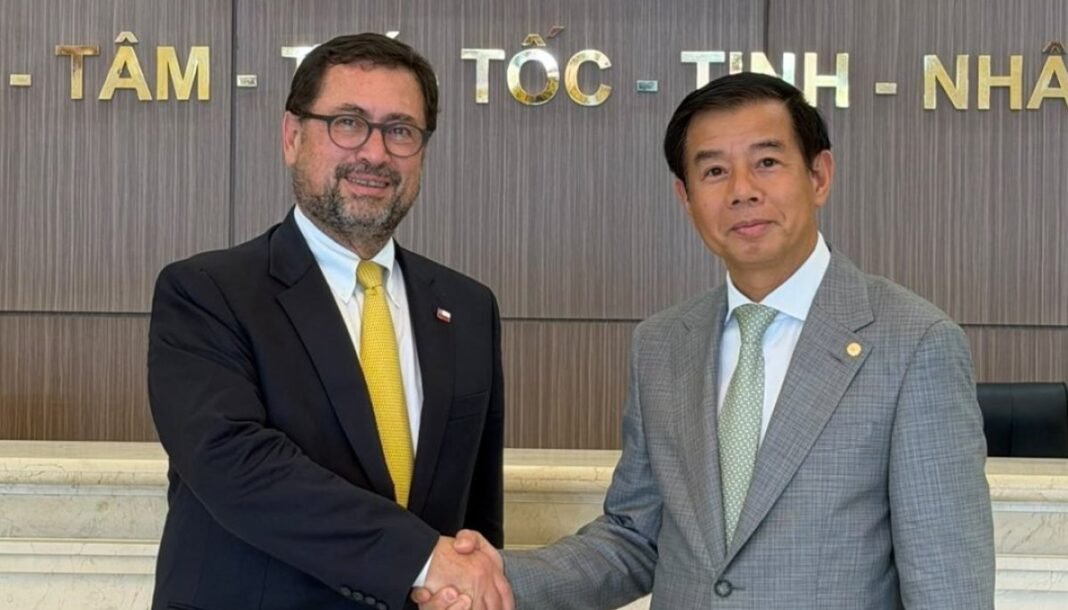
The foreign ministry readout describes The Chilean Minister of Foreign Affairs, Francisco Pérez Mackenna, met this Monday with Vingroup, Vietnam’s largest business conglomerate, and detailed the advantages for investment in Chile. The statement links this meeting to the recently enacted Reconstruction Law, which lowers taxes, provides greater stability and security for investments, and streamlines permitting processes. This suggests a deliberate effort to improve the country’s investment climate, as outlined by the Ministry of Foreign Relatios (MINREL) via press release.

Background
The meeting took place at Vingroup’s headquarters in Hanoi, with Nguyen Viet Quang, the executive vice-chairman and general director of the group, receiving Minister Mackenna. Vingroup is a diversified conglomerate operating across industry and technology, commerce and services, infrastructure, green energies, culture and art, and social entrepreneurship. The company employs over 430,000 people globally and is currently undergoing rapid expansion. This indicates a significant potential partner for Chile’s economic diversification efforts.
The statement does not mention any prior agreements or formal discussions between the two nations beyond the VII Meeting of the Permanent Consultation System with Argentina, which occurred on August 26th, 2026. The Ministry also highlighted its ongoing engagement with other international partners, including the Governor of the International Cooperation Bank of Japan, demonstrating a broader diplomatic strategy.
Analysis
The focus on Vingroup’s investment potential reflects Chile’s apparent desire to attract capital and stimulate economic growth. The Reconstruction Law, as detailed by Minister Mackenna, is intended to create a more favorable environment for foreign businesses, reducing barriers to entry and boosting investor confidence. However, the statement does not address concerns about specific sectors of the Chilean economy or the long-term sustainability of these investment incentives.
Vingroup’s diverse portfolio – spanning industries like technology and infrastructure to green energies and cultural initiatives – suggests a broad range of potential investments for Chile. The conglomerate’s rapid expansion implies a significant influx of capital if the stated benefits materialize. This creates both opportunity and risk, particularly regarding potential strain on Chilean resources or labor markets.
Implications
The visit signals a renewed emphasis on attracting foreign direct investment (FDI) as part of Chile’s broader economic strategy. Should the Reconstruction Law prove effective in attracting capital, it could bolster GDP growth and create employment opportunities. However, this also raises questions about the government’s commitment to diversifying its economy beyond traditional mining exports.
The deepening relationship with Argentina—highlighted by the ongoing Consultation System—suggests a strategic alignment within the Southern Cone. The simultaneous engagement with Japan through the International Cooperation Bank further expands Chile’s network of economic partnerships, potentially offering access to new technologies and investment opportunities. The statement does not address potential implications for trade agreements or regional integration.
Outlook
If the Reconstruction Law successfully reduces bureaucratic hurdles and stimulates investor confidence, Vingroup’s commitment to Chile could lead to significant capital inflows within the next two years. Should this occur, it would bolster the Chilean economy and potentially accelerate infrastructure development. Conversely, if investors remain hesitant due to concerns about regulatory uncertainty or macroeconomic instability, the visit may yield limited tangible results.
Conclusion
The meeting with Vingroup represents a key moment in Chile’s efforts to reposition itself as an investment destination; however, the statement does not articulate specific targets for FDI inflows or outline a clear roadmap for achieving sustainable economic growth. The long-term success of this strategy hinges on the government’s ability to address underlying structural challenges and maintain investor confidence.