
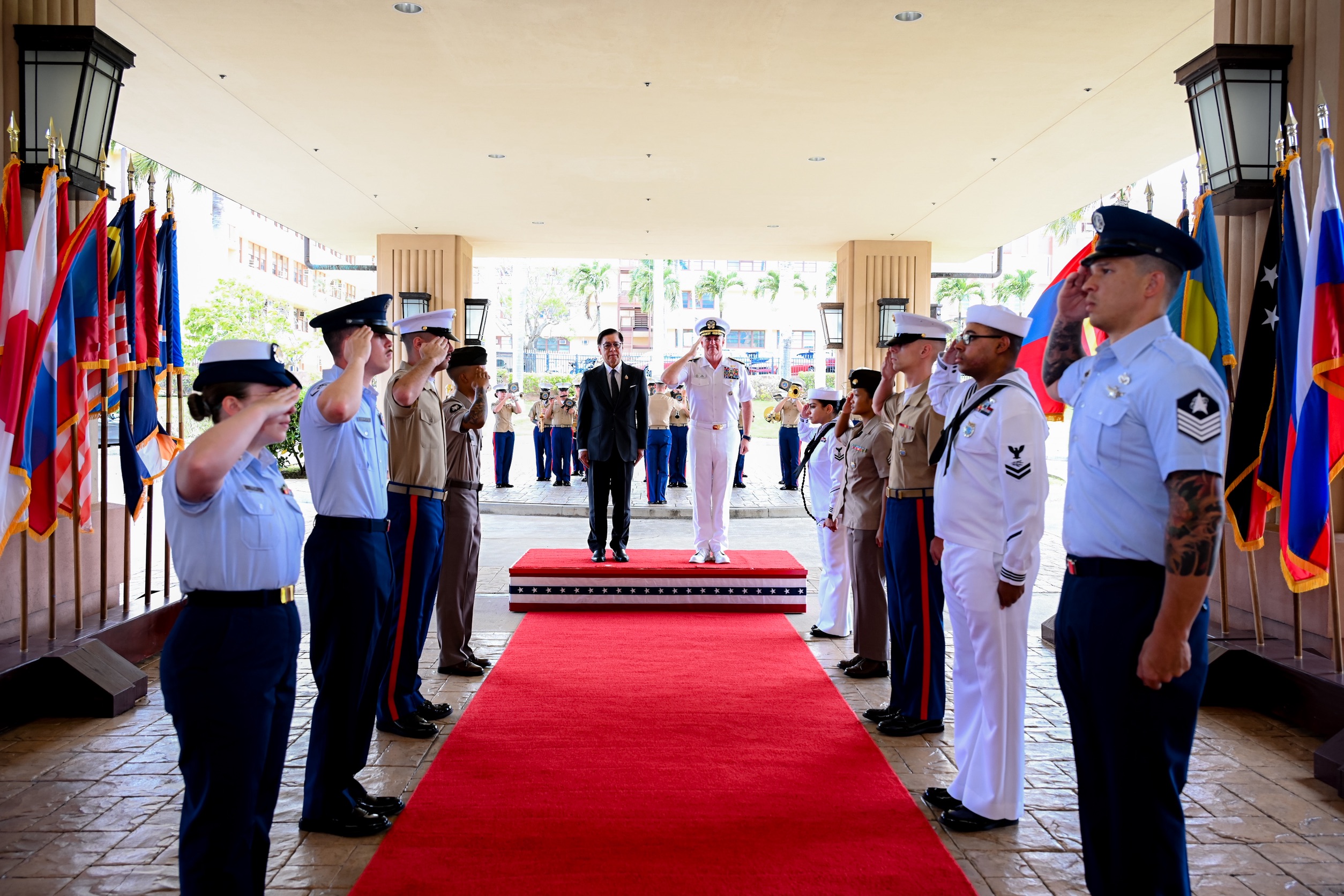
Per the government announcement, On 7 July 2026, Deputy Prime Minister and Minister of Foreign Affairs H.E. Mr. Sihasak Phuangketkeow travelled to Camp H.M. Smith in Honolulu for a meeting with U.S. Pacific Command (USPACOM) Commander Admiral Samuel J. Paparo, as documented by the Thai Ministry of Foreign Affairs here. The visit included an honors ceremony with the Thai and U.S. national anthems and a briefing that featured senior Thai officials – Ambassador Dr. Suriya Chindawongse, Advisor General Nothapol Boonngam, Director‑General Mrs. Hataya Khusakul and Consul‑General Mr. Tor Saralamba.
Background
The ceremony marked the formal opening of the dialogue, after which USPACOM Commander welcomed the Thai delegation and described the meeting as meaningful for the longstanding Thailand‑U.S. alliance. He cited the “evolving international security landscape” and highlighted emerging challenges such as cyber and cognitive warfare. In response, the Deputy Prime Minister underscored the need to make the alliance “more relevant” amid a rapidly shifting geopolitical, geoeconomic and geotechnological environment, and reiterated Thailand’s commitment to regional peace and security.
Both sides exchanged views on regional and global security developments and explored ways to deepen defence and security cooperation, specifically in capacity‑building, modernisation, defence‑industrial‑base collaboration, and the mitigation of online scams.
Analysis
The release indicates that Thailand is seeking expanded cooperation with USPACOM in both conventional and non‑kinetic domains. By mentioning cyber and cognitive warfare, the statement aligns with Thailand’s own concerns about digital vulnerabilities and information operations. The reference to capacity‑building and modernisation suggests an interest in technical assistance or joint training, though the release provides no detail on the scope or timeline of such programmes.
Discussion of defence‑industrial‑base cooperation points to a potential interest in joint production or technology transfer, yet the statement does not disclose any specific projects or procurement pathways. The emphasis on “online scams” reflects a shared perception of hybrid threats that blend criminal activity with strategic manipulation.
The statement does not address Thailand’s existing security arrangements with other partners, nor does it specify funding, implementation mechanisms, or measurable targets for the proposed cooperation.
Implications
If the dialogue translates into concrete initiatives—such as joint cyber‑defence exercises, technology sharing for modernising Thailand’s armed forces, or coordinated actions against online fraud—Bangkok could see measurable gains in operational capability and a clearer signal of U.S. support. Conversely, the absence of detailed agreements means that, for the time being, the visit remains a diplomatic reaffirmation without immediate material impact.
The focus on emerging security challenges may influence regional actors that monitor the balance of capabilities between major powers. However, the statement does not mention any broader ASEAN coordination or the role of other external partners.
Outlook
Should future engagements build on the themes identified on 7 July—adding budgets, timelines, or joint‑venture structures—the Thailand‑U.S. partnership could serve as a model for other ASEAN members seeking similar defence‑industrial collaboration. If, instead, the discussions remain at the level of statements, the partnership’s relevance could be questioned by domestic observers who view the outreach as primarily symbolic.
The statement does not address potential shifts in U.S. strategic priorities that might affect the continuity of support, leaving the durability of any planned cooperation uncertain.
Conclusion
The meeting underscores Thailand’s intent to align its security posture with emerging threats while preserving strategic flexibility. Whether the pledge to make the alliance “more relevant” will culminate in tangible capabilities depends on the development of concrete programmes beyond the diplomatic language of the press release.