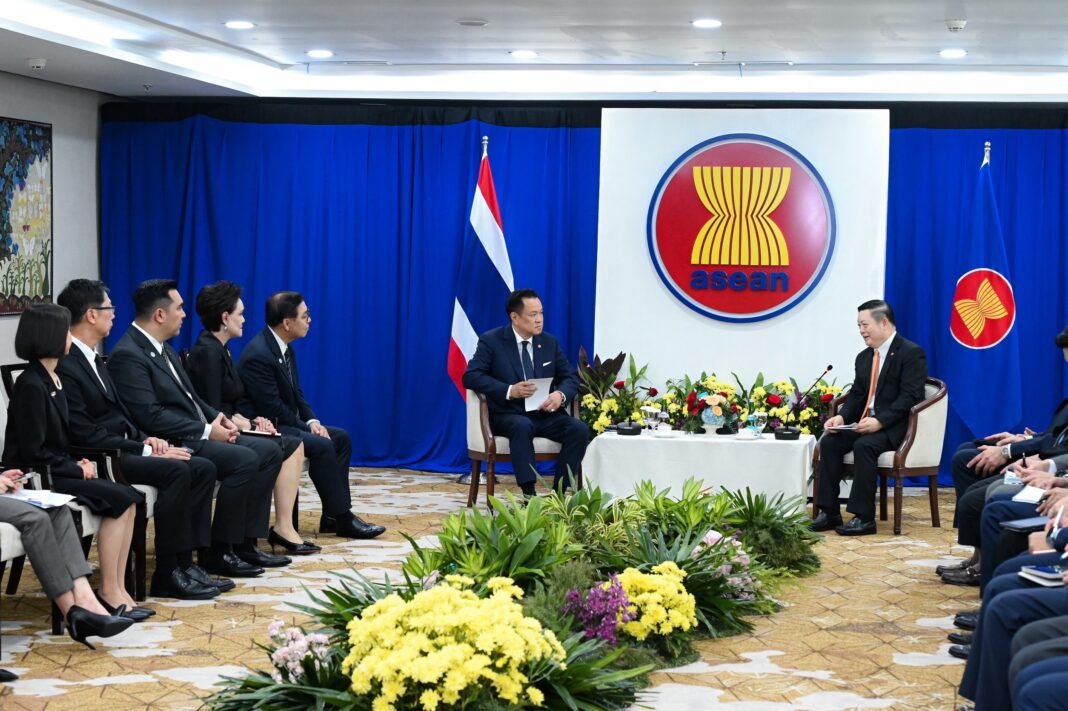
Background: The 2nd Leaders’ Consultation was co-chaired by the Prime Minister of Thailand and the President of Indonesia during this visit. This consultation followed an agreement to develop a roadmap for strategic partnership between the two nations spanning 2026 – 2030. The statement does not mention any previous consultations or agreements that preceded this event. The core objectives outlined in the newly adopted Roadmap encompass food security, energy security, tourism, people-to-people relations, and cooperation on education. Crucially, it also identifies political and security cooperation as a key priority, specifically focusing on defence collaboration and combating transnational crimes, with an emphasis on addressing online scams. This signals a broadening of bilateral engagement beyond purely economic considerations.
Analysis: The stated intent to achieve a $23 billion trade target by 2030 is predicated on several factors – Indonesia’s demographic advantages, its burgeoning middle class, and the relative underdevelopment of Thailand’s manufacturing sector. The emphasis on investment facilitation suggests an effort to attract significant capital inflows, though the statement does not address potential obstacles such as regulatory hurdles or investor sentiment. If implemented as described, this partnership could bolster Thailand’s economic growth but simultaneously concentrates risk in sectors susceptible to global market fluctuations. The inclusion of defence cooperation and combating transnational crimes reflects a growing recognition within both governments of shared security challenges, particularly those related to digital crime. This suggests a strategic alignment on regional stability rather than solely pursuing trade opportunities.
Implications: For policymakers, the deepening engagement with Indonesia carries significant implications for Thailand’s foreign policy strategy. The focus on food and energy security underscores a vulnerability to global supply chain disruptions and necessitates proactive measures in these sectors. Should the investment facilitation efforts succeed, it could alleviate some of Thailand’s economic pressures but also potentially exacerbate existing inequalities. The increased defence cooperation, particularly concerning transnational crimes, has implications for regional security architecture and requires careful calibration with ASEAN partners. Trade agreements with Indonesia will likely shape Thailand’s broader trade relationships within Southeast Asia and beyond.
Outlook: If the Leaders’ Consultation yields a concrete plan for investment promotion, it could accelerate economic growth in both countries. Should the defence cooperation initiative be successfully implemented, it would strengthen regional security dynamics, contingent on continued collaboration with ASEAN members. The success of this partnership hinges on the ability to address potential challenges related to regulatory frameworks, bureaucratic inefficiencies, and geopolitical tensions – issues the statement does not address.
Conclusion: The Prime Minister’s visit to Indonesia marks a clear step toward broadening Thailand’s strategic partnerships, but the ambitious $23 billion trade target remains a significant undertaking with considerable uncertainty attached. The ultimate test will be whether this engagement translates into tangible economic benefits and sustained security cooperation – questions that remain unanswered.