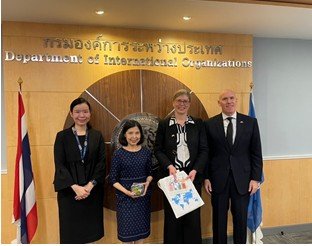
Details in a press release show that On 2 October 2026, Ms. Pinsuda Jayanama, Director-General of the Department of International Organizations, met with Ms. Rachel Moseley, Assistant Secretary of Arms Control and Counter-Proliferation Branch, Department of Foreign Affairs and Trade (DFAT) of Australia. This meeting, as outlined in a Ministry of Foreign Affairs press release, reflects a continued Strategic Partnership between Thailand and Australia. The core purpose of the discussion, according to the statement, was to welcome cooperation in disarmament and non-proliferation of weapons of mass destruction (WMDs), alongside strategic trade control within established frameworks. This emphasis on established frameworks matters because it signals a continuing commitment to adhering to existing international obligations, particularly as the geopolitical landscape shifts, as the statement suggests.
Background
This meeting follows previous engagements between Thai and Australian diplomatic representatives. A statement from 30 September 2026 details a meeting between Ms. Jayanama and the Director-General for Global Issues of the Ministry of Foreign Affairs of Japan, highlighting a pattern of engagement focused on international security issues. Furthermore, a prior statement from 10 September 2026 documented a meeting with the OHCHR Regional Representative for Southeast Asia. These interactions demonstrate a sustained diplomatic effort to maintain bilateral cooperation, particularly in areas related to arms control and counter-proliferation, aligning with Thailand’s broader “5S” Foreign Affairs Masterplan – a 20-year strategic framework outlined in the Ministry’s policy statements.
Analysis
The Thai government’s reaffirmation of its obligations under international agreements on disarmament and non-proliferation, as stated in the press release, indicates a prioritization of adhering to existing commitments. This is further underscored by the reference to United Nations Security Council resolutions. The inclusion of “changing geopolitical landscape” suggests a strategic awareness of evolving global security challenges. The meeting with the Australian representative, focusing on “strategic trade control,” implies a recognition of the need to manage export controls and dual-use technologies. The Thai side’s active participation in these discussions suggests a desire to maintain a constructive role in global efforts to promote international peace and security. The statement does not address the specific topics discussed during the meeting, but the context of the Strategic Partnership hints at a shared interest in regional stability and combating illicit weapons proliferation.
Implications
This meeting carries implications for Thailand’s regional standing. Continued collaboration with Australia, a key security partner, reinforces Thailand’s commitment to international norms and standards. The focus on arms control and counter-proliferation aligns with broader ASEAN efforts to manage security threats. The emphasis on “strategic trade control” could influence Thailand’s approach to trade relations with countries involved in WMD proliferation. The meeting does not significantly alter Thailand’s existing trade relationships, but it demonstrates a willingness to engage in dialogue on complex security issues. The statement does not address the potential impact on Thailand’s defense industry or its procurement policies.
Outlook
Should the visit yield further discussions on specific arms control initiatives, Thailand’s commitment to multilateral engagement will be reinforced. If the Australian representative highlights concerns regarding regional proliferation risks, Thailand’s response could involve increased cooperation with ASEAN partners on monitoring and enforcement. If the visit is primarily focused on maintaining existing agreements, the Thai side will likely continue to prioritize adherence to international obligations, reflecting a conservative approach to arms control. The statement does not suggest any immediate changes to Thailand’s foreign policy priorities.
Conclusion
The meeting between Ms. Jayanama and Ms. Moseley represents a procedural step in a long-standing Strategic Partnership, reaffirming a core element of Thailand’s foreign policy: a dedication to international arms control frameworks. The continued dialogue highlights the ongoing need for coordinated efforts to address complex global security challenges, but the press release offers no indication of a fundamental shift in Thailand’s broader strategic outlook.
Sources & Further Reading
- Official press release
- Foreign ministry source
- Director-General of the International Organizations Department meets with OHCHR Regional Representative for Southeast Asia (10 Sep 202)
- Director-General of the International Organizations Department meets with the Director-General for Global Issues of the Ministry of Foreign Affairs of Japan (3 Oct 2026)
- Director-General of Information Department and Spokesperson of the Ministry of Foreign Affairs meets with Spokesperson of the U.S. Embassy in Thailand (1 Sep 2026)