
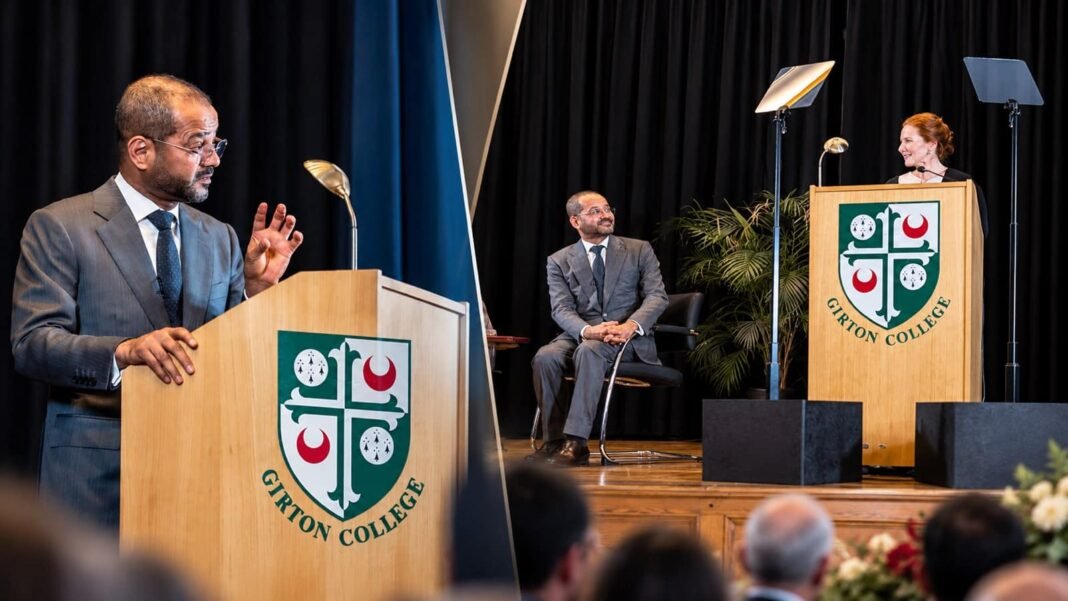
The official readout frames the trip as The statement from Oman’s Foreign Minister Sayyid Badr Albusaidi, delivered at Girton College, University of Cambridge, on 30 October 2026, outlines a strategy predicated on inclusive regional dialogue and shared responsibility for Gulf security. The core of the message – a call for an eight-state security system – directly addresses what the statement identifies as “continued tensions” and “shortcomings in existing regional security arrangements.” This reflects a recognition that the future of Gulf stability hinges on a broader, more integrated approach, one that actively seeks to mitigate the influence of external powers and, crucially, addresses the exclusion of Iran from regional security discussions.
Background
The Minister’s lecture builds upon previous statements, most notably the “Minister’s lecture on Gulf security” delivered on 26 October 2026, which similarly emphasized the need for Gulf states to take collective responsibility for their security. A subsequent infographic, released on 27 October 2026, distilled the 12 key points from the lecture, reinforcing the call for an inclusive regional framework. The 1976 Muscat Initiative, referenced by the Minister, represents an earlier, unrealized vision of collective security, highlighting a desire to revisit a foundational dialogue process. The visit of His Majesty Sultan Haitham bin Tarik to the United Kingdom, detailed in a statement on 29 October 2026, further underscores Oman’s commitment to fostering diplomatic engagement and exploring new avenues for cooperation.
Analysis
The Minister’s messaging reveals a clear stakeholder incentive: Oman seeks to leverage its position as a neutral mediator to foster stability within the Gulf. The explicit rejection of the “inherent hostility” between Iran and the Arab Gulf states is a calculated move, aimed at facilitating dialogue and potentially reshaping regional alliances. The call for a non-aggression pact, directly linked to the 1976 Muscat Initiative, represents a tangible proposal designed to build trust and create a foundation for a more sustainable security system. The statement does not address the underlying reasons for decades of exclusion of Iran from regional security arrangements. The exclusion of Iran from regional security arrangements for decades has had profoundly negative consequences, contributed to continuing tensions and weakened prospects for building a stable security system. However, the statement does not address the potential impediments to achieving consensus among the eight states.
Implications
For policymakers, the emphasis on regional responsibility carries significant implications. It suggests a desire for a more proactive role for Oman in mediating disputes and shaping regional security architecture. Regionally, the renewed focus on a collective security system could potentially reshape the dynamics of the Gulf, though the statement does not address the challenges inherent in achieving such a consensus. The proposed revival of the 1976 Muscat Initiative introduces a potentially complex legal and political landscape. Trade and security implications are not directly addressed, but the shift towards reduced external military and security commitments could reshape Oman’s economic partnerships.
Outlook
Should the visit yield an agreement to reconvene around a table to discuss collective security arrangements, Oman’s role as a facilitator would be significantly strengthened. If the eight states remain divided on the issue of Iran’s inclusion, the prospect of a stable security system remains highly uncertain. The statement does not address the potential timeline or mechanisms for achieving a non-aggression pact.


