
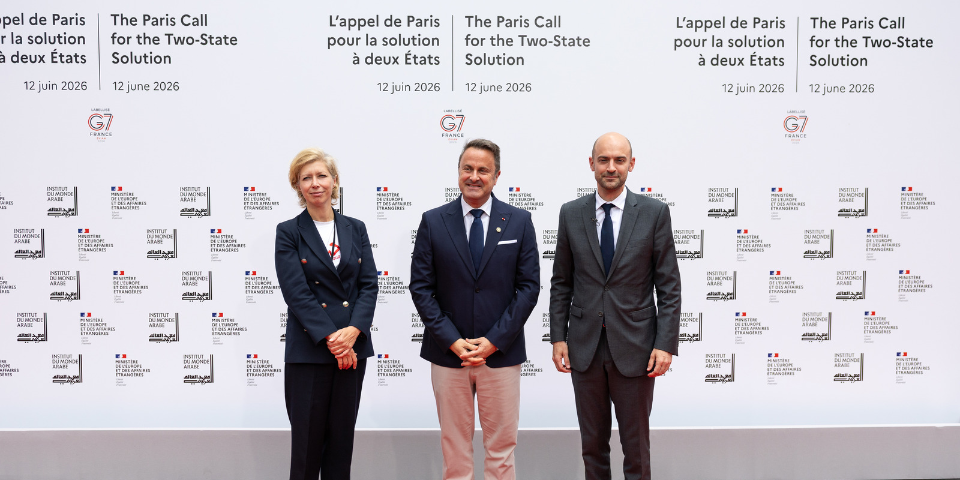
In a published statement ahead of the visit, The Vice-Premier Minister, Xavier Bettel, participated on June 12th, 2026, in the “Paris Call for a Two-State Solution” conference held in Paris. This event matters because it represents the Luxembourg government’s latest attempt to address the ongoing conflict between Israel and Palestine—a situation characterized by deteriorating humanitarian conditions and increasing instability. The press release details a continuation of diplomatic engagement rather than a fundamental shift in approach.
Background
The conference follows a similar event held in New York approximately one year prior, which resulted in recognition of the State of Palestine by several nations including Luxembourg. This timeline establishes a pattern of engagement—a recognition followed by persistent challenges to the two-state solution’s viability. The statement does not mention specific funding commitments or concrete strategies beyond reaffirming support for the resolution.
Analysis
The core issue highlighted is the fragility of the two-state solution amidst escalating tensions. Stakeholders—Israel, Palestine, and international actors—are operating within a context of heightened conflict, humanitarian crisis in Gaza, continued Israeli settlement expansion, and Hamas’s refusal to disarm. This suggests a deeply entrenched stalemate where incremental improvements are increasingly difficult to achieve. The emphasis on civil society engagement reflects a recognition that traditional state-to-state diplomacy has proven insufficient.
Implications
For policymakers, the Luxembourg government’s participation signals a commitment to maintaining diplomatic channels while acknowledging the severity of the situation. Regionally, it offers little in the way of de-escalation and risks being perceived as symbolic action given the continued deterioration on the ground. Trade relations with both Israel and Palestine remain vulnerable, contingent upon the stability of the region—a factor increasingly influenced by the ongoing conflict.
Outlook
Should the visit yield no immediate breakthroughs regarding Gaza or Israeli settlements, the Luxembourg government’s actions will be primarily focused on continued monitoring and advocacy. If the situation in Gaza continues to deteriorate as described, with persistent violations of ceasefires, then further pressure for humanitarian access is likely. Should the Israeli government continue to advance settlement construction—as implied by the concern over the Supreme Court ruling—the statement does not address whether Luxembourg will consider targeted sanctions or other measures.
Conclusion
The “Paris Call” represents a reaffirmation of a failing strategy. The continued engagement, without any indication of a shift in priorities or concrete action, leaves open the question of whether Luxembourg’s diplomatic efforts are genuinely aimed at fostering peace or simply serving to maintain the status quo.