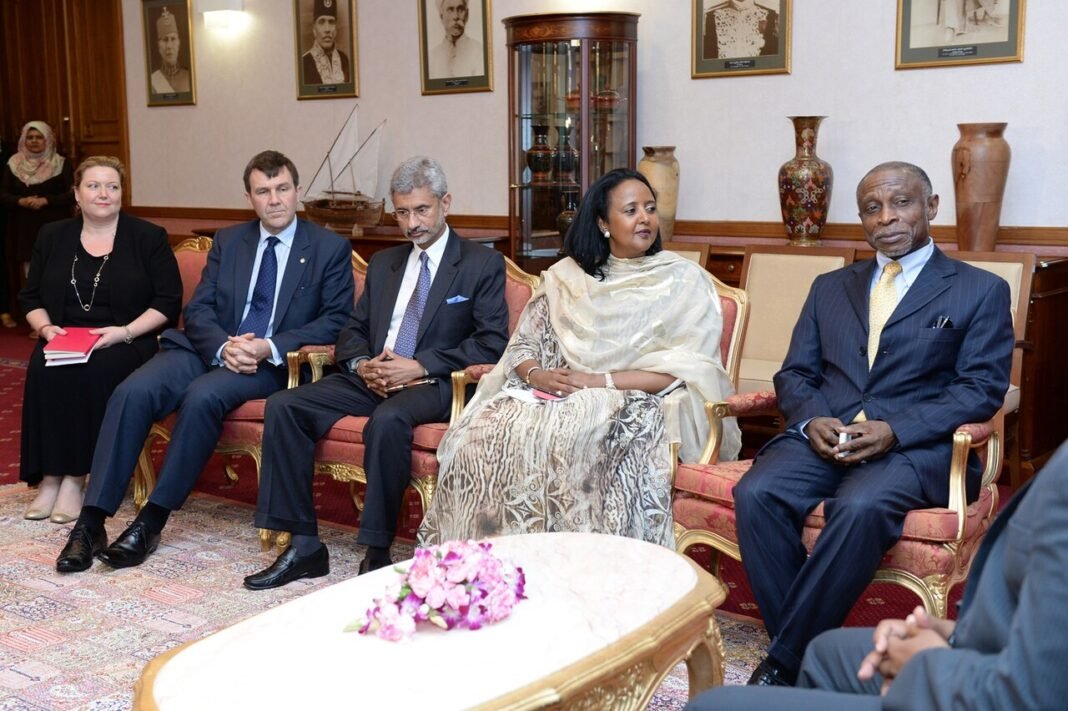
Per the government announcement, The High-Level Ministerial Meeting of Like-Minded Global South Countries and Friends was held on the margins of the 81st Session of the United Nations General Assembly in New York on 22 September 2026. External Affairs Minister Dr. S. Jaishankar chaired the meeting under the theme of “Navigating Together Towards a Brighter Future – the Compelling Case for an Empowered Global South”. This suggests a deliberate framing of India’s role within a specific geopolitical narrative.

Background
The statement does not address prior meetings. However, in March the ministry said Jaishankar was held in New York on 23 September 2026 on the sidelines of the 81st United Nations General Assembly. This confirms the event’s placement within the broader UNGA context. The statement does not address the FIPIC Forum for India-Pacific Islands Cooperation (FIPIC) Foreign Ministers’ Meeting, New York (September 23, 2026) which Jaishankar attended on 23 September 2026. The statement does not address the visit of EAM Dr. S. Jaishankar to New York, USA for the High Level Week at the 81st Session of the United Nations General Assembly.
Analysis
The participants discussed challenges facing Global South countries. These include ongoing conflicts impacting food and energy security, volatility in trade and investment flows, concerns of seafarers in ongoing conflicts, extreme climate events, and the delays in achieving the Sustainable Development Goals (SDGs). The statement does not address the Indian government’s stated priorities regarding climate change mitigation. The participants expressed shared concern over the weakening of multilateral institutions, and emphasized the urgent need for comprehensive reforms, particularly in the United Nations, to address current global challenges which disproportionately affect the Global South countries. This indicates a growing frustration with the perceived limitations of the UN system.
The participants exchanged views on global and regional developments and the need for Global South to coordinate in multilateral fora. They resolved to expand South-South cooperation by leveraging mutual strengths and harnessing artificial intelligence to make it human-centric. This suggests a strategy aimed at fostering economic partnerships and technological collaboration within the Global South.
Implications
The meeting’s outcome has implications for India’s diplomatic strategy within multilateral institutions. The focus on reforming the UN suggests a desire to reshape global governance structures to better reflect the interests of developing nations. The emphasis on South-South cooperation could strengthen India’s relationships with key regional partners, particularly in Africa and Southeast Asia. The statement does not address the potential impact on India’s trade relations with Western nations.
Outlook
Should the visit yield further engagement with key Global South countries, India could leverage this momentum to push for reforms within the UN Security Council. If the participants successfully coordinate their positions on global issues, it could strengthen their collective voice in international forums. The statement does not address the potential for increased trilateral cooperation with France and the UAE.
Conclusion
The meeting’s outcome, as articulated, reveals a persistent focus on the Global South’s concerns within the international system. The question remains whether this coordinated messaging will translate into tangible shifts in global policy or remain largely rhetorical.
Sources & Further Reading
- Official press release
- Foreign ministry source
- Forum for India-Pacific Islands Cooperation (FIPIC) Foreign Ministers’ Meeting, New York (September 23, 2026) (24 Septemb)
- Visit of EAM Dr. S. Jaishankar to New York, USA for the High Level Week at the 81st Session of the United Nations General Assembly (20 Septemb)
- India-France-UAE Trilateral Ministerial Meeting (23 Septemb)