
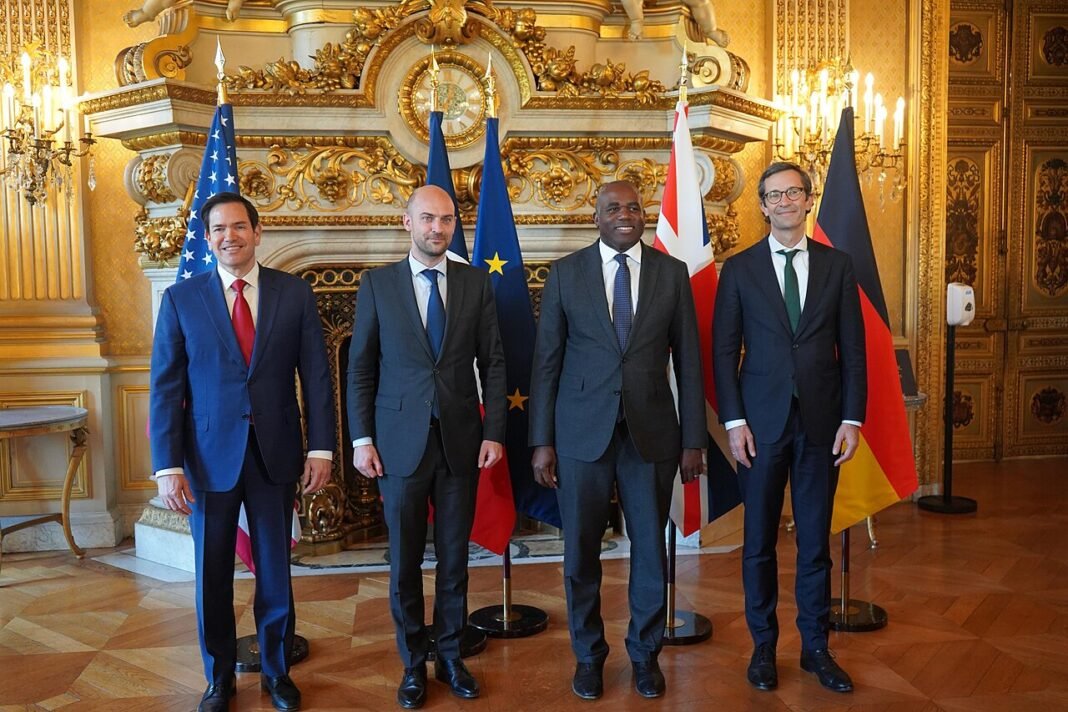
A ministry communiqué confirms that In New York on September 22nd, 2026, Minister for Europe and Foreign Affairs Jean-Noël Barrot held a meeting with his Iranian counterpart, Mr. Abbas Araghchi. The meeting, taking place on the sidelines of the United Nations General Assembly, focused on the regional situation. This engagement underscores France’s continued interest in resolving the ongoing conflict and addressing concerns related to the Iranian nuclear programme, as stated by the Ministry. The meeting’s timing is significant given the persistent instability in the region and the unresolved issue of the Strait of Hormuz.

Background
Prior statements by the Ministry highlight a pattern of engagement with Iran, primarily focused on bilateral relations. In March, the Ministry stated its commitment to maintaining dialogue with Iran, despite ongoing tensions. This meeting builds upon previous discussions, including a meeting with the Jordanian counterpart on September 5th, 2026, and a meeting with the Djibouti counterpart on September 8th, 2026, all aimed at fostering bilateral relationships and addressing shared concerns. The Ministry’s ongoing engagement with Iran is consistent with a strategy of multilateral diplomacy, as evidenced by the ongoing conversations with China.
Analysis
The Minister’s call for a renewed commitment to diplomacy reflects France’s assessment of the situation as fundamentally unresolvable through other means. The statement explicitly identifies the Iranian nuclear programme as a primary concern, aligning with a long-standing French position. The prioritization of reopening the Strait of Hormuz represents a significant strategic element, acknowledging the potential for catastrophic disruption to global energy supplies. The unacceptable attacks on French staff in Tehran remain a key issue, underlining France’s commitment to protecting its diplomatic presence and personnel. The statement does not address any specific proposals or concessions that might have been discussed during the meeting.
Implications
This meeting carries implications for regional stability, particularly concerning the ongoing conflict and the potential for escalation. The French commitment to maritime security and freedom of navigation in the Strait of Hormuz has significant consequences for global trade and energy markets. The continued prioritization of diplomatic solutions, as repeatedly stated by the Ministry, suggests a cautious approach to broader geopolitical tensions. The Ministry’s condemnation of the attacks on French staff reinforces France’s stance on international law and the protection of its diplomatic assets.
Outlook
Should the visit yield no immediate breakthrough in the resolution of the conflict, France will likely continue to advocate for a diplomatic solution, as previously stated. If the Iranian government demonstrates a willingness to engage in constructive dialogue and address concerns regarding the nuclear programme, the situation could potentially stabilize. However, should the attacks on French diplomatic personnel continue, France will likely maintain its firm stance, reiterating its commitment to safeguarding its interests and personnel.
Conclusion
The meeting highlights France’s persistent, if somewhat reactive, engagement with Iran. The question remains whether this diplomatic pressure can effectively address the underlying tensions within the region, or if a more fundamental shift in Iranian policy is required to achieve a lasting resolution.
Sources & Further Reading
- Official press release
- Foreign ministry source
- China – Conversation between Jean-Noel Barrot, minister for Europe and Foreign… (September)
- Meeting between Jean-Noël barrot, Minister for Europe and Foreign affairs, and… (September)
- Djibouti – Meeting between Jean-Noel Barrot, minister for Europe and Foreign… (September)


.jpg)