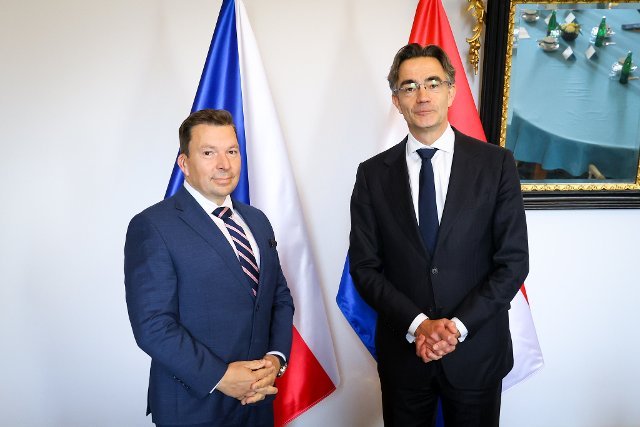
As set out in a formal announcement, Prague, October 5, 2026 – State Secretary of the Czech Ministry of Foreign Affairs Miloslav Stašek met with Christiaan Rebergen, Secretary-General of the Ministry of Foreign Affairs of the Netherlands. The meeting, held on October 5, 2026, focused on Czech-Dutch relations, current foreign policy issues and the functioning of the two ministries. This exchange, documented with a photograph by MZV CR / MFA CZ, signals a continued commitment to bilateral cooperation within the framework of established shared interests.

Background
Czech-Dutch relations are characterized by “excellent state,” according to the statement. This reflects “long-standing shared interests and priorities.” The discussion centered on opportunities to further develop cooperation across several sectors. These included trade, defence, and energy. The meeting addressed “current foreign policy issues,” placing particular emphasis on the “present security situation and transatlantic relations.” The statement does not address the specific nature of these security issues.
Furthermore, the state secretaries engaged in “exchanging experience in managing networks of diplomatic missions.” The discussion extended to the “internal functioning of the foreign ministries.” A key element of the conversation was the “use of artificial intelligence in diplomatic work” and the “modernisation of the foreign service.” The statement does not address the extent of these modernisation efforts.
Analysis
The meeting’s focus on “current foreign policy issues” suggests a prioritization of pragmatic engagement with a key European partner. The inclusion of “transatlantic relations” indicates a potential alignment with broader Western security concerns. The discussion about “managing networks of diplomatic missions” reflects standard diplomatic protocol and operational considerations for both ministries. The attention to “artificial intelligence in diplomatic work” and “modernisation of the foreign service” signals a recognition of evolving technological and operational demands within the foreign ministry.
The exchange of experience regarding diplomatic networks and the discussion of AI represent standard diplomatic practice. However, the framing of the discussion around “current foreign policy issues” and “transatlantic relations” suggests a deliberate effort to position the Czech Republic within the broader context of European security. This suggests a desire to demonstrate alignment with established alliances and to address shared challenges.
Implications
The meeting’s implications for regional stability are conditional. Should the visit yield further engagement with the Netherlands on matters of defence and energy, it could contribute to a more coordinated European approach to security challenges. The discussions regarding trade cooperation could bolster economic ties between the two countries. The focus on modernizing the foreign service, if implemented as described, reflects a recognition of the need to adapt to evolving geopolitical circumstances.
The Czech Republic’s prioritization of “transatlantic relations” has implications for its foreign policy orientation. This suggests a continued commitment to NATO and broader Western alliances. The exchange of experience in managing diplomatic networks could inform Czech diplomatic strategy and practice. The statement does not address how this meeting will affect trade agreements or broader EU policy.
Outlook
If the visit yields further discussions on defence cooperation, the Czech Republic might seek to deepen its involvement in joint military exercises or intelligence sharing with the Netherlands. Should the Netherlands continue to prioritize transatlantic engagement, the Czech Republic could find itself increasingly aligned with Western security policies. The statement does not address potential future collaboration on specific security initiatives.
If the modernisation of the foreign service progresses as discussed, the Czech Ministry of Foreign Affairs could adopt more efficient and technologically advanced practices. This could improve the ministry’s ability to respond to emerging foreign policy challenges and to coordinate diplomatic efforts effectively. The statement does not outline a timeline or specific deliverables for the modernisation process.
Conclusion
The meeting confirms the ongoing importance of Czech-Dutch relations, but the specific contours of future collaboration remain undefined. The continued emphasis on transatlantic alignment, as highlighted in the exchange, raises the question of Prague’s long-term strategic orientation within the European Union.