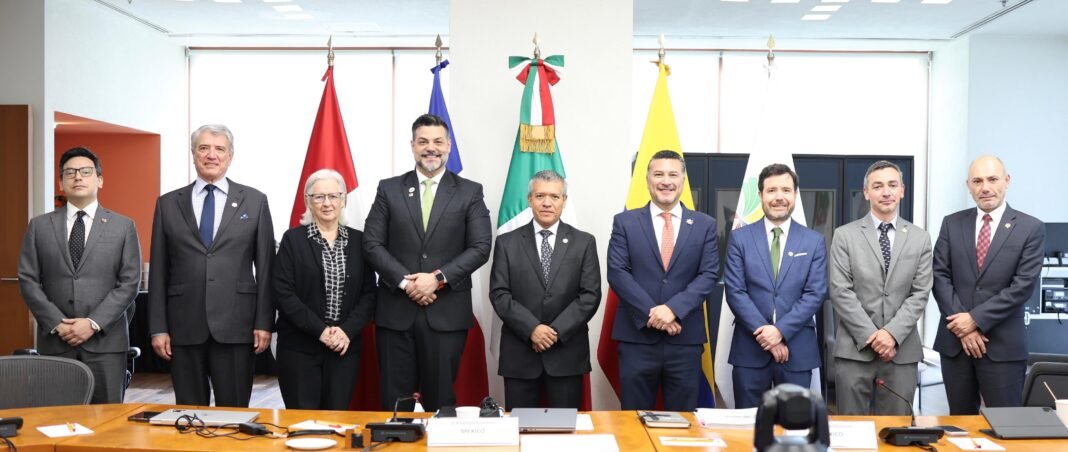
Reporting in a government statement, Colombia reaffirmed its commitment to expanding youth employment opportunities and strengthening micro, small, and medium-sized enterprises (SMEs) during the National Coordinators Meeting of the Pacific Alliance, held on October 15th. This event, preparatory for the II High-Level Group Meeting scheduled for October 16th in Mexico, saw participation from Vice Minister of Multilateral Affairs, Daniella Restrepo, and a delegation representing Colombia’s interests within the Alliance. The statement’s core purpose, according to the Ministry of Foreign Affairs, is to capitalize on the Alliance’s framework to contribute to the country’s economic growth by fostering job creation and facilitating access to international markets. The statement does not mention the total number of participants in the meeting.

Background
The Pacific Alliance, established in 2011, comprises Chile, Colombia, Mexico, and Peru. It operates on the principles of free circulation of goods, services, capital, and people, aiming to foster economic integration within the Asia-Pacific region. The Alliance’s strategic importance has been a consistent focus for Colombian foreign policy, as evidenced by ongoing engagement and collaborative initiatives. The ministry’s previous statement on September 25th, 2026, highlighted Colombia’s commitment to integrating trade, digital transformation, and SME strengthening within the Alliance framework, alongside its collaboration with the Association of Southeast Asian Nations (ASEAN). This current meeting represents a continuation of this broader strategy, explicitly aiming to link youth employment initiatives with regional development goals. The ministry’s earlier statement on October 8th, 2026, detailed a cooperation agreement with the Association of Caribbean States (AEC) concerning the “Gran Caribe” region, further illustrating Colombia’s multi-faceted approach to regional partnerships.
Analysis
Colombia’s prioritization of youth employment within the Pacific Alliance reflects a recognized challenge—the high rate of youth unemployment in Latin America. According to the International Labour Organization (ILO), youth unemployment in the region reached 13.8% in 2024. Colombia’s specific rate for young people aged 15 to 28 years was 15.3% between April and June of 2025. This aligns with the Ministry’s stated policy of promoting competitiveness and technological advancement through private sector strengthening and international cooperation. The initiative’s success hinges on effectively aligning national talent development programs with the Alliance’s objectives, as highlighted by Director of Regional Integration Mechanisms Francisco Solano Olarte. The statement does not address the potential challenges of coordinating these efforts across four distinct economies. The ambition to transform the Pacific Alliance Volunteer Youth program into a regional, rotating model suggests a desire for broader participation and knowledge sharing. The stated focus on Asia-Pacific as a trade and cooperation axis represents a strategic shift, potentially seeking to diversify Colombia’s economic partnerships beyond traditional markets.
Implications
This renewed focus on youth employment carries significant implications for regional stability and trade. Successfully leveraging the Alliance’s network could provide Colombia with a crucial pathway to economic growth, reducing social unrest and fostering a more skilled workforce. The proposed articulation with Nestlé and the Council of Business Leaders of the Pacific Alliance demonstrates a commitment to practical, industry-led solutions. The emphasis on SMEs, representing 99% of businesses in the Alliance and generating 67% of employment, underscores the importance of supporting smaller enterprises, which are often key drivers of local economies. However, the statement does not address the potential for increased competition within the Alliance, nor does it detail the specific mechanisms for promoting greater export activity among Colombian SMEs—currently accounting for only 14% of total Alliance exports. Should the visit yield agreements on infrastructure development and trade facilitation, it could stimulate regional investment and economic activity.
Outlook
Should the proposed Asia-Pacific trade corridor prove successful, Colombia’s economic integration within the Pacific Alliance could accelerate. If the youth volunteer program gains traction and attracts significant international investment, it could serve as a catalyst for broader regional development. If the Alliance’s initiatives are effectively implemented, Colombia could become a key hub for talent exchange and technological innovation. The statement does not address the potential risks associated with relying heavily on the Alliance’s success, particularly if regional economic conditions deteriorate. The transition of the Mexican Presidency Pro Tempore in December will be a critical juncture, potentially impacting the momentum of these initiatives.
Conclusion
Colombia’s renewed engagement within the Pacific Alliance, centered on youth employment and SME development, presents a strategic opportunity. However, the ultimate success of these efforts will depend on the ability of the Colombian government to translate ambitious goals into concrete, measurable outcomes—leaving open the question of whether this renewed focus will translate into tangible economic growth and social progress for the country.
Sources & Further Reading
- Official press release
- Foreign ministry source
- Colombia avanza en la ratificación del TLC con Singapur para ampliar las oportunidades comerciales en Asia-Pacífico (2026-10-16)
- Colombia impulsa comercio, transformación digital y fortalecimiento de las MiPymes en la agenda Alianza del Pacífico–ASEAN (2026-09-25)
- Colombia y la AEC acuerdan fortalecer la cooperación para el desarrollo del Gran Caribe (2026-10-08)