
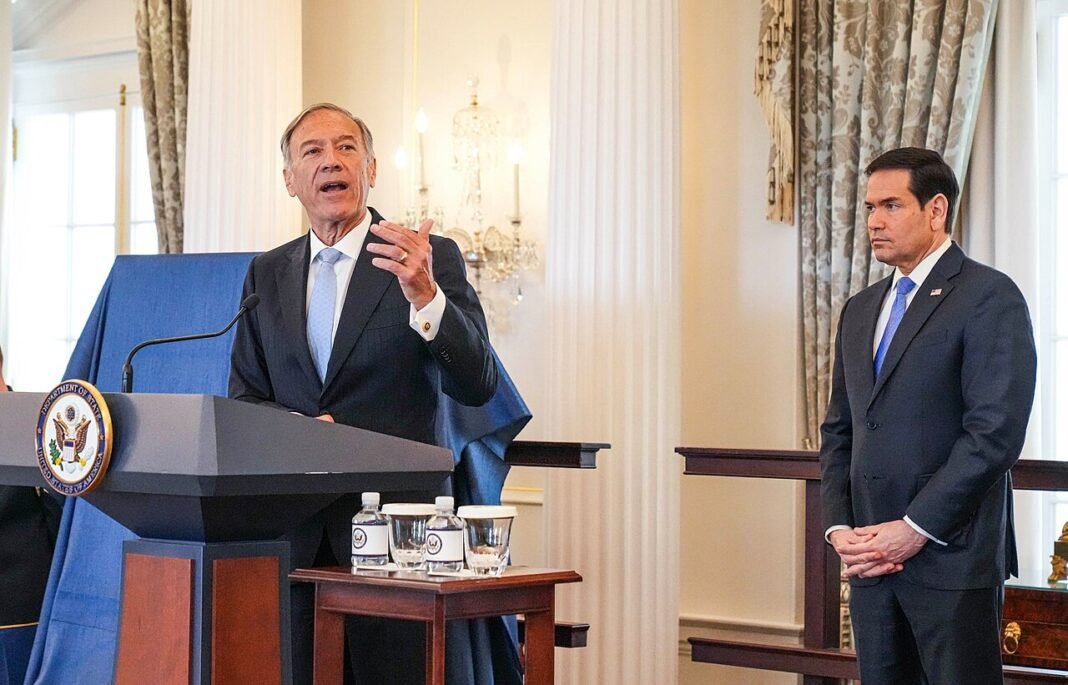
A ministry communiqué confirms that The most consequential concrete detail from the press release is Secretary of State Marco Rubio’s assertion that the State Department, through its America.gov project, intends to revolutionize the process of obtaining an American passport. This suggests a fundamental shift in how the government handles a traditionally cumbersome task, promising greater accessibility and ease for millions of Americans. The statement does not address the potential implications of this shift for bureaucratic oversight or the security of personal data.

Background
Prior to this announcement, the State Department’s Bureau of Consular Affairs has been grappling with persistent criticisms regarding the difficulty and inefficiency of the passport application process. The statement does not mention specific figures on passport application volume or processing times, but it acknowledges the “maze” inherent in the current system, characterized by multiple forms, appointments, and potential delays. The press release references a prior event, Secretary Rubio’s remarks at the American Chamber of Commerce Peru Event on September 10, 2026, where he also expressed frustration with the existing system. The statement does not address the timeline for the rollout of the new online application, only stating it will begin next year. The release also cites the “Critical Minerals Framework Memorandum of Understanding Signing Ceremony” with Lithuania, demonstrating a broader diplomatic agenda alongside this domestic initiative – a fact the statement does not mention.
Analysis
The core stakeholder incentive driving this initiative is clearly political: Secretary Rubio’s office is aiming to demonstrate tangible improvements in government service delivery, a key plank in the administration’s broader efforts to showcase efficiency. The statement does not address the potential for increased demand on the State Department’s resources, nor does it explain how the “whole-of-government project” – America.gov – will be funded or coordinated. The creation of a “cottage industry” of third-party passport service providers, as described by Rubio, highlights a conflict between the government’s desire for streamlined service and the potential for private sector profit. The fact that the process has evolved over time – from a “wax seal” to electronic chips – suggests a gradual, reactive approach to improving the passport system, not a deliberate, proactive redesign. The statement does not address the potential for increased fraud or identity theft if the online application process is not rigorously secured. The initiative’s focus on simplifying the process – “making it simpler and easier and more effective” – could inadvertently create vulnerabilities if not carefully managed.
Implications
For policymakers, the success of America.gov will be judged not just on its efficiency but also on its security. A streamlined online application process could potentially reduce the workload on State Department personnel, freeing them up for other diplomatic priorities. However, the statement does not address the potential impact on staffing levels or the need for additional cybersecurity investment. Regionally, the initiative could strengthen the United States’ image as a technologically advanced nation, potentially boosting tourism and business investment. The fact that the passport serves as a “trusted and powerful – and I would argue most important – identity document” carries significant implications for US foreign policy, particularly in areas where passport verification is crucial. The initiative’s potential impact on trade and security is limited, as the statement does not address the specific measures being taken to ensure the security of the application process or the passports themselves.
Outlook
Should the rollout of America.gov proceed as described, and if the online application process proves successful, the State Department could potentially reduce its reliance on third-party service providers. If the system is plagued by technical glitches or security breaches, as is always a possibility with large-scale digital initiatives, the administration could face significant political backlash. If the government fails to adequately address the concerns raised by the “cottage industry” – the companies charging fees for services that should be readily available – it could damage public trust in government services. The statement does not address the potential for future iterations of the passport system, such as incorporating biometric data or expanding the range of eligible applications.
Conclusion
The State Department’s ambition to transform the passport application process through America.gov presents a significant opportunity to improve government service delivery, but the success of this initiative hinges on the ability to balance accessibility with robust security measures – a challenge that remains largely unaddressed in the press release.
Sources & Further Reading
- Official press release
- Foreign ministry source
- Secretary of State Marco Rubio Remarks at the American Chamber of Commerce Peru Event (Unknown Da)
- Secretary of State Marco Rubio and Lithuanian Foreign Minister Kęstutis Budrys at the Critical Minerals Framework Memorandum of Understanding Signing Ceremony (Unknown Da)
- Secretary of State Marco Rubio Remarks at the American Chamber of Commerce Peru Event (Unknown Da)



.jpg)