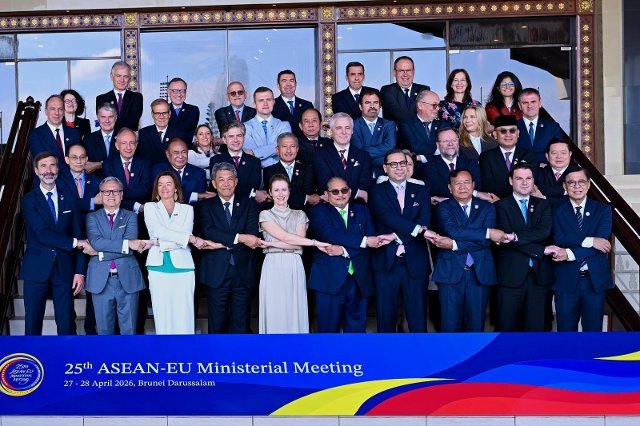
Per the government announcement, On 27–28 April 2026, Deputy Prime Minister and Minister of Foreign Affairs Petr Macinka led the Czech delegation to an EU–ASEAN ministerial meeting in Bandar Seri Begawan. This event marks a deliberate effort by the Czech Republic to position itself as an active partner within Southeast Asia—a region increasingly defined by shifting alliances and escalating competition. The statement does not mention the specific economic rationale driving this strategy, but Macinka’s declaration that “the centre of the global economy is in Asia” suggests a strategic realignment based on evolving trade flows.

Background
The EU–ASEAN ministerial meeting represents a recurring forum for dialogue and cooperation between the European Union and Southeast Asian nations. These meetings have historically focused on issues such as trade, investment, and political stability within the ASEAN bloc. The statement does not detail any prior agreements or established frameworks that underpin this renewed engagement. However, the timing—28 April 2026— coincides with a period of heightened strategic competition between major powers in Asia, adding another layer to Prague’s calculations.
Analysis
Macinka’s emphasis on “equal partnership” and “pragmatic approach” appears intended to mitigate concerns about the Czech Republic becoming overly reliant on a region known for its complex geopolitical dynamics. The statement does not address potential vulnerabilities related to supply chains or dependencies within Southeast Asia. The delegation’s bilateral meetings with foreign ministers from Cambodia, the Philippines, Singapore, Vietnam, Thailand, and Malaysia demonstrate an effort to establish concrete areas of collaboration—specifically, “sharing technologies” and “supporting industrial modernisation.” If implemented as described, this suggests a focus on leveraging Czech expertise in sectors like advanced manufacturing and digital technology. The statement does not address the potential for competition between Czech firms and established players within ASEAN economies.
Implications
The Czech Republic’s stated intention to be an “active partner” carries implications for regional stability, particularly given the broader strategic contest in Southeast Asia. Should the visit yield increased trade and investment flows, it could strengthen economic ties between the EU and ASEAN, potentially fostering greater cooperation on issues such as maritime security and infrastructure development. The statement does not address the potential impact of this engagement on existing alliances or partnerships within the region—specifically, those involving China or the United States.
Outlook
If the bilateral meetings result in agreements to foster “open trade” and “practical solutions,” it could signal a deepening economic relationship between Prague and Southeast Asia. Should the Czech Republic successfully diversify its export markets and secure access to new technologies, this could bolster its competitiveness within the global economy. The statement does not address potential risks associated with political instability or regulatory divergence within ASEAN nations.