
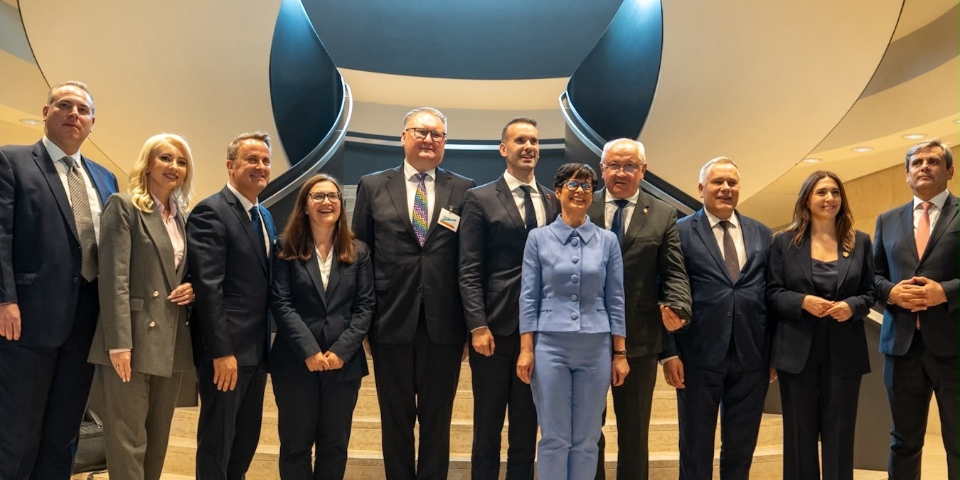
The foreign ministry readout describes The statement does not mention the specific number of interviews conducted. However, on June 15th, 2026, Prime Minister Luc Frieden and Vice-Premier Minister, Minister for Foreign Affairs and Trade, Xavier Bettel, engaged in bilateral interviews with the Prime Minister of Montenegro, Milojko Spajić, and the Vice-Premier Minister of Ukraine responsible for European integration and Euro-Atlantic affairs, Taras Kachka. This action matters because it signals a deliberate effort by Luxembourg to position itself as a key facilitator within the EU’s enlargement process.
Background: The activities were framed within the context of ongoing discussions surrounding the accession pathways of candidate countries. Previous meetings between Luxembourgian officials and representatives from Montenegro, Ukraine, and Moldova have focused on aligning reform efforts with European Union standards. The statement does not detail the specific timeline or previous agreements established through these interactions. However, it references the operating framework of the EU’s enlargement policy—specifically, adherence to the Copenhagen criteria and a commitment to demonstrable progress in implementing the acquis communautaire.
Analysis: Luxembourg’s engagement reflects a strategic calculation – bolstering its own influence within the European Union while simultaneously supporting the integration ambitions of Ukraine, Montenegro, and Moldova. The focus on “élargissement” suggests an understanding that EU membership remains a crucial geopolitical tool for these nations, particularly Ukraine in the face of ongoing security concerns. A key incentive for Luxembourg is maintaining a strong and unified European Union – this suggests a desire to prevent further divisions within the bloc. The repeated emphasis on respecting Copenhagen criteria indicates a cautious approach, prioritizing demonstrable reforms over symbolic gestures. This also points to potential tensions regarding the pace of accession, particularly given the varying levels of preparedness among candidate countries.
Implications: For policymakers, the stated intent emphasizes a sustained commitment to supporting European integration, regardless of broader geopolitical shifts. Should Luxembourg successfully maintain its influence within the EU’s enlargement framework, it could translate into increased trade opportunities and security cooperation with these newly integrated nations. The activity also has wider regional implications; strengthening ties between the EU and countries like Montenegro and Moldova contributes to stability in the Western Balkans and Black Sea regions. The statement does not address the specific impact on Luxembourg’s trade or security portfolios resulting from this engagement.
Outlook: If the visit yields continued positive assessments of Ukraine’s progress in opening chapters of accession negotiations, it would reinforce Luxembourg’s position as a supportive partner. Should the Ukrainian government continue to implement reforms aligned with EU standards—specifically addressing concerns regarding judicial independence and anti-corruption measures—the momentum for eventual membership could be maintained. Conversely, should significant setbacks occur in Ukraine’s reform efforts or if Montenegro fails to achieve further closures of accession chapters, Luxembourg’s leverage within the EU’s enlargement process would diminish. The statement does not outline contingency plans should the Moldovan government continue its current path.
Conclusion: The bilateral meetings demonstrate a calculated effort by Luxembourg to remain relevant in an increasingly complex geopolitical landscape. However, the ultimate success hinges on the ability of Ukraine, Montenegro and Moldova to meet the stringent requirements for EU membership—a task that remains fraught with political and economic challenges.