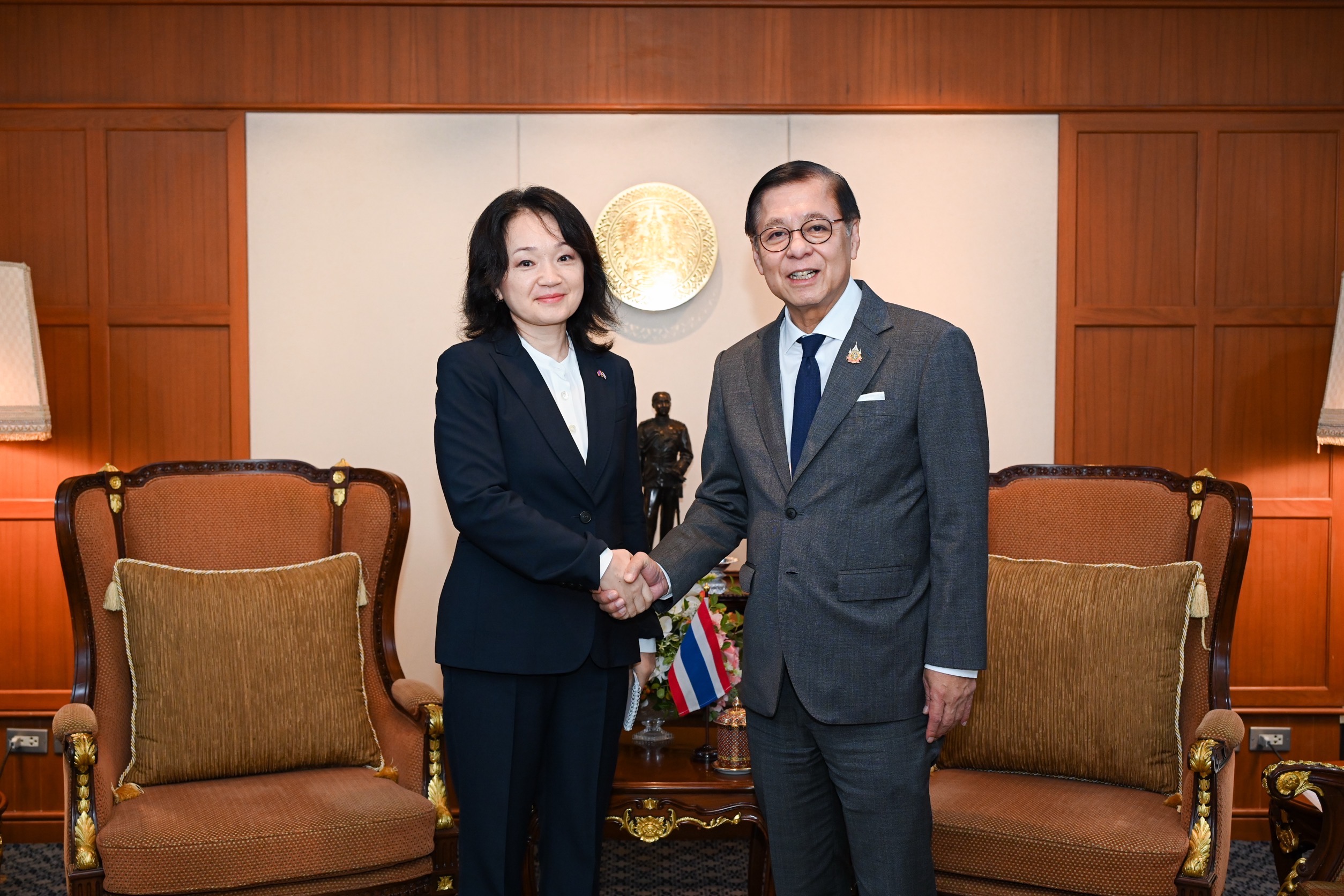
Per the government announcement, On 26 October 2026, Deputy Prime Minister and Minister of Foreign Affairs Sihasak Phuangketkeow met with Ambassador of Mongolia to Thailand Oyu Vasha. This meeting, occurring on the Ambassador’s assumption of duty, reflects the longstanding cordial relations between Thailand and Mongolia and the steady progress in bilateral cooperation. The statement highlights the ongoing focus on technical cooperation and people-to-people exchanges, central components of the Thailand – Mongolia Five-Year Cooperation Plan (2022-2027) and preparations for the subsequent five-year plan.
Background
The meeting occurred within the broader context of Thailand’s “5S” Foreign Affairs Masterplan, a 20-year initiative aiming to strengthen strategic partnerships. The statement references previous engagements with the United States Ambassador to Thailand (7 Oct 2026) and a planned visit by the Minister to Laos (30 Sep 2026), demonstrating a sustained diplomatic effort. The Thailand – Mongolia Five-Year Cooperation Plan (2022-2027) represents a key framework for bilateral collaboration, currently under review for its next iteration.
Analysis
The meeting’s focus on “high-level exchanges” and “promoting cooperation in trade and investment” suggests a desire to solidify existing economic ties. The explicit reference to advancing the current Cooperation Plan signals a commitment to sustained engagement, particularly as Thailand navigates regional economic trends. The discussion regarding “connectivity” likely pertains to infrastructure projects and trade routes, aligning with broader Southeast Asian development goals. The statement does not address the potential role of this engagement in relation to regional economic blocs like ASEAN or broader geopolitical alignments.
Implications
For Thailand, the meeting reinforces its commitment to strategic partnerships within Southeast Asia. Should the visit yield a renewed focus on trade and investment, it could bolster Thailand’s economic growth. The discussion regarding “connectivity” could impact Thailand’s infrastructure development plans, potentially attracting foreign investment and facilitating regional trade. The meeting’s timing, coinciding with the ongoing review of the Cooperation Plan, suggests a proactive approach to shaping Thailand’s foreign policy agenda. The statement does not address potential implications for regional security dynamics or Thailand’s relationship with other neighboring countries.
Outlook
If the visit yields a concrete agreement on specific investment projects, it would represent a tangible step forward. Should the discussions primarily focus on reaffirming existing commitments, the immediate impact on Thailand’s economy is likely to be limited. The success of the next five-year Cooperation Plan hinges on Thailand’s ability to secure continued support from Mongolia and adapt to evolving regional economic conditions – a factor the statement does not address.
Conclusion
The meeting between the Thai and Mongolian Ambassadors serves to maintain a consistent diplomatic channel, but the substance of the discussions remains largely undefined. The continued emphasis on the Five-Year Cooperation Plan suggests a deliberate, if somewhat protracted, approach to shaping Thailand’s strategic partnerships, leaving open the question of whether this plan will ultimately deliver on its ambitious objectives.
Sources & Further Reading
- Official press release
- Foreign ministry source
- Deputy Prime Minister and Minister of Foreign Affairs meets with Ambassador of the United States to Thailand (7 Oct 2026)
- Deputy Prime Minister and Minister of Foreign Affairs meets with Ambassador of the State of Israel to Thailand (8 Sep 2026)
- Deputy Prime Minister and Minister of Foreign Affairs to pay official visit to Lao PDR (30 Sep 202)