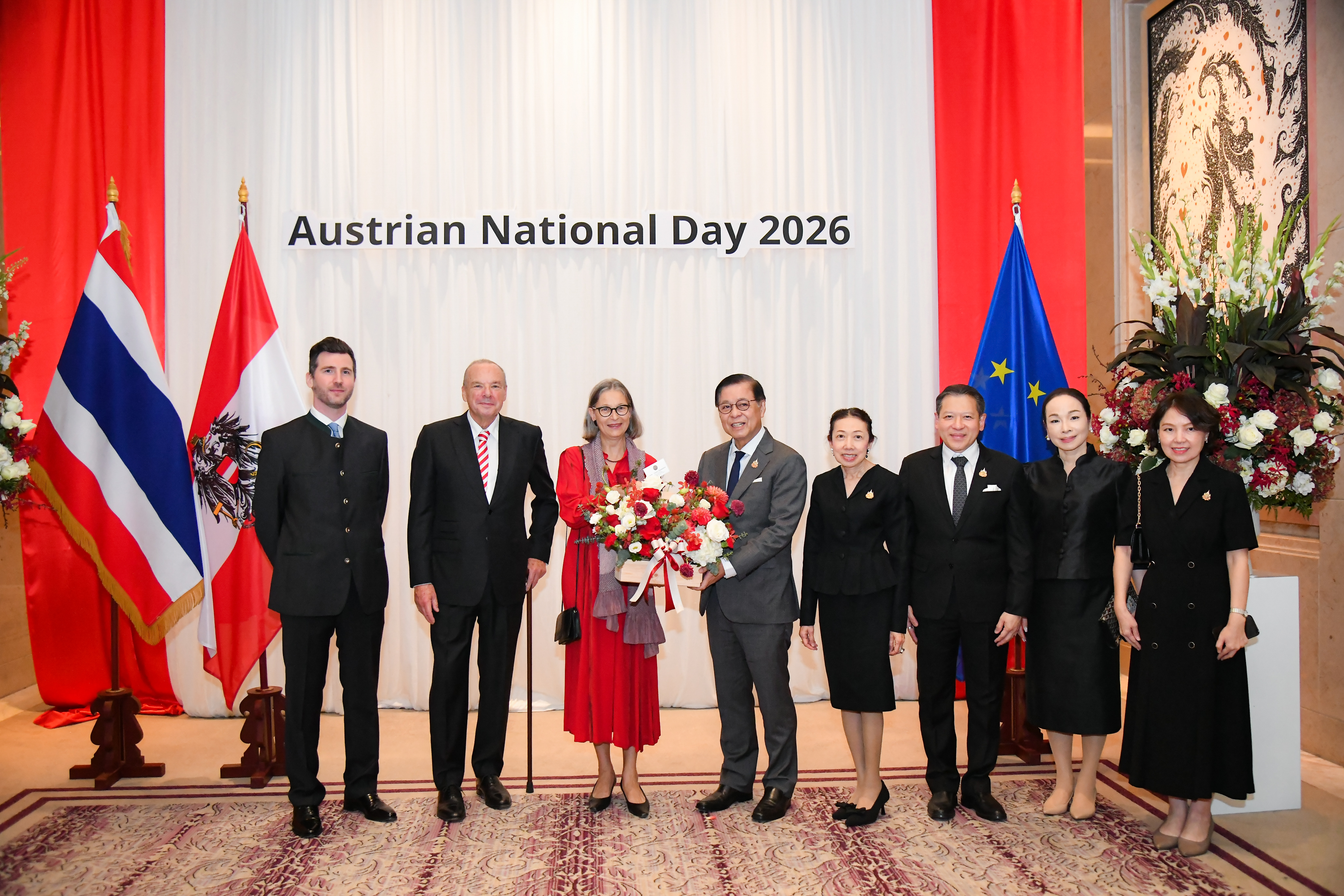
On 26 October 2026, Deputy Prime Minister and Minister of Foreign Affairs Sihasak Phuangketkeow attended the reception on the occasion of the National Day of the Republic of Austria, held at the Siam Kempinski Hotel Bangkok. This event, as outlined in the Ministry of Foreign Affairs press release, underscored a longstanding and comprehensive relationship between Thailand and Austria, spanning over 157 years since diplomatic ties were established in 1869. The significance of this engagement lies in the government’s explicit intention to expand economic cooperation, particularly through advancements in the Thailand-EU Free Trade negotiations, alongside continued collaboration on climate action, security, and defense matters.; see the full statement.
Background
The Ministry of Foreign Affairs’ activities are framed within the context of the “5S” Foreign Affairs Masterplan, a 20-year strategy aimed at strengthening Thailand’s international standing. This strategic framework, as detailed in the Ministry’s annual reports, prioritizes Security, Stability, Sustainability, Service, and Soft Power. Prior to this reception, on 30 September 2026, the Deputy Prime Minister and Minister of Foreign Affairs attended a meeting between the Prime Minister and foreign Ambassadors and Consuls-General to Thailand, further demonstrating the government’s commitment to maintaining robust diplomatic relations. Furthermore, the Ministry’s historical record, as evidenced by statements from September 2026, highlights a continuous emphasis on strengthening bilateral ties with key partners, including Hungary, as demonstrated by the Vice Minister for Foreign Affairs’ attendance at the Hungarian National Day Reception on 29 October 2026. These engagements reflect a consistent approach to Thailand’s foreign policy objectives.
Analysis
The Deputy Prime Minister and Minister of Foreign Affairs’ attendance at the Austrian National Day reception, coupled with the explicit mention of trade negotiations and security cooperation, suggests a deliberate effort to solidify Thailand’s strategic partnerships. The statement regarding the shared values of the two countries – promoting a rules-based international order and combating transnational crime – indicates a common ideological alignment, frequently referenced within the Ministry’s policy statements. The emphasis on the Thailand-EU Free Trade negotiations is particularly noteworthy, given the ongoing complexities and potential benefits associated with this trade agreement. The acknowledgement of Austria’s role as a non-permanent member of the United Nations Security Council (UNSC) for the 2027-2028 term represents a strategic opportunity for Thailand to leverage this position for mutual benefit. This suggests a calculated approach to international engagement, aligning with the broader “5S” Masterplan. The fact that the statement does not address Thailand’s trade balance with Austria, or the value of bilateral trade at 17,594 million baht, is a notable omission.
Implications
The event’s implications extend beyond mere diplomatic courtesy. The renewed focus on trade negotiations with the EU signals a potential shift in Thailand’s economic strategy, aiming to diversify its trading partners and enhance its access to global markets. The commitment to security cooperation, particularly in light of regional security challenges, underscores Thailand’s willingness to engage in multilateral efforts to maintain stability. The acknowledgement of Austria’s UNSC role implies a desire to participate actively in international security debates and contribute to global peacekeeping efforts. Should the visit yield further discussions on climate action, Thailand would be signalling a commitment to international environmental standards and potentially attracting European investment in green technologies. This supports the broader strategic goals outlined within the “5S” Foreign Affairs Masterplan.
Outlook
If the discussions following the reception lead to substantive progress in the Thailand-EU Free Trade negotiations, this would represent a significant step forward for Thailand’s economy. Should the Ministry of Foreign Affairs continue to prioritize security cooperation with Austria, this could translate into increased joint training exercises or collaborative initiatives in combating transnational crime. The Ministry’s continued engagement with the UNSC, particularly as Austria assumes its non-permanent seat, presents an opportunity for Thailand to advocate for its interests and contribute to broader international security discussions. The statement does not address the potential for increased investment from Austrian companies in Thailand’s strategic sectors, or the implications for Thailand’s overall foreign policy posture.
Sources & Further Reading
- Official press release
- Foreign ministry source
- Deputy Prime Minister and Minister of Foreign Affairs to pay official visit to Lao PDR (30 Sep 202)
- Vice Foreign Minister for Foreign Affairs attends Reception on the occasion of the National Day of Hungary (29 Oct 202)
- Deputy Prime Minister and Minister of Foreign Affairs attends a meeting between the Prime Minister and foreign Ambassadors and Consuls-General to Thailand (7 Sep 2026)