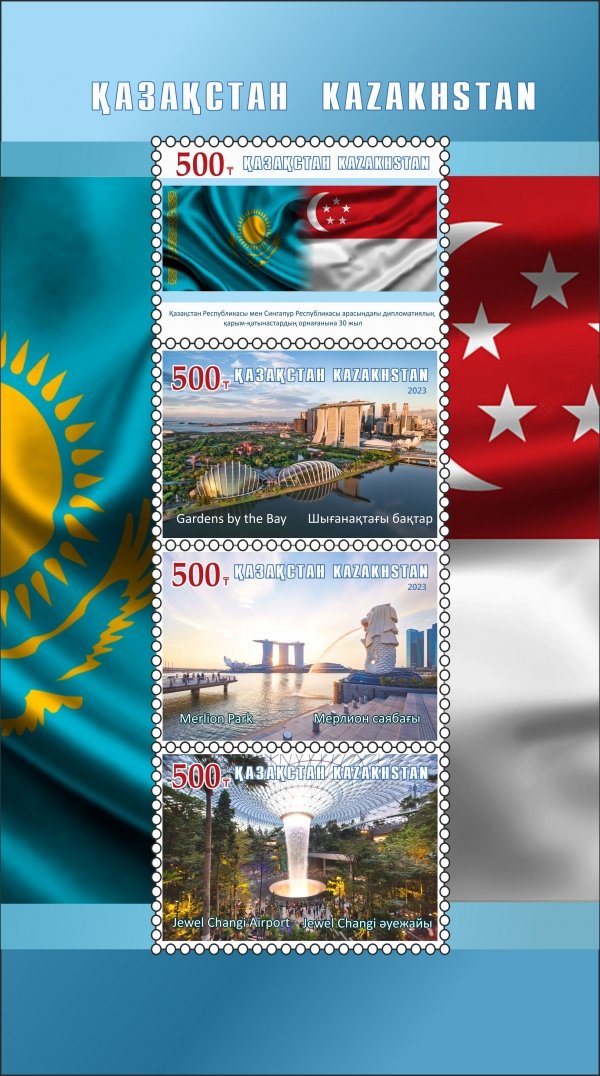
The official readout frames the trip as Senior Minister Lee Hsien Loong’s current visit to the Republic of Kazakhstan represents a formalization of existing interests between the two nations. The most immediate consequence of this trip – as outlined in the Ministry of Foreign Affairs press statement – is the signing of two key agreements. This fact, that Senior Minister Lee called on President Kassym-Jomart Tokayev and was conferred the Order of Dostyk (Friendship) of the First Class by President Tokayev, establishes a foundational element for future collaboration.

Background
The Ministry of Foreign Affairs statement details a sustained engagement between Singapore and Kazakhstan. Prior to this visit, in March the ministry said that Singapore had been actively exploring opportunities with Kazakhstan across several sectors. This suggests a deliberate strategy on the part of Singapore to broaden its economic partnerships beyond traditional Southeast Asian alliances. The release notes that discussions centered around strengthening areas such as the economy, connectivity, Artificial Intelligence (AI) and digitalisation. These topics are central to Kazakhstan’s stated ambitions for economic diversification, fueled by its substantial hydrocarbon reserves.
The statement also references previous engagements, specifically the visit by Minister for Foreign Affairs Dr Vivian Balakrishnan to Palau in August 2026. This highlights Singapore’s broader diplomatic activity and commitment to regional partnerships across multiple forums. The release does not address any prior discussions or agreements related to these specific areas of cooperation – namely water resources, digital trade, or AI training.
Analysis
The focus on AI and digitalisation reflects a global trend—and Kazakhstan’s explicit desire to leverage its technological potential. Singapore’s expertise in this field, combined with Kazakhstan’s strategic location along the Middle Corridor, creates an attractive nexus for trade and investment. The agreement on cooperation in water resources is particularly noteworthy as it aligns with Kazakhstan’s significant water challenges – a consequence of climate change and limited infrastructure. This suggests a pragmatic approach to collaboration, addressing tangible needs while simultaneously fostering broader economic ties.
The Joint Training Programme (JTP) on AI, digital development, and STEM planned for Astana represents a targeted investment in human capital. The fact that the program will train up to 30 mid-to-senior government officials from Central Asian countries signals Singapore’s intention to play a role in regional capacity building. This action could be interpreted as a subtle effort to influence policy decisions within Kazakhstan and its neighboring states – particularly concerning digital governance.
Implications
For policymakers, the visit underscores the importance of diversifying trade routes beyond traditional European markets. Strengthening connectivity between Southeast Asia and Central Asia offers Singapore access to new consumer bases and supply chains. The agreements could potentially bolster Kazakhstan’s efforts to attract foreign investment in sectors like digital technology and logistics – though the statement does not provide figures for potential investment or trade volumes.
The regional implications are significant, particularly concerning security. The Middle Corridor, a vital transportation route connecting Asia with Europe, has long been vulnerable to instability. Strengthening this corridor through enhanced digital trade integration could contribute to greater economic resilience and reduce dependence on alternative routes – if implemented as described. This suggests a broader geopolitical strategy for Singapore, seeking to promote stability in a region facing considerable challenges.
Outlook
Should the visit yield tangible outcomes in terms of increased trade flows and investment activity, it would represent a positive development for both countries. If the JTP proves successful in training skilled personnel, Kazakhstan could benefit from enhanced technological capabilities. However, given the lack of detail regarding specific targets or timelines, this remains conditional. Should Singapore continue to prioritize technical cooperation with Central Asian nations, it will likely lead to further agreements on AI and digital trade – but without a clear commitment to addressing broader geopolitical risks along the Middle Corridor.
Conclusion
The visit concludes with Senior Minister Lee Hsien Loong scheduled to deliver a lecture at Nazarbayev University focusing on Singapore’s economic development. This suggests a continuing interest in sharing Singapore’s experience, but leaves open the question of whether this exchange will translate into concrete policy adjustments within Kazakhstan – or serve primarily as a diplomatic exercise.
Sources & Further Reading
- Official press release
- Foreign ministry source
- 31 August 2026Official Visit by Senior Minister Lee Hsien Loong to Tashkent And Samarkand, The Republic of Uzbekistan 27 to 31 August 2026CountryUzbekistanOfficial Visit by Senior Minister Lee Hsien Loong to Tashkent And Samarkand, The Republic of Uzbekistan 27 to 31 August 2026Press Statements (31 August)
- 1 September 2026Visit By Minister for Foreign Affairs Dr Vivian Balakrishnan to the Republic of Palau for the 55th Pacific Islands Forum Leaders Meeting 31 August to 1 September 2026CountryPalauVisit By Minister for Foreign Affairs Dr Vivian Balakrishnan to the Republic of Palau for the 55th Pacific Islands Forum Leaders Meeting 31 August to 1 September 2026Press Statements (1 Septembe)
- 30 August 2026Visit by Minister for Foreign Affairs Dr Vivian Balakrishnan to the Republic of Palau for the 55th Pacific Islands Forum Leaders Meeting 31 August to 1 September 2026CountryPalauVisit by Minister for Foreign Affairs Dr Vivian Balakrishnan to the Republic of Palau for the 55th Pacific Islands Forum Leaders Meeting 31 August to 1 September 2026.Press Statements (30 August)