
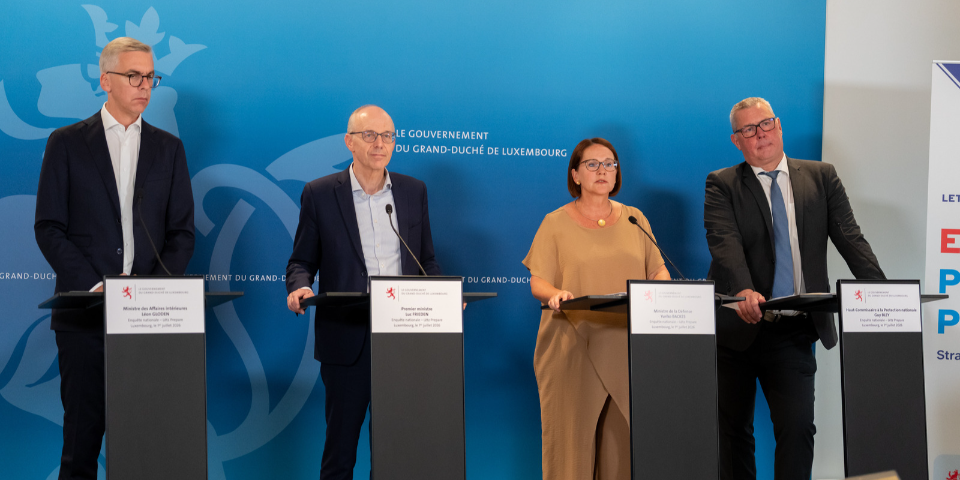
The foreign ministry readout describes The Prime Minister, Luc Frieden, alongside the Ministers of Home Affairs, Léon Gloden, and Defence, Yuriko Backes, presented the findings of the national risk and threat perception survey on July 1st, 2026. This event, livestreamed at 11:30 AM, marked a key moment in Luxembourg’s evolving approach to security. The statement does not address the scope or methodology of the survey itself – only that it was conducted. The initiative, spearheaded by the Directorate of Defence and the High Commission for National Protection, aims to detail the government’s assessment of current risks and threats facing the country.
Background
This presentation follows prior meetings concerning national security strategy and defense policy. The Ministry of Foreign and European Affairs, Defence, Development Cooperation and Foreign Trade is involved in coordinating these efforts. The survey’s results will inform decisions regarding resource allocation within the Ministry of Home Affairs, the Ministry of Defence, and the High Commission for National Protection. The statement does not specify the timeframe or population group covered by the survey.
Analysis
The government’s prioritization of risk perception suggests a demonstrable shift in security concerns. The involvement of multiple ministries – Home Affairs, Defence, and the High Commission for National Protection – indicates an acknowledgement of a multi-faceted threat landscape. If implemented as described, this survey represents a focused effort to understand and respond to perceived vulnerabilities within Luxembourg’s borders. This suggests a heightened awareness of potential external pressures impacting national security.
Implications
The findings will likely shape future investment in defense capabilities and border security measures. The presentation highlights the importance of coordinated action between government agencies. Should the visit yield further insights into specific threats, it could influence Luxembourg’s engagement within European Union security frameworks. The implications extend to trade agreements and international relations – any perceived weakness in national security postures may affect negotiating positions.
Outlook
If the survey results are as presented, the government will likely increase investment in defensive capabilities. Should the focus remain on “hybrid threats,” this suggests continued vigilance against disinformation campaigns and cyberattacks. The statement does not address Luxembourg’s strategic position within NATO or its relationship with neighboring countries.
Conclusion
The presentation of these risk perceptions establishes a baseline for future security policy discussions, but it leaves unanswered the precise nature of those threats facing Luxembourg – a critical gap in understanding the government’s strategic priorities.