
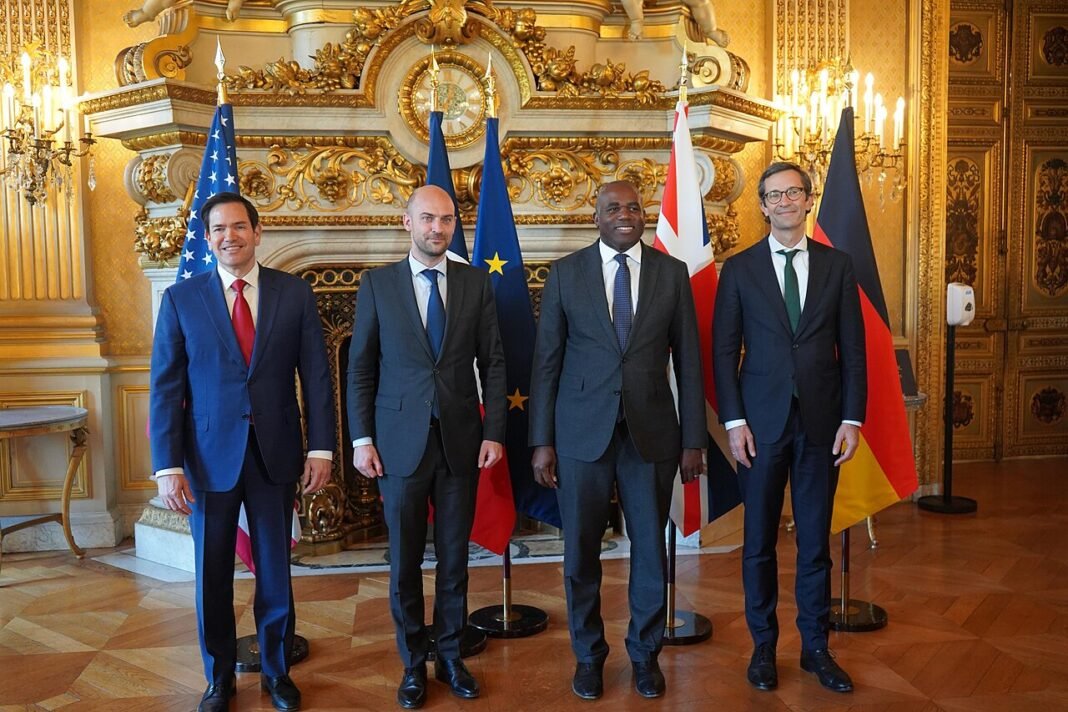
France’s Minister for Europe and Foreign Affairs, Jean-Noël Barrot, met with Ms Beate Meinl-Reisinger, Federal Minister for European and International Affairs of the Republic of Austria, on October 13th 2026 in Paris. This meeting focused on current international concerns, specifically Austria’s participation in the United Nations Security Council as a non-permanent member in 2027 and 2028, and the potential for increased Franco-Austrian collaboration within that framework. The statement does not mention the specific duration of the meeting or the attendees’ roles beyond their respective ministerial positions.; see the full statement.

Background
The bilateral relationship between France and Austria has a long history. The statement does not address the specific details of that history. Prior to this meeting, discussions regarding Austria’s involvement in the United Nations Security Council were ongoing, reflecting a broader European effort to strengthen the Council’s effectiveness. The Ministry of Foreign Affairs noted the existing “many similar views” between the two nations. The September 14th 2026 conversation between Barrot and his Chinese counterpart, focused on establishing a “relation bilatérale,” highlighting a pattern of bilateral engagement across diverse international partnerships. A similar meeting in Djibouti on September 08th 2026 with Abdoulkader Houssein Omar, Minister for Foreign Affairs of Djibouti, similarly centered on “relation bilatérale” discussions. Furthermore, a meeting between Barrot and his Indian counterpart on September 21st 2026, during the United Nations General Assembly, also emphasized a “relation bilatérale” framework. These prior statements by the ministry demonstrate a consistent approach to international diplomacy, prioritizing bilateral relationships as a cornerstone of France’s foreign policy.
Analysis
The meeting’s agenda reflects several interconnected priorities. Austria’s impending role on the UN Security Council is a key element, suggesting France’s interest in leveraging Austria’s position to advance its own security objectives. The discussion regarding the EU’s next Multiannual Financial Framework indicates a shared concern over the challenges posed by major global macroeconomic imbalances, a persistent issue for the European Union. The ministers’ “many similar views” suggest a degree of alignment on fundamental security concerns, particularly regarding Ukraine and European security. The statement does not provide insight into the specific nature of the “prospects of stepping up Franco-Austrian cooperation.” The focus on the Western Balkans, a region facing considerable instability, suggests a shared interest in promoting stability and preventing further conflict. The meeting’s timing, coinciding with Austria’s upcoming UNSC membership, indicates a strategic effort to integrate Austria into France’s broader European security architecture.
Implications
The meeting’s focus on the UN Security Council has implications for France’s broader diplomatic strategy within the international organization. Austria’s participation in the UNSC could provide France with a valuable ally in advocating for specific resolutions and initiatives. The discussions on the EU’s Multiannual Financial Framework signal a continued commitment to addressing economic challenges within the European Union. Increased Franco-Austrian cooperation could strengthen the transatlantic alliance, particularly in the context of ongoing geopolitical tensions. The meeting’s emphasis on European security and the Western Balkans suggests a renewed focus on addressing instability in this region, potentially involving further engagement with regional partners.
Outlook
Should the visit yield a commitment to increased collaboration on the UN Security Council, France would likely seek to coordinate its efforts with Austria on key resolutions concerning Ukraine and broader European security concerns. If the ministers were able to identify shared priorities regarding the Western Balkans, France might consider supporting Austria’s efforts to promote stability in the region. Should the EU’s Multiannual Financial Framework negotiations progress successfully, it could provide a framework for increased cooperation between France and Austria on economic development and investment. The statement does not address the potential for further discussions regarding trade or energy policy.
Sources & Further Reading
- Official press release
- Foreign ministry source
- China – Conversation between Jean-Noel Barrot, minister for Europe and Foreign… (September)
- Djibouti – Meeting between Jean-Noel Barrot, minister for Europe and Foreign… (September)
- United Nations General Assembly – Meeting between Jean-Noel Barrot, Minister… (September)


.jpg)