
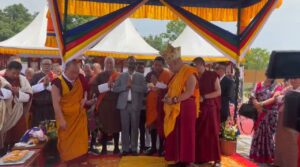
The foreign ministry readout describes The ground-breaking ceremony for the Bhutan Temple Complex in Lumbini, Nepal, on June 27, 2026, marks a significant step in a project funded entirely by the Royal. The statement does not address the specifics of this funding or the overall budget allocated to the complex.
Background
Prior to the ceremony, the Bhutanese delegation visited the Maya Devi Temple, a site venerated as the birthplace of Lord Buddha. This visit underscores the project’s foundational connection to one of Buddhism’s most sacred locations. The statement does not mention any prior meetings or agreements that led to this initiative.
The temple complex occupies Plot WC4, an 80 x 80 metre plot secured from the original Lumbini Development Master Plan designed by Kenzo Tange. This land acquisition occurred after a lease agreement was signed on June 25, 2025, following preparatory works including site clearing and boundary wall construction. The project is managed and implemented by the Department of Culture and Dzongkha Development under the Ministry of Home Affairs.
Analysis
The acquisition of this prime site – the last remaining plot in the Western Monastic Zone – suggests a deliberate strategic move on Bhutan’s part. The statement does not explain the rationale behind prioritizing this specific location over others within the zone. This action reflects a deepening engagement between Bhutan and Nepal, driven by shared cultural heritage and a desire to bolster Lumbini as a global Buddhist pilgrimage destination.
The project’s design, in the traditional Bhutanese Dzong architectural style, with its distinctive three-storey temple and 12-cornered plan, indicates an effort to showcase Bhutan’s unique cultural identity. The construction timeline of two years, targeting completion by 2028, suggests a commitment to delivering a substantial cultural landmark.
Implications
The Salhang-Tendrel ceremony has implications for regional stability, particularly concerning the ongoing dynamics between India and China in the Himalayas. The close cooperation between Bhutan and Nepal strengthens existing ties and potentially offers a platform for dialogue on broader regional issues. The statement does not address how this project will impact trade or security relations.
Furthermore, the investment in Lumbini, a region with significant tourism potential, could contribute to local employment and economic activity. It is expected to inspire peace, compassion, and spiritual reflection for pilgrims and visitors from around the world – if the complex is successfully developed and maintained.
Outlook
Should the visit yield a strengthened relationship with Nepal, as intended by the project’s stated goals, it would represent a significant diplomatic victory for Bhutan. If construction proceeds according to schedule and budget—the statement does not provide details on these metrics — the Bhutan Temple Complex could become a focal point for Buddhist tourism within five years.
Conclusion
The Salhang-Tendrel ceremony marks the beginning of a landmark project, but the ultimate success hinges on more than just construction. The statement does not address the long-term sustainability of the complex or Bhutan’s continued commitment to this significant cultural and diplomatic undertaking.