
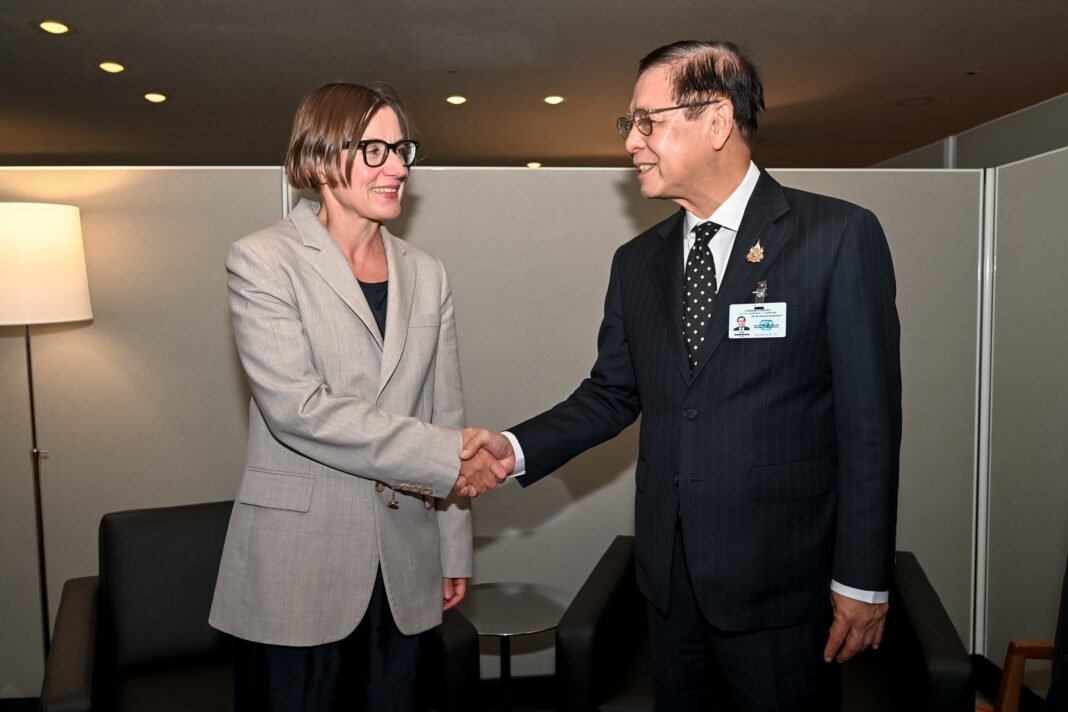

On 23 September 2026, Deputy Prime Minister and Minister of Foreign Affairs, Sihasak Phuangketkeow, met with Mirjana Spoljaric Egger, President of the International Committee of the Red Cross (ICRC), at the United Nations Headquarters in New York. This meeting, occurring on the sidelines of the High-level Week of the 81st Session of the United Nations General Assembly (UNGA81), focused specifically on the situation in Myanmar. The statement does not mention the specific challenges faced by the ICRC, but it highlights the ongoing efforts of the Thai government to deliver humanitarian assistance to the country. This engagement underscores Thailand’s continued diplomatic attention to a complex and protracted crisis. (Read the full statement.)
Background
The meeting occurred within the framework of the High-level Week of the United Nations General Assembly. This annual event provides a platform for global leaders to address pressing international issues. Prior to this meeting, on 19 September 2026, the Ministry of Foreign Affairs announced the Deputy Prime Minister and Minister of Foreign Affairs’ attendance at UNGA81. Further, a statement from 24 September 2026 detailed a meeting with Julie Bishop, Special Envoy of the United Nations Secretary-General on Myanmar, also taking place at UN Headquarters. The Ministry of Foreign Affairs has previously, on 19 September 2026, announced the Deputy Prime Minister and Minister of Foreign Affairs’ attendance at UNGA81. These engagements demonstrate Thailand’s sustained diplomatic activity regarding Myanmar. The statement does not mention the 20-Year “5S” Foreign Affairs Masterplan or the Council of Ministers’ Policy Statement on Foreign Policy.
Analysis
The exchange of views between Mr. Phuangketkeow and Mrs. Egger centered on the situation in Myanmar. The Thai government’s communication of its efforts to deliver humanitarian assistance constitutes a key element of its foreign policy approach. The ICRC President’s emphasis on the critical need for assistance – specifically in public health, clean water, and essential infrastructure – reveals the severity of the situation within Myanmar. The statement does not address the underlying causes of the crisis or the political dynamics within the country. The invitation to attend the High-level Conference on Humanity in War, co-organized by the ICRC and the Government of Jordan on 7 December 2026 in Amman, suggests a potential pathway for international collaboration on humanitarian relief. The meeting’s focus on the ICRC’s workshops for the Royal Thai Armed Forces indicates a longstanding and established partnership.
Implications
The meeting carries implications for Thailand’s regional diplomacy and its role within the international community. The continued engagement with the ICRC signals a commitment to upholding humanitarian principles and providing assistance to a vulnerable population. Should the visit yield the invitation to attend the Amman conference, it would represent a significant step in coordinating international efforts to address the humanitarian crisis in Myanmar. The ongoing cooperation with the ICRC could also influence Thailand’s approach to regional security issues, particularly those related to border security and cross-border instability. The statement does not address Thailand’s broader trade or security relationships with Myanmar or its neighbors.
Outlook
If the visit yields the invitation to attend the High-level Conference on Humanity in War in Amman, Thailand’s commitment to international humanitarian efforts would be further demonstrated. Should the ICRC continue to require assistance in Myanmar, Thailand’s willingness to reiterate its commitment to delivering aid will remain a critical element of its foreign policy. The statement does not address potential future diplomatic engagements or the ongoing monitoring of the situation in Myanmar. It does not specify any anticipated changes to Thailand’s existing aid programs or its relationship with the ICRC.
Conclusion
The meeting between the Deputy Prime Minister and the ICRC President represents a continuation of Thailand’s engagement with the humanitarian crisis in Myanmar. However, the statement does not offer a prognosis for the situation in Myanmar or outline any discernible shift in Thailand’s broader foreign policy strategy concerning the country. The long-term impact of this dialogue remains to be seen.
Sources & Further Reading
- Official press release
- Foreign ministry source
- Deputy Prime Minister and Minister of Foreign Affairs to attend the High-level Week of the 81st Session of the United Nations General Assembly (UNGA81 High-level Week) at UN Headquarters, New York (19 Sep 202)
- Deputy Prime Minister and Minister of Foreign Affairs to attend the High-level Week of the 81st Session of the United Nations General Assembly (UNGA81 High-level Week) at UN Headquarters, New York (19 Sep 202)
- Deputy Prime Minister and Minister of Foreign Affairs meets with Ms. Julie Bishop, Special Envoy of the United Nations Secretary-General on Myanmar on the sidelines of the High-level Week of the 81st Session of the United Nations General Assembly (24 Sep 202)