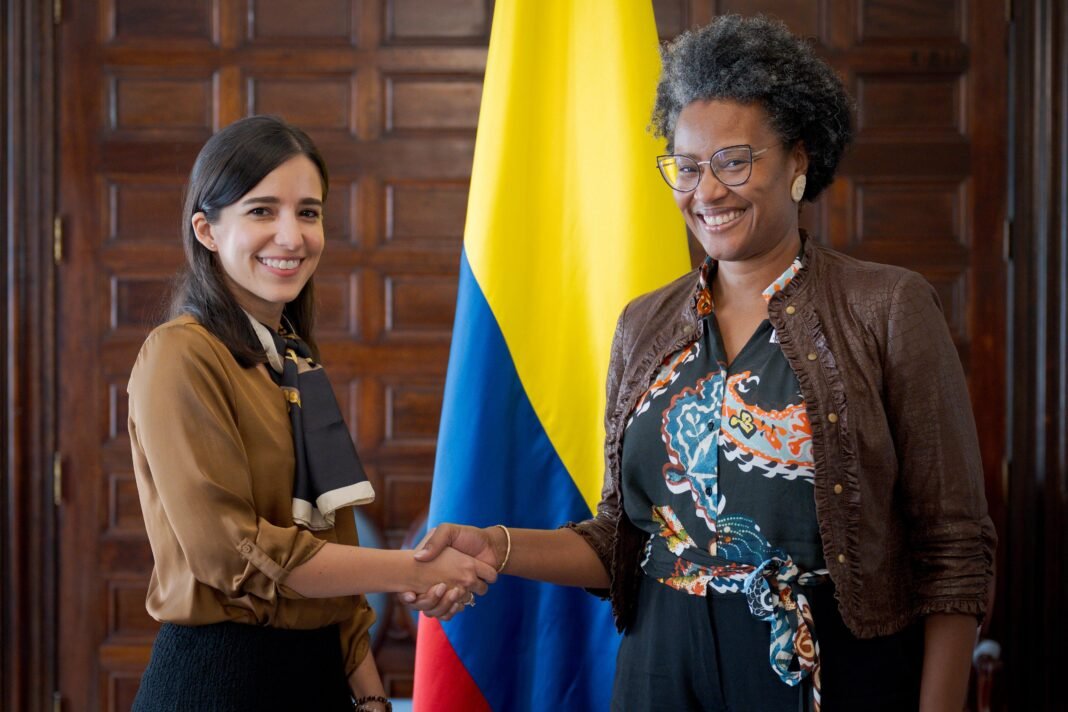
The Colombian government, through Vice Minister Daniella Restrepo Duarte, formally recognized yesterday the vital contributions of the Federación Internacional de Sociedades de la Cruz Roja y de la Media Luna Roja (FICR) and the Sociedad Nacional de la Cruz Roja Colombiana in the aftermath of the August 10th earthquake. This acknowledgement, formalized during a meeting in Bogotá, comes after the devastating 7.4 magnitude quake impacted multiple regions of the country and underscores the extensive international support now mobilized to address the crisis – specifically, a 25 million franc Swiss francs appeal activated by the International Committee of the Red Cross (ICRC). The statement does not address any specific challenges faced by these organizations or the scale of unmet needs within affected communities.; see the full statement.

Background
The meeting brought together Vice Minister Restrepo Duarte with Loyce Pace, Director Regional para las Américas of the FICR, and Marylin Bonfante, representative of the Sociedad Nacional de la Cruz Roja Colombiana. This collaboration builds upon decades of cooperation between Colombia and the International Red Cross Movement, focused on building robust humanitarian response capabilities within the country. The statement does not mention previous agreements or formal structures governing this relationship; however, it highlights a longstanding partnership forged through coordinated disaster relief efforts.
Analysis
The government’s recognition of the FICR and Cruz Roja Colombiana’s role is a strategic move. This acknowledgement serves to demonstrate Colombia’s commitment to international assistance and leverages the established network of support provided by the ICRC, which has activated a significant financial appeal – 25 million Swiss francs – designed to bolster recovery and reconstruction efforts. The rapid mobilization described in the statement suggests a well-established response infrastructure, largely built on decades of cooperation. However, the statement does not address the logistical challenges of coordinating aid delivery across diverse terrains and access constraints within affected regions. It also doesn’t detail the specific priorities identified by the Cruz Roja Colombiana or the FICR regarding immediate needs – such as medical supplies, water purification systems, or search-and-rescue operations.
Implications
This recognition has significant implications for regional stability. The ability of international organizations to rapidly deploy resources and expertise demonstrates Colombia’s capacity to manage large-scale disasters – a factor that can mitigate potential instability arising from the earthquake’s impact on vulnerable communities. Furthermore, the activation of the 25 million Swiss francs appeal signals external confidence in Colombia’s governance structures and disaster preparedness. The statement does not address how this international funding will be integrated into Colombia’s broader economic recovery plans or whether it aligns with existing trade agreements.
Outlook
Should the visit yield further commitments from the ICRC and other international partners, a sustained focus on reconstruction is projected. If the 84,200 people targeted by the Plan de Respuesta Sismo Colombia are truly reached within the next 24 months – as outlined in the statement – it would represent significant progress. However, this success hinges on overcoming logistical hurdles and securing continued funding. Should the 39% of resources allocated to reconstruction be fully utilized and effectively implemented over the 24-month period, it could contribute towards Colombia’s longer-term recovery.
Conclusion
The government’s acknowledgement represents a critical first step, yet the statement offers no insight into the challenges of long-term recovery or the extent to which international support will truly address the needs of those most impacted by the earthquake. The continued prioritization of community-led reconstruction efforts remains an open question.