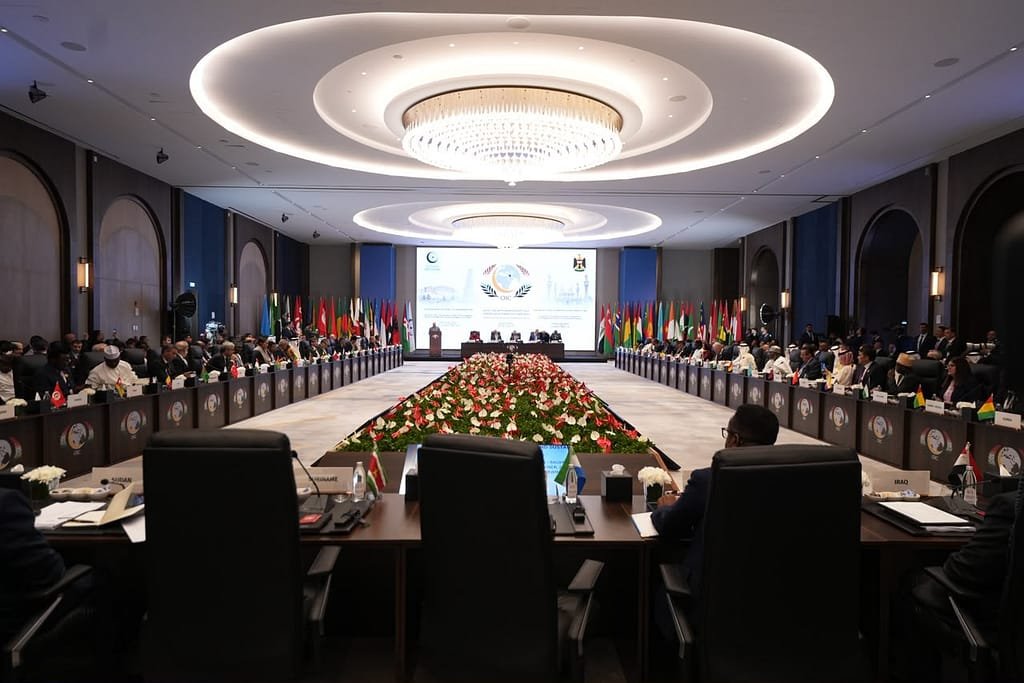
Per the government announcement, The Special Representative for Middle East Peace, Lee Kyung-chul, attended the High-Level Ministerial Global Alliance for the Implementation of the Two-State Solution on Thursday, September 24, 2026. This event, coinciding with the High-Level Week of the United Nations General Assembly, saw him meet with key officials from the United Nations, the European Union (EU), and other organizations. The purpose of these meetings was to discuss a broad range of regional issues, most notably the Israeli-Palestinian issue, as outlined in the press release.

Background
The Global Alliance for the Implementation of the Two-State Solution was launched in September 2024, during the 79th session of the United Nations General Assembly. This alliance, led by Saudi Arabia, the EU, and Norway, seeks to rally international support for the two-state solution and promote cooperation toward its realization. The statement notes that Korea’s statements have consistently supported this solution. Prior to this meeting, Foreign Minister Cho Hyun had been meeting with candidates for the next UN Secretary-General, as evidenced by a statement from September 22, 2026, which details his engagements with four candidates during his visit to New York. This reflects a broader effort to strengthen multilateral cooperation, particularly with the EU and MIKTA member states, as highlighted in another ministry statement from September 22, 2026, concerning his participation in the EU-Indo-Pacific Foreign Ministers’ Meeting.
Analysis
The Korean government’s continued engagement with the two-state solution, as articulated by Special Representative Lee, suggests a firm commitment to this internationally agreed-upon framework. The timing of these meetings, during the UN General Assembly’s High-Level Week, underscores Seoul’s desire to remain visible and proactive in addressing the region’s most pressing challenges. The statement reveals a concern over recent settler violence and settlement construction in the West Bank, indicating a potential frustration with the lack of progress towards a negotiated settlement. The continued dialogue with the EU and UN reflects a strategic prioritization of multilateral engagement, particularly in a region characterized by instability and conflict. The S.H.I.N.E. Initiative, announced last year, provides a framework for continued cooperation, potentially offering tangible assistance in the form of ODA and humanitarian aid. The exchange of views on major regional developments, including armed conflicts and the situation in Afghanistan, signals a comprehensive approach to regional security.
Implications
The meetings have implications for regional stability, primarily through Seoul’s continued emphasis on the two-state solution. Should the international community stand united in underscoring the value of this solution and contributing to its realization, the window of opportunity will be further expanded, as Special Representative Lee stated. The Korean government’s willingness to engage with all relevant actors – the UN, the EU, and individual nations – suggests a desire to play a mediating role. The potential for ODA and humanitarian assistance through the S.H.I.N.E. Initiative could provide critical support to affected populations, although the statement does not address the scale of this commitment. The ongoing dialogue with the EU and MIKTA nations could lead to coordinated efforts to address shared security concerns.
Outlook
If the international community continues to demonstrate a commitment to the two-state solution, the Korean government will likely maintain its engagement. Should the situation in the West Bank deteriorate further, as Special Representative Lee expressed concern about, Seoul may increase its diplomatic pressure on both sides. The continued support offered through the S.H.I.N.E. Initiative will depend on the evolving security and political landscape in the region.