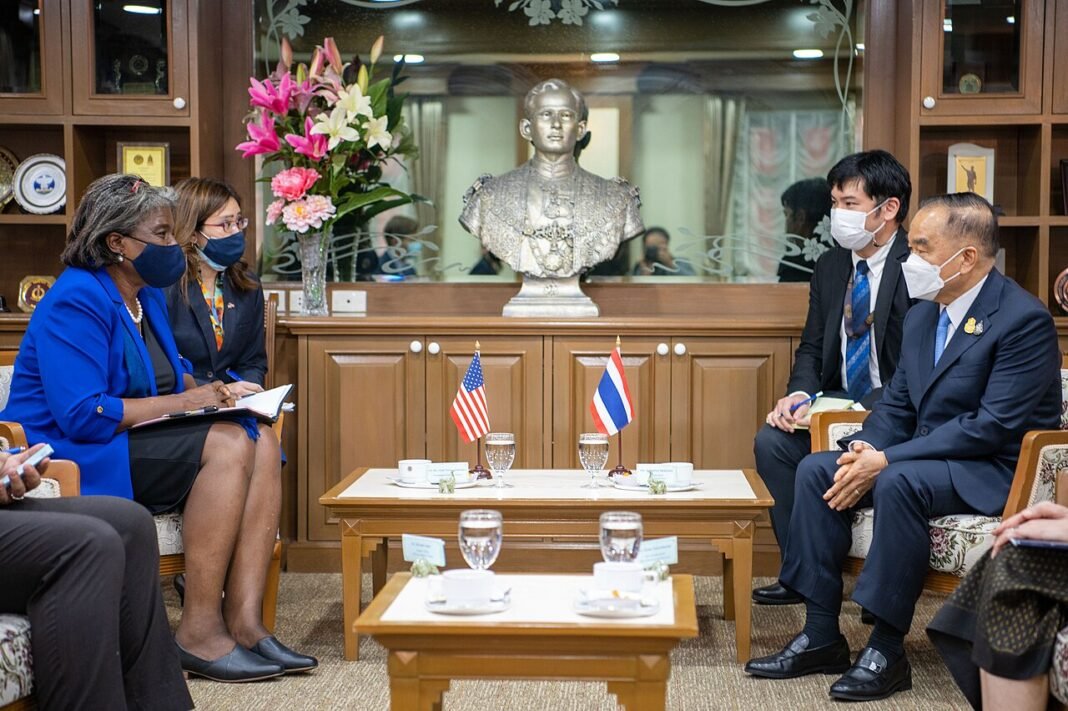
Details in a press release show that The Ministry of Foreign Affairs issued a statement on 7 October 2026 clarifying Thailand’s position following Cambodian media reports alleging U.S. pressure regarding tensions along the Thailand-Cambodia border. The core of the statement, accessible via the MFA website, reiterates Thailand’s commitment to the Joint Statement agreed with Cambodia in December 2025 and the importance of building trust and confidence. This commitment is underscored by the recent discussions between Deputy Prime Minister and Minister of Foreign Affairs of Thailand and the U.S. Secretary of State, including meetings with the U.S. Deputy Secretary of State in New York on 24 September 2026 and with the U.S. Ambassador to Thailand on 5 October 2026.

Background
Thailand’s foreign policy is currently guided by the 20-Year “5S” Foreign Affairs Masterplan, a framework established in 2018. Prior to this latest statement, the Ministry of Foreign Affairs had engaged in diplomatic activity, most recently with a visit by the Vice Minister for Foreign Affairs on 19 September 2026 to Canada, and a planned official visit by the Deputy Prime Minister and Minister of Foreign Affairs to Laos PDR on 30 September 2026. Furthermore, a Joint Statement of the Thailand-Singapore “Forward-Looking Strategic Partnership” was released on 3 September 2026, demonstrating a commitment to regional collaboration and stability. These prior statements, while outlining Thailand’s broader diplomatic priorities, do not directly address the current dispute with Cambodia.
Analysis
The Thai Ministry’s response reveals a fundamental divergence in perception between Bangkok and Phnom Penh. The statement’s insistence on adherence to the December 2025 Joint Statement, coupled with the explicit mention of security concerns – including landmines and transnational criminal networks – highlights Thailand’s prioritization of border security. This is presented as a prerequisite for effective technical discussions within the Joint Boundary Commission (JBC). The Ministry’s condemnation of Cambodia’s “distortion of facts” suggests a strategic calculation: to deflect criticism by framing Cambodia’s actions as politically motivated. The statement does not address the nature of the U.S. involvement, nor does it elaborate on the specific “activities” triggering Cambodian concerns. This opacity is consistent with Thailand’s approach to managing sensitive border issues, prioritizing a measured response over immediate confrontation.
Implications
This reaffirmation carries significant implications for regional stability. The continued impasse between Thailand and Cambodia, fueled by disputed claims and mutual accusations, risks escalating tensions. The Ministry’s call for Cambodia to refrain from “provocation” reflects a recognition of the potential for miscalculation. The continued operation of the JBC, contingent on a “conducive atmosphere,” suggests a willingness to maintain a technical track, but the statement does not offer any concrete steps to accelerate progress. The Thai government’s actions regarding the JBC have implications for ASEAN’s broader efforts to mediate disputes within its member states, particularly given the longstanding history of border disagreements within the region.
Outlook
Should the visit yield no immediate breakthroughs, Thailand will likely continue to pursue a strategy of quiet diplomacy, emphasizing adherence to existing agreements and highlighting Cambodia’s lack of constructive engagement. If the situation deteriorates further, and Cambodia continues to utilize international fora to amplify its grievances, Thailand’s response will likely become more assertive, potentially involving legal challenges or increased military preparedness along the border. The Ministry’s call for Cambodia to refrain from “provocation” is a conditional statement; Thailand will likely interpret this as a mandate to maintain a robust defensive posture, particularly given the ongoing threat of landmines and criminal activity.
Conclusion
Thailand’s statement underscores a persistent gap between its stated commitment to dialogue and the perceived intransigence of its neighbor. The question remains whether this commitment will translate into tangible progress toward resolving the border dispute, or whether it will ultimately serve as a framework for managing a long-standing and increasingly fraught relationship.
Sources & Further Reading
- Official press release
- Foreign ministry source
- Vice Minister for Foreign Affairs of Thailand visits Canada (19 Sep 202)
- Deputy Prime Minister and Minister of Foreign Affairs to pay official visit to Lao PDR (30 Sep 202)
- Joint Statement of the Thailand – Singapore "Forward-Looking Strategic Partnership" (3 Sep 2026)