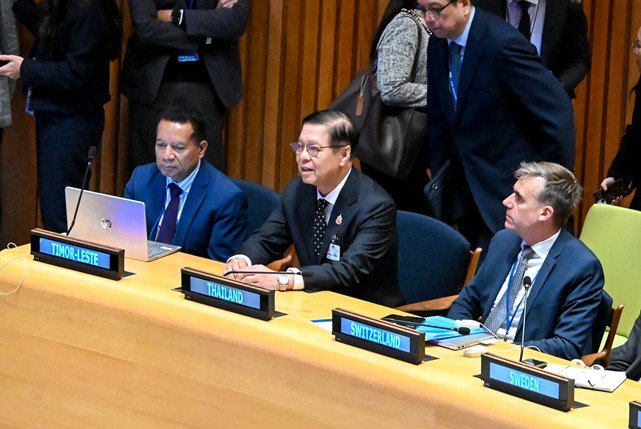
Background: The meeting, held on the occasion of the 81st Session of the United Nations General Assembly, reflects a consistent pattern of engagement by the Thai Ministry of Foreign Affairs on international climate initiatives. Prior to this event, the ministry had participated in the 5th Thailand – Singapore Leaders’ Retreat (2 September 2026), demonstrating a commitment to regional cooperation on issues of mutual concern. Furthermore, a meeting between the Prime Minister and foreign Ambassadors and Consuls-General-General to Thailand (7 September 2026) highlighted the diplomatic efforts to address global challenges. The statement does not mention any specific agreements or outcomes from these prior engagements. The Ministry of Foreign Affairs’ 20-Year “5S” Foreign Affairs Masterplan, outlined in the press release, prioritizes sustainable development and regional integration, providing a framework for this approach.
Analysis: Thailand’s framing of the energy transition as one requiring careful management, focusing on “building an efficient energy system with diverse energy sources and resilience to changing circumstances,” suggests a prioritization of national energy security. The statement’s emphasis on increasing clean energy generation, developing power grids, and improving energy efficiency reveals a pragmatic approach, likely driven by concerns about potential disruptions to Thailand’s energy supply. The acknowledgement of “energy insecurity” if the transition is not properly managed indicates a cautious stance, potentially influenced by Thailand’s dependence on imported fossil fuels. The inclusion of ASEAN cooperation, specifically the development of an ASEAN power grid, demonstrates a strategic interest in strengthening regional energy security, a priority highlighted in the 20-Year “5S” Masterplan. The statement does not address the specific investment strategies Thailand intends to deploy to achieve these goals.
Implications: This attendance and the articulated policy priorities have significant implications for Thailand’s foreign policy. The focus on regional cooperation, particularly within ASEAN, signals a potential shift away from solely bilateral engagements towards a more networked approach to addressing global challenges. Should Thailand successfully advance the ASEAN power grid, it could bolster regional stability and reduce Thailand’s reliance on external energy sources. The emphasis on “just transition” – incorporating industry and job creation alongside energy diversification – suggests a desire to mitigate potential social and economic disruptions associated with the energy transition. The statement does not address how Thailand’s approach to the “just transition” aligns with international standards or commitments. The increased focus on clean energy generation could impact Thailand’s trade relationships, particularly with countries heavily invested in fossil fuel production.
Outlook: If the visit yields further discussions on regional energy infrastructure projects, Thailand’s commitment to ASEAN cooperation could strengthen. Should Thailand successfully secure international financing for its green energy initiatives – as outlined in the 20-Year “5S” Masterplan – it could accelerate its transition to a more sustainable energy system. The statement does not address the potential challenges Thailand might face in securing such financing, particularly given broader global economic uncertainties. The emphasis on building a “resilient energy system” suggests a preparedness for potential disruptions, but the statement does not detail the specific risks Thailand anticipates.
Conclusion: The Deputy Prime Minister’s attendance at this meeting underscores Thailand’s evolving role in the global energy conversation. However, the measured approach articulated in the statement – prioritizing national security and regional cooperation – raises questions about the speed and scale of Thailand’s commitment to fully embracing the energy transition. The statement’s focus on a “just transition” suggests a pragmatic, rather than revolutionary, approach to this complex challenge.
Sources & Further Reading
- Official press release
- Foreign ministry source
- Deputy Prime Minister and Minister of Foreign Affairs attends a meeting between the Prime Minister and foreign Ambassadors and Consuls-General to Thailand (7 Sep 2026)
- Deputy Prime Minister and Minister of Foreign Affairs to pay a working visit to Malaysia (4 Sep 2026)
- Deputy Prime Minister and Minister of Foreign Affairs joins the Prime Minister in attending the 5th Thailand – Singapore Leaders' Retreat (2 Sep 2026)