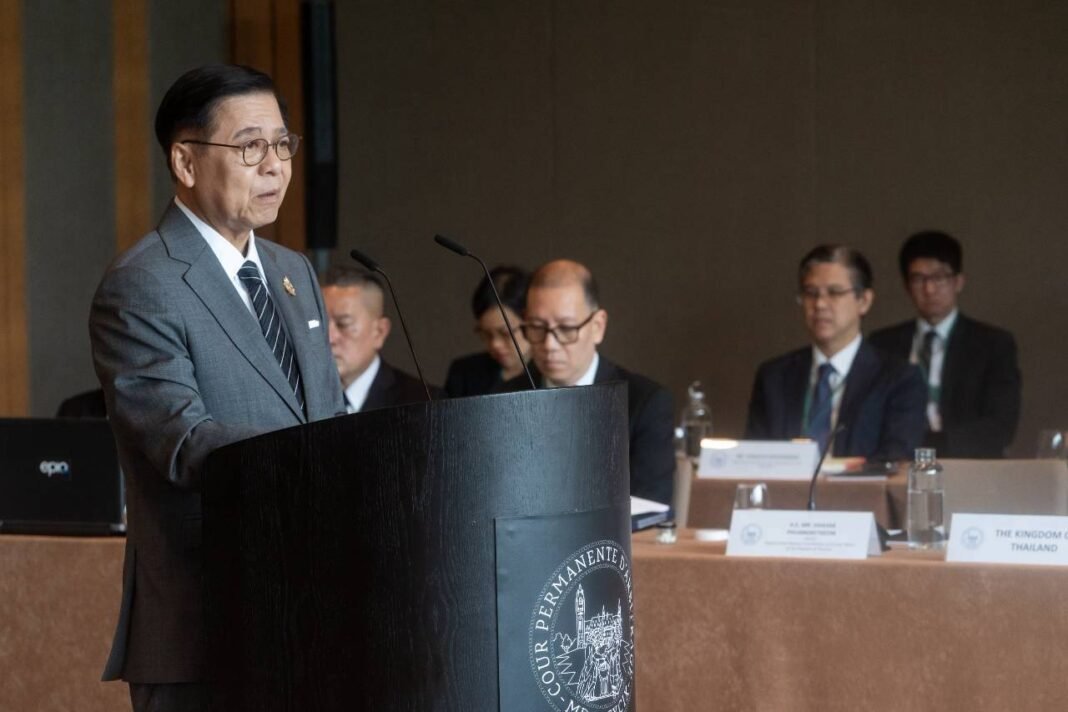
Per the government announcement, The Deputy Prime Minister and Minister of Foreign Affairs of Thailand, Sihasak Phuangketkeow, led a Thai delegation to Singapore on 14–16 September 2026 to attend the first meeting with the Conciliation Commission convened under the 1982 United Nations Convention on the Law of the Sea (UNCLOS). This event, as outlined in a press release from the Ministry of Foreign Affairs, marks a key step in the ongoing bilateral proceedings between Thailand and Cambodia concerning maritime boundary delimitation. The statement does not mention the specific amount of funding involved.
Background
This meeting follows the adoption of two key documents: the Terms of Appointment (TOA) and the Rules of Procedure (ROP). The Permanent Court of Arbitration (PCA) is designated as the Registry for the Conciliation Commission, reflecting the established legal framework of UNCLOS. The statement does not mention the timeline for the entire process, but indicates a projected duration of approximately 12 months for the conciliation proceedings. Prior to this meeting, the Ministry of Foreign Affairs, as detailed in a statement issued on 9 September 2026, had already been engaged in discussions regarding the potential for a conciliation process under UNCLOS with Cambodia. An opening statement by the Deputy Prime Minister and Minister of Foreign Affairs, dated 15 September 2026, further reinforced Thailand’s commitment to a good-faith approach to achieving an equitable solution, in accordance with international law.
Analysis
The Thai delegation’s participation in this first meeting signals an intent to formally engage with the Conciliation Commission. The adoption of the TOA and ROP establishes the operational parameters for the proceedings, providing a structured framework for the Commission’s work. The Thai government’s emphasis on “a candid manner” suggests a desire to present its position openly, potentially aiming to build mutual trust—a factor highlighted in the opening statement. This process, if successful, could resolve a long-standing dispute, but the statement does not address the inherent complexities of maritime boundary delimitation. The involvement of the Hydrographic Department and the Naval Operations Department, Royal Thai Navy, alongside the Department of Mineral Fuels, Ministry of Energy, indicates a comprehensive approach, reflecting the potential implications of the dispute beyond purely maritime boundaries.
Implications
The commencement of the conciliation process carries significant implications for regional stability. A successful resolution, achieved through the Commission’s recommendations, could de-escalate tensions between Thailand and Cambodia, reducing the risk of further incidents in the disputed areas. Should the process yield a sustainable solution as appropriate, it would align Thailand with international law and strengthen its position within the ASEAN regional bloc. The statement does not address the potential impact on trade or security, but the delimitation of maritime boundaries directly affects access to resources and navigation routes. The scheduled meeting in October 2026 and the anticipated 12-month timeframe for the conciliation process underscore the commitment to a formalized and potentially protracted negotiation.
Outlook
Should the Conciliation Commission issue its report within the projected 12-month timeframe, the next steps would depend entirely on the recommendations made. If the Commission’s conclusions are accepted by both parties, the process would move towards the implementation phase, requiring further agreements and potentially adjustments to existing maritime zones. If the report is non-legally binding, the two parties may use it as a basis for further discussions to reach a sustainable resolution as appropriate. The Thai government’s continued emphasis on “a sustainable solution” suggests a willingness to compromise, but the statement does not provide any indication of specific concessions Thailand might be prepared to make.
Conclusion
The first meeting with the Conciliation Commission represents a formal undertaking to address the long-standing maritime boundary dispute with Cambodia. However, the statement does not outline a definitive outcome or a clear pathway forward, leaving the ultimate resolution contingent on the Commission’s recommendations and the subsequent willingness of both parties to engage in further negotiations. The process’s success will ultimately hinge on the ability of Thailand and Cambodia to build mutual trust and establish a durable agreement.
Sources & Further Reading
- Official press release
- Foreign ministry source
- Update on the Conciliation Proceedings under the 1982 United Nations Convention on the Law of the Sea between Thailand and Cambodia: The First Meeting with the Conciliation Commission (9 Sep 2026)
- Opening Statement by the Deputy Prime Minister and Minister of Foreign Affairs at the First Meeting of the Conciliation Commission between Thailand and Cambodia under UNCLOS (15 Sep 202)
- Deputy Prime Minister and Minister of Foreign Affairs attends a meeting between the Prime Minister and foreign Ambassadors and Consuls-General to Thailand (7 Sep 2026)