
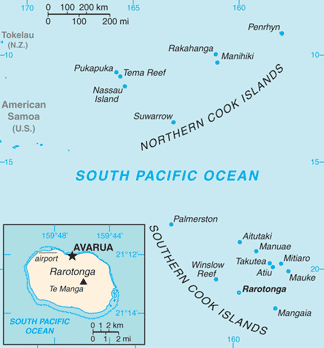
A ministry communiqué confirms that The announcement of a joint upgrade to the port at Penrhyn (Tongareva), Cook Islands, represents a significant, if understated, shift in U.S. foreign policy priorities within the Pacific. The fact that Washington is contributing $50 million – approximately $NZ84 million – towards this project, alongside New Zealand’s $17.5 million ($NZ10 million) commitment, underscores a deliberate effort to bolster infrastructure and security across a region increasingly viewed through the lens of critical minerals access. This investment directly ties back to the Critical Minerals Framework signed earlier this year with Cook Islands, revealing a strategic interest extending beyond traditional diplomatic engagement.

Background
Prior to this announcement, U.S. engagement in the northern Cook Islands had largely been limited to humanitarian assistance and maritime security cooperation. The signing of the Critical Minerals Framework earlier this year marked a formalization of this interest, driven by growing demand for rare earth elements and other strategically important minerals. This framework, the statement does not address, established mechanisms for collaboration on resource exploration and development – a key driver behind the Penrhyn Port Project. The Pacific Islands Forum Leaders Meeting, scheduled to take place in Palau during the same period, provided a high-profile setting for this announcement, signifying its importance within the broader regional diplomatic agenda.
Analysis
The motivations underpinning this joint venture are layered. For New Zealand, the project leverages existing expertise in infrastructure delivery across the Pacific – a recognized strength highlighted by Foreign Minister Winston Peters. The U.S. rationale centers on bolstering security and economic prosperity, referencing its historic ties to Penrhyn atoll where U.S. personnel constructed port facilities over 80 years ago. However, the statement does not explicitly detail the specific minerals expected to be facilitated through this upgraded port, nor does it address potential geopolitical implications related to China’s growing influence in the Pacific Islands Forum. The project represents a calculated effort by Washington to maintain a strategic presence and demonstrate commitment to its allies, potentially mitigating risks associated with Beijing’s expanding economic and diplomatic reach.
Implications
The Penrhyn Port Project carries significant implications for regional stability. The enhanced maritime access afforded by the upgraded facilities will undoubtedly improve logistical support for Tongareva and other northern Cook Islands communities, addressing a critical need highlighted by Prime Minister Mark Brown. This investment strengthens New Zealand’s position as a key partner in the Pacific, reinforcing its existing security cooperation agreements with both the U.S. and Cook Islands. Furthermore, the project could stimulate economic opportunities within the region, particularly if access to critical minerals facilitates new trade routes or industrial development – though this remains contingent on successful mineral extraction and processing.
Outlook
Should the visit to Palau yield further agreements related to resource exploration and development, as suggested by the project’s framing within the Critical Minerals Framework, the U.S. commitment could escalate. If New Zealand successfully manages the implementation of the infrastructure upgrades, aligning with its stated experience in Pacific projects, the partnership may solidify. However, if delays or cost overruns occur – a risk given the remote location and logistical challenges – the project’s long-term viability will be questioned. The success of this initiative hinges on resolving critical issues regarding sustainable resource management and equitable benefit sharing, aspects the statement does not address.
Conclusion
The Penrhyn Port Project demonstrates a deliberate U.S. effort to reassert its influence in the Pacific – but it ultimately raises questions about whether this investment will translate into sustained economic development or merely serve as another element of Washington’s broader strategic competition within the region. The long-term success of this partnership, and indeed, the future of U.S. engagement in the Cook Islands, remains uncertain.



_map.png)