
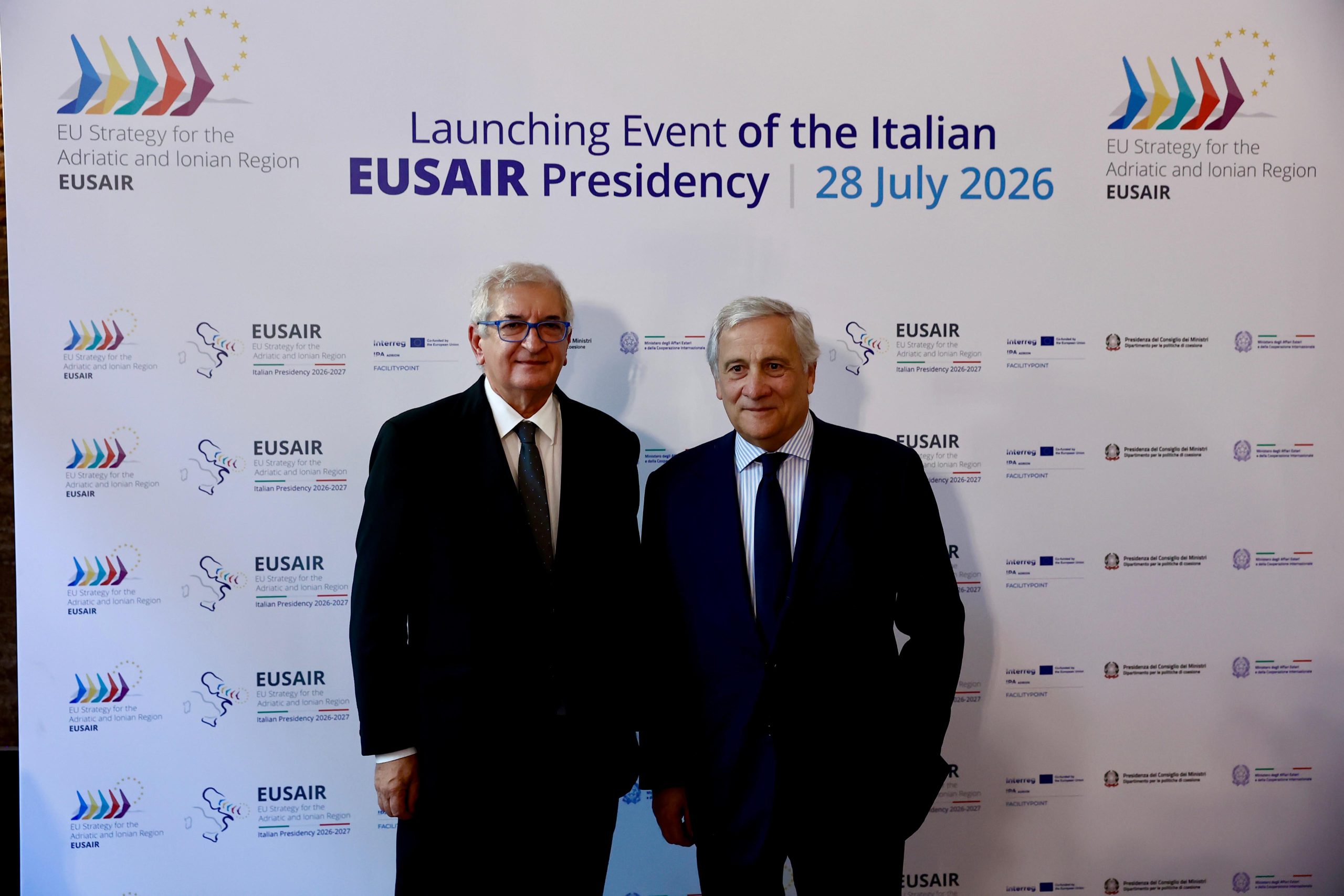
In a published statement ahead of the visit, The launch of Italy’s six-year presidency over the European Union Strategy for the Adriatic-Ionian Region (EUSAIR) at Unioncamere headquarters on July 28, 2026, signals a renewed focus on regional development within a rapidly changing European landscape. This event, marked by the presence of Ministers Tajani and Foti, establishes Italy’s central role in coordinating infrastructure investment, energy connectivity, and integration efforts across the Adriatic-Ionian region – a zone encompassing ten countries including Slovenia, Croatia, Serbia, and Greece – with implications for EU enlargement processes. The statement does not address the overall budget allocated to the EUSAIR or its potential impact on Italy’s own recovery funds.
The EUSAIR, established in 2014 as one of the EU’s macro-regional strategies alongside those for the Alps, Danube, and Baltic Sea, aims to foster sustainable development across a geographically diverse area. The strategy’s core mandate centers on revitalizing regional cooperation, strengthening infrastructure connectivity, and developing the blue economy—the economic sector relating to oceans and seas – within this region. This new Italian Presidency (June 2026 – May 2027) builds upon previous iterations of the EUSAIR, which has become increasingly central in light of changes in the geopolitical landscape and the European Union’s enlargement process. The statement does not mention the specific funding mechanisms utilized by the EUSAIR, nor its historical performance.
The core incentive driving Italy’s commitment to the EUSAIR is the perceived strategic advantage of integrating the Western Balkans into the European Union. Minister Foti’s emphasis on recognizing investment in EU integration processes highlights a potential geopolitical calculation – bolstering the region’s readiness for accession while simultaneously demonstrating Italian leadership. The topics discussed – ‘Right to remain’, climate emergency, rule of law, and demographic challenge – reflect broader EU priorities, but the statement does not explicitly detail how these will be translated into concrete policy initiatives within the EUSAIR. The emphasis on digital revolution, energy transition, and transport infrastructure upgrades suggests a focus on economic competitiveness and aligning with European Green Deal objectives.
The Italian Presidency of the EUSAIR carries significant implications for regional stability in Southeast Europe. Should the strategy succeed, it could accelerate the integration prospects of countries like Serbia and North Macedonia, potentially easing tensions within the Western Balkans. The focus on infrastructure projects – IMEC, Corridor VIII, Corridor X, and the Trieste–Ljubljana–Zagreb–Belgrade railway line – suggests an attempt to diversify trade routes and integrate energy markets, furthering Italy’s strategic interests in the Adriatic Sea. The revitalisation of port cooperation in Trieste, Koper, and Rijeka is central to this agenda.
If the Italian Presidency successfully leverages EU funding streams—details currently absent from the official statement—to advance these projects, it could stimulate economic growth across the Adriatic-Ionian region. Should the Western Balkans continue their current trajectory of investment in European integration, this would further strengthen the rationale for Italy’s leadership role. However, should political instability or economic stagnation impede progress within the Western Balkan countries, the EUSAIR’s effectiveness will be significantly diminished.
The launch event establishes a six-year timeframe for Italy’s stewardship of the EUSAIR, yet the statement does not articulate a clear vision for how this leadership will translate into tangible outcomes for the Western Balkans or reshape broader EU integration dynamics. The future of the strategy hinges on the ability to overcome persistent obstacles related to regional political divisions and economic disparities.